North Carolina Quitclaim Deed
County Specific Legal Forms Validated as recently as October 5, 2026 by our Forms Development Team
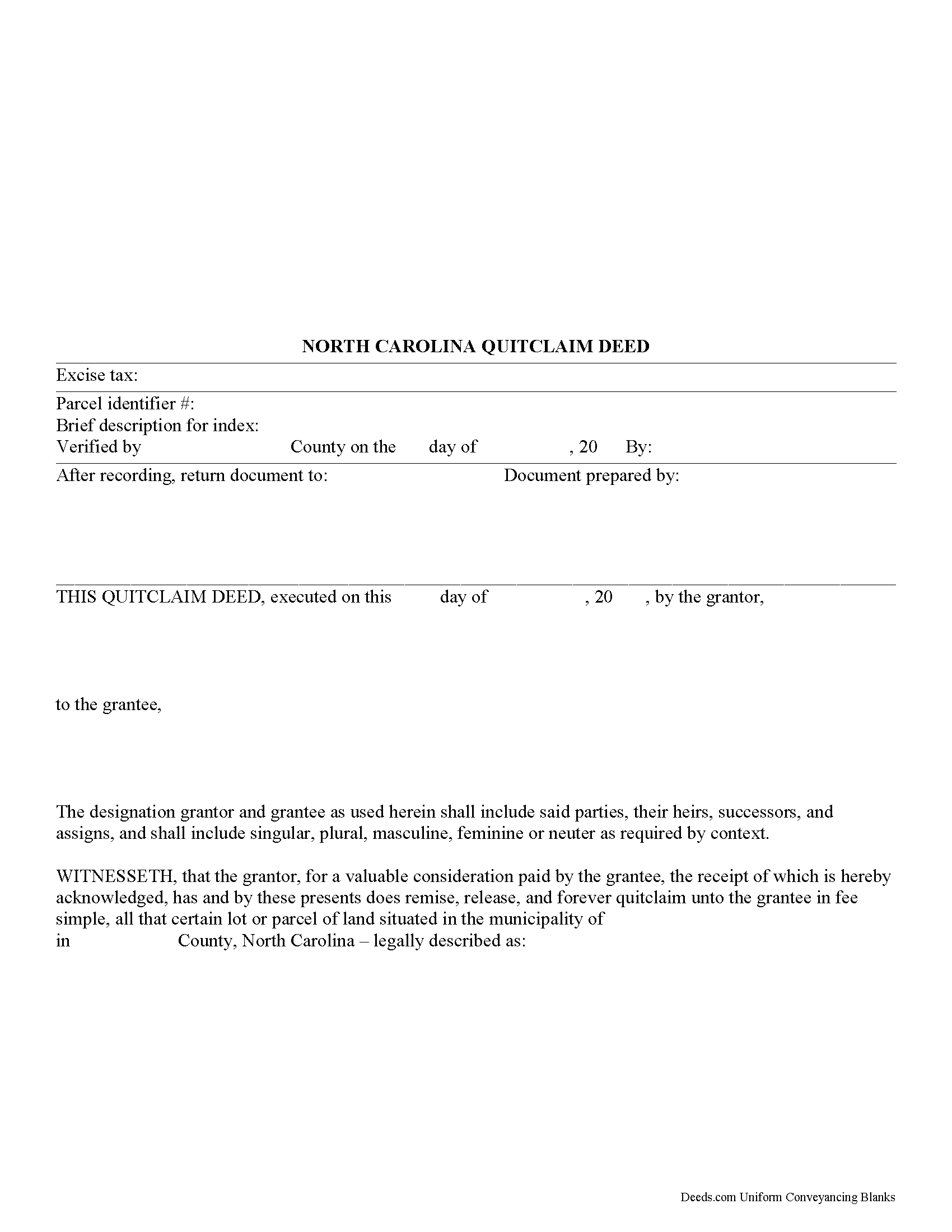
About the North Carolina Quitclaim Deed
How to Use This Form
- Select your county from the list
- Download the county-specific form
- Fill in the required information
- Have the document notarized if required
- Record with your county recorder's office
What Others Like You Are Saying
"It was confusing at first, but the customer service was excellent and fast and I got everything take…"
"This a seamless way to get a beneficiary deed recorded. Everything was easier than I imagined includ…"
"Outstanding product and so easy to use! Highly recommend this product. We successfully used the Virg…"
"Thank you everything was as expected very good service"
"ALTHOUGH IT TOOK A LITTLE LONGER THAN EXPECTED TO RECEIVE AN INVOICE TO ALLOW ME TO PAY THE REQUIRED…"
4.8/5 from 4,828 reviews. Read all
Everything a North Carolina quitclaim deed accomplishes is decided by words someone writes onto it. The state prescribes no form for the instrument, supplies no covenants from particular granting words, and, since the 2024 rewrite of Chapter 41, spreads the language that fixes how two grantees hold across three separate Articles. This fillable deed is built for that reality: one or two individuals release whatever interest they hold in North Carolina land, to one or two named grantees, with no covenant of title and nothing about status, capacity, or co-ownership printed on the page in advance.
Three Articles behind one grantee blank
What the receiving side gets is settled by the words typed after the grantee names, and Session Law 2024-47 reorganized where those words come from. Article 7 of Chapter 41 supplies the fallback: co-ownership is a tenancy in common unless something else is created, and G.S. 41-90 lets each cotenant deal with that cotenant's own share alone. Article 6 supplies survivorship between individuals, but only where the intent is expressed, and it lists the phrases that express it, from joint tenants with right of survivorship down to with right of survivorship, subject to the 120 hour rule in G.S. 41-74. Article 5 supplies the marital estate, which under G.S. 41-56 arises by default where two grantees are then married to each other and no contrary intention appears.
A page that preprints nothing about the parties
The Grantor block and the Grantee block are open multi-line fields. Each holds one or two natural persons signing in their own right, with the names, status recitals, and any tenancy designation supplied by whoever completes the form, so four count patterns run through one instrument: one to one, one to two, two to one, and two to two. Section 9 makes that work in prose, defining Grantor and Grantee by reference to the numbered blocks and providing that the singular includes the plural. Execution follows, with two signature blocks and a certificate under each, the second pair left empty where a single owner conveys. Positions appearing in the records under this shape include co-owners consolidating a parcel into one name and two owners releasing land to a pair taking it together. The form does not recite an entity, a trustee, an agent under a power of attorney, three or more owners on a side, or a joinder line for a spouse holding no record title.
What the label does not decide
No statute defines a North Carolina quitclaim, so the operative sentence carries the load: the Grantor remises, releases, and forever quitclaims all right, title, claim, and interest, if any, and a sentence of its own states that the deed passes only what the Grantor holds at delivery, without covenant or warranty of title, express or implied. G.S. 39-1 sends the whole of that estate unless the deed plainly shows a smaller one, and G.S. 39-1.1 tells a court to read every provision together when clauses pull against each other, which is why the disclaimer sits in the text rather than in the title. Deeds of trust, easements, and restrictions ride through untouched. Searches reach the instrument as a quit claim deed, a quitclaim, and a non-warranty deed.
The entries a register reads before indexing
Page one keeps the three inch band G.S. 161-14(b) reserves, names the instrument type below it, then gathers what gets read at the counter: the drafter entry G.S. 47-17.1 makes a condition of acceptance, the excise figure the presenter reports under G.S. 105-228.32 at the G.S. 105-228.30 rate of a dollar for each five hundred dollars or fraction, a parcel identifier blank for the county systems of G.S. 161-30, and a return address. Inside, the deed states each party's mailing address and whether the land takes in a grantor's primary residence, as G.S. 105-317.2 directs. Then sequence decides the rest: under G.S. 47-18 a conveyance counts against lien creditors and later purchasers for value only once registered where the land sits, and competing instruments rank in the order they reach the record.
The download carries this deed as a fillable PDF, a completed example worked through a Johnston County release by two cotenants to a couple taking as joint tenants with right of survivorship, and a plain language guide covering each section, the signing and marital statutes, the vesting menu, excise treatment, and recording. These materials describe North Carolina law in general terms and are not legal advice.
Important: County-Specific Forms
Our quitclaim deed forms are specifically formatted for each of the 100 counties in North Carolina.
After selecting your county, you'll receive forms that meet all local recording requirements, ensuring your documents will be accepted without delays or rejection fees.