North Carolina Quitclaim Deed (Divorce)
County Specific Legal Forms Validated as recently as October 8, 2026 by our Forms Development Team
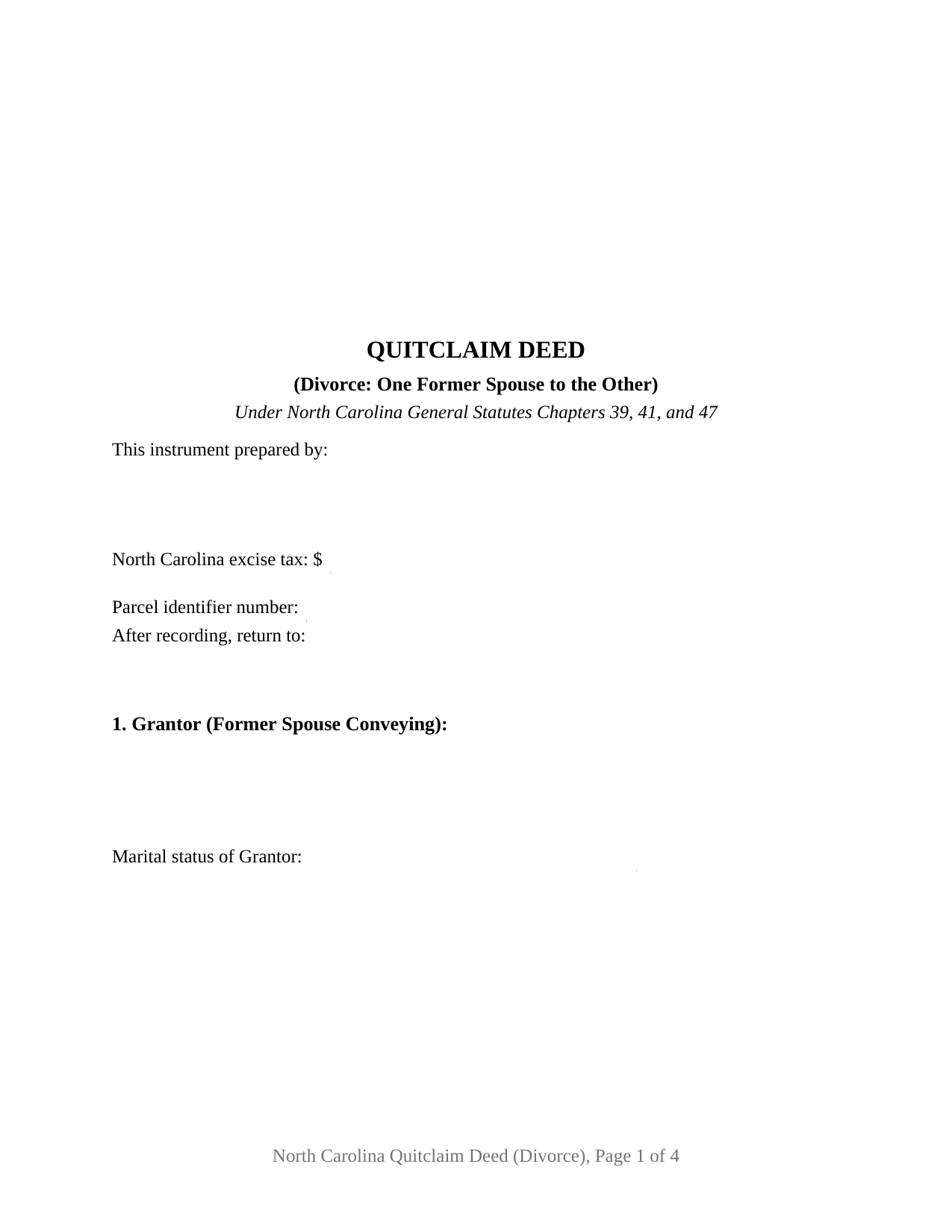
About the North Carolina Quitclaim Deed (Divorce)
How to Use This Form
- Select your county from the list
- Download the county-specific form
- Fill in the required information
- Have the document notarized if required
- Record with your county recorder's office
What Others Like You Are Saying
"So quick. So easy. Worth every penny!"
"So far I am having a good experience."
"Working with one document at a time every thing was great, but the program will not let multiple doc…"
"The service was fast and efficient. So glad I stumbled upon this website!"
"Thanks so much for all your help! That was painless."
4.8/5 from 4,836 reviews. Read all
The judgment came first. By the time this deed is signed, a North Carolina absolute divorce has already changed the estate: G.S. 41-63(5) converts property held as tenants by the entirety into a tenancy in common, so two former spouses hold undivided shares of what used to be the marital residence. This fillable quitclaim deed moves one of those shares. One former spouse signs as Grantor, the other is named as Grantee, and the instrument releases the Grantor's interest with no covenant or warranty of title.
What the divorce already did to the title
Tenancy by the entirety depends on the marriage that created it. G.S. 41-63 lists the events that end it short of death, and subdivision (5) supplies the consequence: an absolute divorce of the spouses converts entireties property to a tenancy in common. Nothing reaches the registry when that happens. The index still shows a deed running to a husband and wife while the estate beneath it has changed form, and each former spouse holds an undivided interest that G.S. 41-90 lets that cotenant convey alone. Section 10 names the conversion expressly, so the page states what the release reaches.
The division belongs to the order, not to the deed
North Carolina draws that line in statutory text. G.S. 50-20(d) lets the parties provide for distribution of marital and divisible property by written agreement acknowledged under G.S. 52-10 and G.S. 52-10.1, then adds, citing G.S. 39-13.3(a)(2) and G.S. 41-63(4)b., that the parties shall not provide for this distribution in an instrument of conveyance of real property. Session Law 2025-25 rewrote G.S. 39-13.3(a)(2) to the same effect on October 1, 2025: a right or claim for equitable distribution shall not be waived or released in the instrument of conveyance. So this form carries identification blanks and no division terms. Section 3 takes the judgment by court, file number, and date; Section 4 takes the separation agreement, consent order, or equitable distribution judgment the conveyance carries out, each prepared separately and not part of this package.
One signature, and the joinder line that is absent
What is missing from this deed says as much as what it carries. G.S. 29-30 supplies the elective life estate that G.S. 39-7 asks a spouse to sign away, and G.S. 41-58 calls for written joinder of both spouses on entireties property; the judgment named in Section 3 ended the marriage both provisions run with. So the form recites one Grantor, one signature line, one printed name line for the register's index, and one certificate carrying the substance of G.S. 10B-41(a). A marital status line earns its place, because a Grantor who has remarried holds the land during a new marriage, which G.S. 39-7 reaches through the current spouse's execution. Positions appearing in the records here include a former spouse releasing the residence to the one keeping it under a consent order, a departing owner clearing the chain before a refinance, and an undivided half interest a title search surfaced years after a divorce. The form is not set up for two conveying owners, for spouses still married when they sign, for an entity or trustee Grantor, or for an agent's signature.
A release, and the figures page one reports
No North Carolina statute prescribes a quitclaim, so the operative words do the work: the deed passes what the Grantor has, if any, and G.S. 39-1 sends the whole of that estate unless the deed shows less. A deed of trust both former spouses signed rides through untouched, and so does the note behind it. Page one keeps the three inch band G.S. 161-14(b) requires, names the instrument type beneath it, then gathers what the counter reads: the drafter name G.S. 47-17.1 puts on a first page as a condition of acceptance, the excise figure G.S. 105-228.32 makes the presenter's report, a parcel identifier line under G.S. 161-30, and the return address. Where no consideration in property or money is due or paid by the transferee, G.S. 105-228.29 places the transfer outside the tax. Searchers find it as a quit claim deed, a quitclaim, a non-warranty deed, or a divorce deed; under every label, G.S. 47-18 measures priority from registration where the land lies.
The download holds this deed as a fillable PDF, a completed example worked through a Guilford County release following an absolute divorce, and a plain language guide covering each section, the divorce and vesting statutes, excise reporting, and recording. Nothing here is legal advice; it describes North Carolina law generally.
Important: County-Specific Forms
Our quitclaim deed (divorce) forms are specifically formatted for each of the 100 counties in North Carolina.
After selecting your county, you'll receive forms that meet all local recording requirements, ensuring your documents will be accepted without delays or rejection fees.