North Carolina Quitclaim Deed (Married Grantor with Non-Owner Spouse Joinder)
County Specific Legal Forms Validated as recently as October 14, 2026 by our Forms Development Team
About the North Carolina Quitclaim Deed (Married Grantor with Non-Owner Spouse Joinder)
How to Use This Form
- Select your county from the list
- Download the county-specific form
- Fill in the required information
- Have the document notarized if required
- Record with your county recorder's office
What Others Like You Are Saying
"I loved that there was a sample with the downloads. It made it much easier to fill out the document …"
"SIMPLE, THAT IS GOOD"
"Very easy to navigate website. Quick filing, great communication. Saved me hundreds of dollars vs. f…"
"I really appreciate your forms according to South Dakota laws and statues. Your forms allow me to ef…"
"The release of mortgage form was OK, and accepted at the recorder's office, but there were some prob…"
4.8/5 from 4,829 reviews. Read all
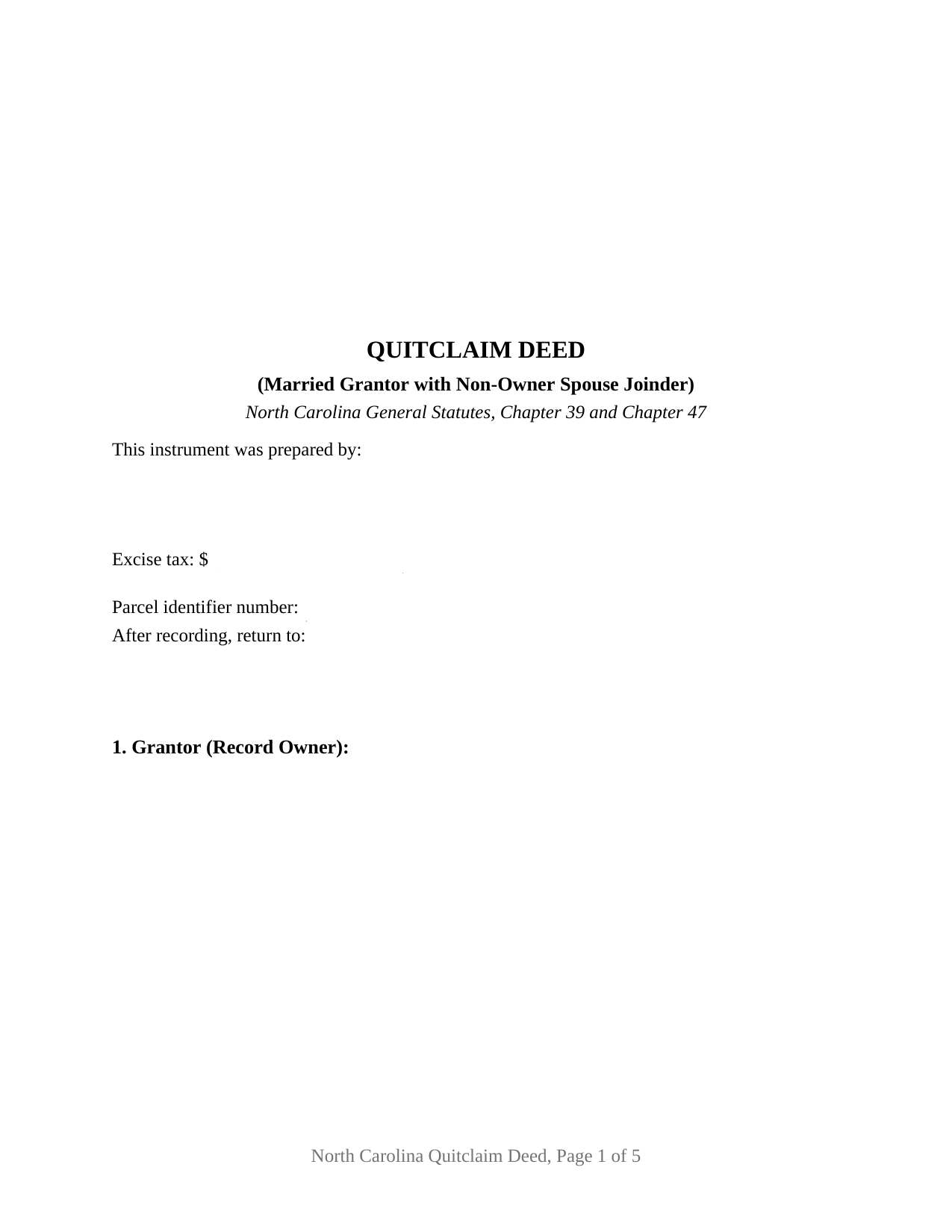
One name in the record, two signatures on the deed. This North Carolina quitclaim deed comes as a fillable PDF drawn for a married record owner who holds the property alone: the owner releases whatever interest the owner has, and the owner's husband or wife signs a second labeled line as a joining spouse, receiving nothing and conveying nothing, so that a marital right no title index carries stays behind.
The right the second signature reaches
Dower and curtesy left North Carolina law in 1959, abolished by G.S. 29-4, and for land the elective life estate of G.S. 29-30 took their place: a surviving spouse may elect a life estate in one third in value of the real estate the deceased spouse was seised and possessed of at any time during the marriage. The measure looks back across the whole marriage, so it can reach land sold years earlier. G.S. 39-7(a) supplies the release and frames it as execution, not wording: to waive the G.S. 29-30 elective life estate, every conveyance or other instrument affecting the estate, right or title of a married person in land must be executed by that person's spouse, with due proof or acknowledgment made and certified as provided by law. The signature is the waiver, and this deed gives it a labeled line and a certificate of its own.
One record owner, one joining spouse
The form recites exactly one record owner as Grantor and one non-owner spouse as Joining Spouse, and prints under the second block a sentence stating that the Joining Spouse holds no record title and signs solely for the purpose stated in the conveyance section. That section moves twice: the Grantor remises, releases, and forever quitclaims all right, title, and interest, if any, in the land, and the Joining Spouse joins to waive and release the G.S. 29-30 elective life estate as to it, conveying nothing and warranting nothing. Two signature blocks and two acknowledgment certificates follow, matching the way these deeds get signed, since G.S. 39-8 allows the two acknowledgments to be taken before different officers, at different times and places, one of them outside the state, in either order. Patterns presenting this shape in the records include land one spouse acquired before the marriage and deeds away during it, a parcel held in one spouse's name alone passing to a relative or to a company the owner forms, and a closing where the examining attorney wants the spouse's signature before the buyer's title is insured. The form is not built for land both spouses own, which is held by the entirety and moves under G.S. 41-58 only with both owners joining, nor for co-owners not married to each other.
A release, not a promise
No statute prescribes a North Carolina quitclaim deed, so the instrument, also searched as a quit claim deed or a non-warranty deed, carries its own operative words and its own disclaimer: it passes the interest the Grantor has, if any, without covenant or warranty of title, express or implied. The fee simple presumption of G.S. 39-1 delivers the whole of what the Grantor owns unless the deed plainly shows a smaller estate. How the receiving side holds what arrives is written into the grantee blank, and the guide walks that menu, from the tenancy in common default to the entirety estate the completed example illustrates.
What a missing certificate costs
Page one keeps the three inch space G.S. 161-14(b) reserves and gathers, below it, the drafter entry that G.S. 47-17.1 makes a condition of acceptance, the excise tax figure, the parcel number, and the return block. One consequence of that design earns its own sentence: under G.S. 47-14(d) registration is effective only as to parties whose execution is duly proved or acknowledged, and G.S. 39-9 provides that a deed purporting to be signed by both spouses may be ordered registered on one acknowledgment while never becoming the deed of the other. Taken to the counter with the owner's certificate alone, this deed still moves the owner's interest and leaves the marital right where it stood.
The download holds the deed as a fillable PDF, a completed example worked through a Forsyth County conveyance of land the grantor held separately, and a plain language guide covering each numbered section, the excise tax and county prerequisites, the acknowledgment rules, and how the grantees may hold title. The materials describe North Carolina law in general terms and are not legal advice.
Important: County-Specific Forms
Our quitclaim deed (married grantor with non-owner spouse joinder) forms are specifically formatted for each of the 100 counties in North Carolina.
After selecting your county, you'll receive forms that meet all local recording requirements, ensuring your documents will be accepted without delays or rejection fees.