North Carolina Quitclaim Deed (Trustee Grantor)
County Specific Legal Forms Validated as recently as October 5, 2026 by our Forms Development Team
About the North Carolina Quitclaim Deed (Trustee Grantor)
How to Use This Form
- Select your county from the list
- Download the county-specific form
- Fill in the required information
- Have the document notarized if required
- Record with your county recorder's office
What Others Like You Are Saying
"When I found this website, I was confused and hesitant to use this website to submit paperwork that …"
"Thanks so much for the TOD Beneficiary Deed with the explanation, supplementary forms and great exam…"
"Both experiences were professional. Thank you"
"I was very impressed. I needed a Grant Deed that would comply with Calif. law. I haven't tried to re…"
"easy to use once i found out i could fill it out right on the deeds website instead of downloading i…"
4.8/5 from 4,828 reviews. Read all
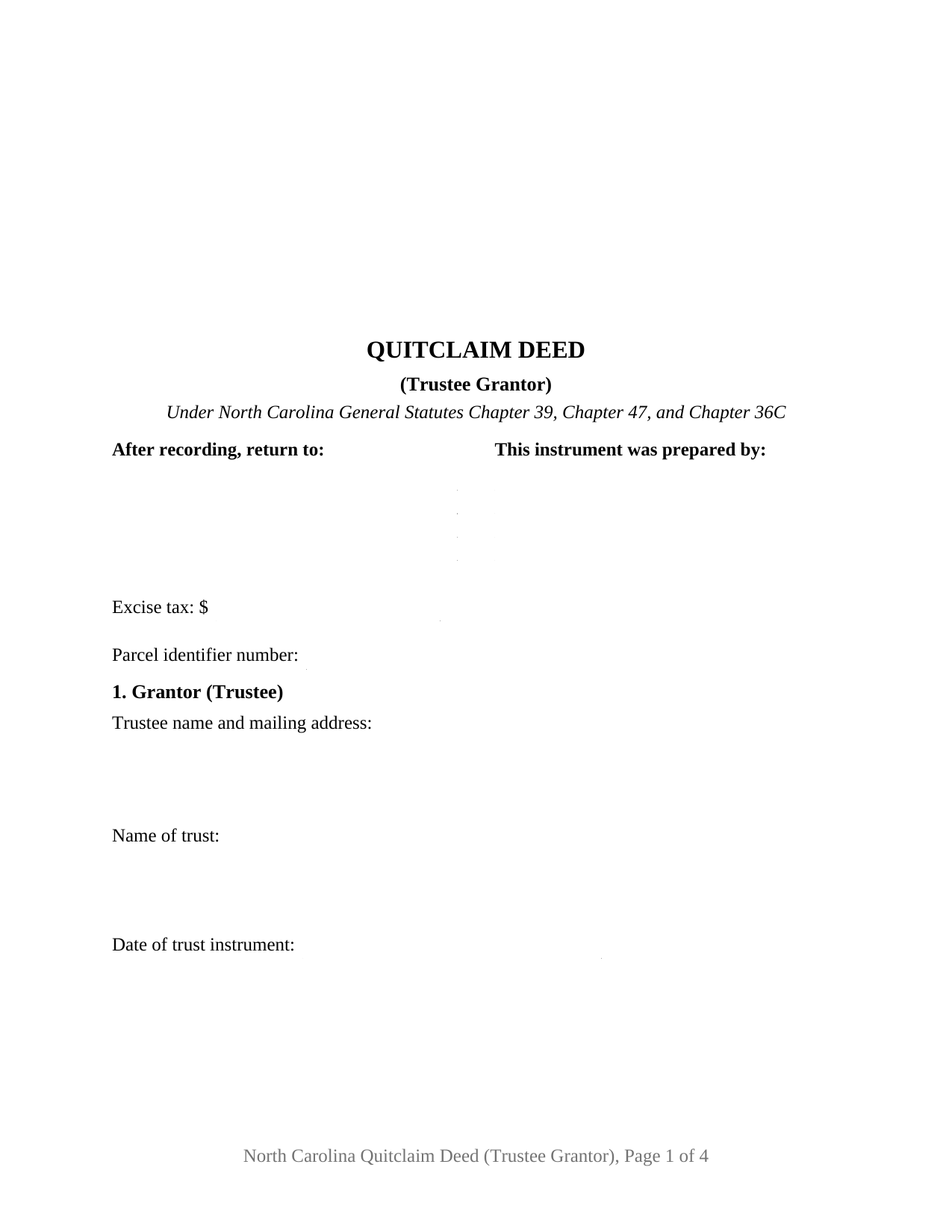
A trustee's signature line carries two things: a name and an office. This fillable North Carolina quitclaim deed is drawn for the moment land leaves a trust. One acting trustee signs as Grantor, in that fiduciary capacity and not individually, releasing whatever right, title, and interest the trust holds in the described parcel to the named Grantee, with no covenant of title attached.
Where a trustee's authority to convey comes from
A trustee conveying North Carolina land answers to two documents: the trust instrument and the Uniform Trust Code. G.S. 36C-8-816 lists the trustee's specific powers, among them the power at subdivision (2) to acquire or sell property, for cash or on credit, at public or private sale, and the powers at subdivision (26) that survive termination, including distributing trust property to the persons entitled to it. The other side of the table has its own protection: under G.S. 36C-10-1012(b) a person other than a beneficiary dealing in good faith and for value with a trustee need not inquire into the extent of the trustee's powers. A certification of trust under G.S. 36C-10-1013 is recorded separately where a lender or insurer wants that authority documented, and is not part of this package.
The statute that reads past imperfect wording
Trust deeds reach North Carolina registries worded loosely, and G.S. 39-6.7 absorbs the variation. Subsection (b) treats an instrument purporting to convey an interest by a trust as a transfer by the trustee or trustees of that trust. Subsection (c) makes the deed sufficient whether the trustee signed as such or on behalf of the trust, and whether the deed that brought title in ran to the trustee as such or to the trust by name; subsection (d) lets the trustee convey as trustee in that second situation. Both print in Section 8, so the question is answered on the page rather than argued later.
One trustee signs, and the certificate says so
The form recites one acting trustee, the name of the trust, and the date of the trust instrument, then a single signature block whose printed name line carries the office beside the name. One acknowledgment certificate follows, its by-line taking the signer's name with the fiduciary capacity: G.S. 47-38 states that its certificate form serves an individual acting as the trustee of a trust whether or not the certificate says so, and G.S. 47-37.1(b) permits the acknowledgment to identify the fiduciary capacity. Positions presenting this configuration in the records include a trustee distributing a parcel to a beneficiary as the trust winds up, a successor trustee clearing trust-held land out after the settlor has died, and a trustee releasing the trust's undivided share so that title gathers in one name. The form is not set up for two cotrustees signing together, the configuration G.S. 36C-7-703(a) reaches by calling for unanimity where two cotrustees serve, nor for the substitution and foreclosure instruments that belong to a deed of trust under Chapter 45.
A release, and an excise line that tracks the consideration
North Carolina prescribes no quitclaim form, so this instrument, searched as a quit claim deed and as a non-warranty deed, works through its own words: it remises, releases, and quitclaims the trust's interest, if any, with no warranty of title traveling with it. G.S. 39-1 carries the whole of what the trust holds unless the deed shows a smaller estate, liens and easements included. The excise figure on page one follows the recited consideration, one dollar per five hundred dollars or fraction under G.S. 105-228.30, collected and marked by the register under G.S. 105-228.32; G.S. 105-228.29 lists the classes outside the tax.
What page one gives the register
Page one keeps the three inch recording space of G.S. 161-14(b), states the instrument type beneath it, and gathers the drafter entry G.S. 47-17.1 makes a condition of acceptance, the parcel identifier for the county systems of G.S. 161-30, and the return block. The body carries the party addresses and the primary residence statement of G.S. 105-317.2. Registration in the county where the land lies is what makes the conveyance good against lien creditors and purchasers under G.S. 47-18.
The download holds this deed as a fillable PDF, a completed example worked through a Buncombe County distribution from a family trust to a beneficiary, and a plain language guide covering each numbered section, the trustee entries, the vesting menu, and the recording steps. The materials describe North Carolina law in general terms and are not legal advice.
Important: County-Specific Forms
Our quitclaim deed (trustee grantor) forms are specifically formatted for each of the 100 counties in North Carolina.
After selecting your county, you'll receive forms that meet all local recording requirements, ensuring your documents will be accepted without delays or rejection fees.