Ohio Mineral Deed (Quitclaim) (Individual by Attorney-in-Fact)
County Specific Legal Forms Validated as recently as October 27, 2026 by our Forms Development Team
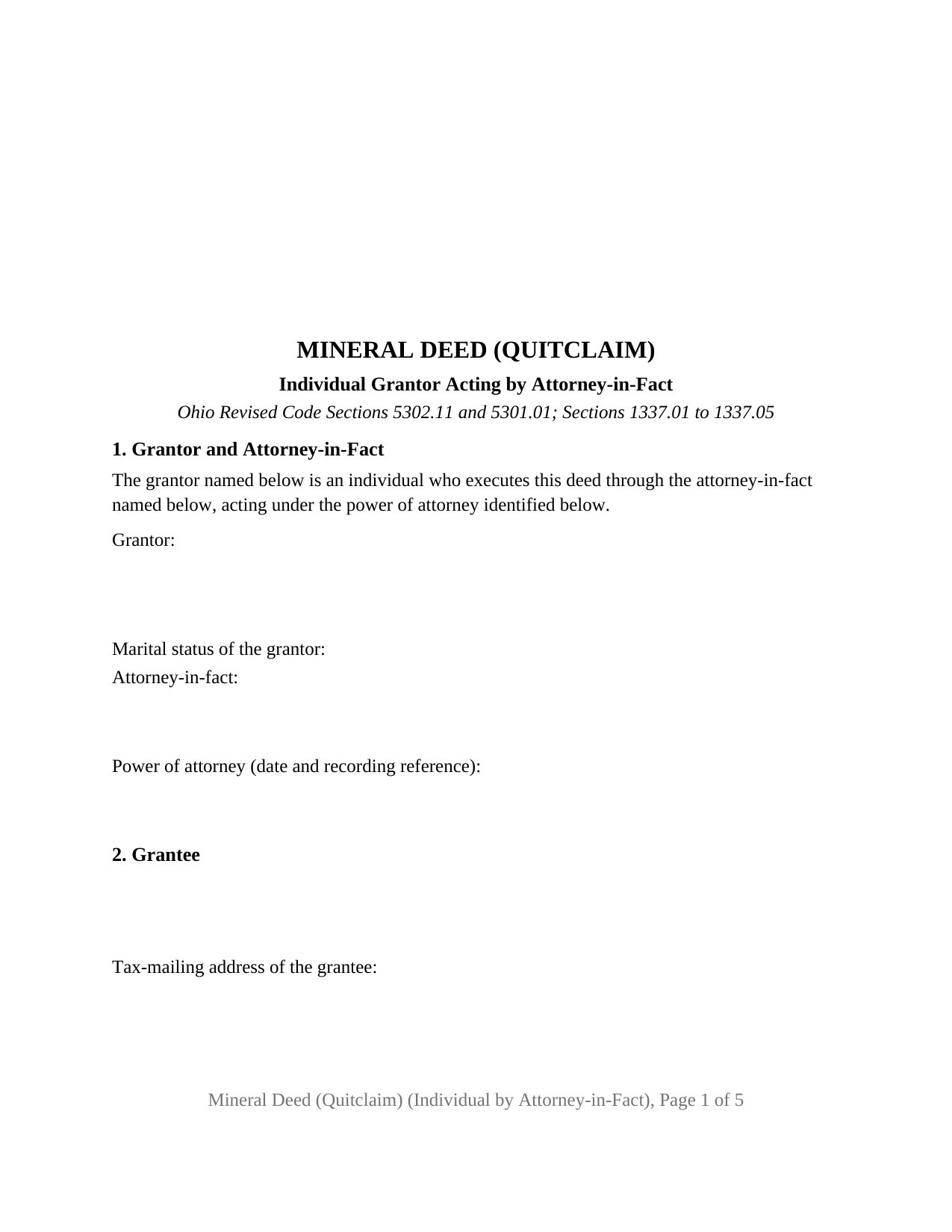
About the Ohio Mineral Deed (Quitclaim) (Individual by Attorney-in-Fact)
How to Use This Form
- Select your county from the list
- Download the county-specific form
- Fill in the required information
- Have the document notarized if required
- Record with your county recorder's office
What Others Like You Are Saying
"Zero problems, ended up with quality documents. Will use again."
"This site was a breeze using."
"This was a good way to find the owners of land located in the middle of some that I owned. The exper…"
"All required forms readily available at fair price. Easy to create account. Immediately acquired doc…"
"This was so easy and the instructions were great."
4.8/5 from 4,836 reviews. Read all
This Ohio mineral deed is built for one configuration: an individual owner of an oil, gas, or other mineral interest under Ohio land whose attorney-in-fact signs the deed for the owner under a power of attorney. The deed quitclaims the owner's interest in the described minerals to the grantee, following the quit-claim form in Section 5302.11 of the Ohio Revised Code, and carries the acknowledgment certificate Ohio prints for an attorney in fact acting for a principal.
A signature that rests on a recorded power
Ohio treats a deed signed through a power of attorney as the principal's own act. Section 1337.02 provides that it conveys the grantor's interest as fully as if the grantor had signed in person, and Section 1337.03 provides that the deed is not defective because the attorney-in-fact's name is subscribed as such attorney instead of the principal's, or because the notary's certificate states that the signer acknowledged it as attorney.
What the statute insists on is order. Under Section 1337.04, as amended effective October 24, 2024, the power of attorney is executed and acknowledged before the deed and recorded with the county recorder of the county where the land lies before the deed is recorded. The form's first section identifies the power of attorney by its date and recording reference, so the deed and the recorded power read together.
What the attorney-in-fact may convey
The deed confers no authority of its own; the power of attorney does that. Under Ohio's Uniform Power of Attorney Act, a grant of general authority over real property authorizes the agent to sell, convey with or without covenants, quitclaim, release, or otherwise dispose of an interest in real property, in the words of Section 1337.45(B), unless the power provides otherwise. Two limits sit beside that grant: a gift requires an express grant of gift authority under Section 1337.42(A), and under Section 1337.42(B) an agent who is not an ancestor, spouse, or descendant of the principal may not use the power to create an interest in the principal's property in the agent.
The mineral interest as Ohio real property
Ohio law defines a mineral interest as a fee interest in at least one mineral, absolute or fractional, and a conveyance of minerals or mineral rights passes through the county auditor for the conveyance fee statement and transfer endorsement before the recorder accepts it, exactly as a deed of the surface does. The form describes the surface tract by its recorded legal description and parcel number, then describes the mineral interest conveyed in its own section.
Recording has a consequence beyond notice. Under the Dormant Mineral Act, Section 5301.56, a severed mineral interest can be deemed abandoned and vested in the surface owner unless, within the preceding twenty years, it has been the subject of a recorded title transaction, a term the Marketable Title Act defines to include a quit claim deed.
One grantor, one agent, and the spouse's dower
The form recites exactly one individual grantor executing through one attorney-in-fact, with the grantor's marital status entered as a fact where the statutory form prints it. A married grantor's dower is not released by the agent's signature on the grantor's behalf; Ohio dower under Section 2103.02 belongs to the spouse, and the statutory quitclaim form carries a line by which the wife or husband of the grantor releases all rights of dower. The deed prints that line with a signature block and its own acknowledgment certificate for the spouse, completed when the grantor is married and left blank when the grantor is not. An aging parent whose adult child holds a durable power of attorney, with the parent's spouse joining to release dower, presents the pattern this deed recites; a grantor signing in person, two grantors, an entity or trustee grantor, and co-agents acting together are configurations this form is not set up as.
The deed quitclaims: Section 5302.11 gives it the force and effect of a deed in fee simple, but without covenants of any kind on the part of the grantor, so the grantee receives the interest the grantor holds, subject to recorded leases, prior reservations, and outstanding fractional shares.
The package includes the fillable form, a completed example filled in for a realistic Guernsey County fact pattern, and the guide that walks through every numbered section, the power of attorney recording rule, and the auditor and recorder steps. This description and the guide describe the form and the governing Ohio statutes in general terms; they are not legal advice.
Important: County-Specific Forms
Our mineral deed (quitclaim) (individual by attorney-in-fact) forms are specifically formatted for each of the 88 counties in Ohio.
After selecting your county, you'll receive forms that meet all local recording requirements, ensuring your documents will be accepted without delays or rejection fees.