Ohio Mineral Deed (Quitclaim) (Entity to Individual)
County Specific Legal Forms Validated as recently as October 27, 2026 by our Forms Development Team
About the Ohio Mineral Deed (Quitclaim) (Entity to Individual)
How to Use This Form
- Select your county from the list
- Download the county-specific form
- Fill in the required information
- Have the document notarized if required
- Record with your county recorder's office
What Others Like You Are Saying
"I was able to download the TOD deed form with no issues and it showed immediately. I appreciate that…"
"So far so good once we got the initial problems worked out."
"I found all the forms I needed to complete a Quit Claim Deed on Deeds.com. All the forms are availab…"
"Very concise and thorough website. Easily navigated and easily affordable."
"Finding and downloading necessary forms, and especially the example forms, were tremendously easy an…"
4.8/5 from 4,836 reviews. Read all
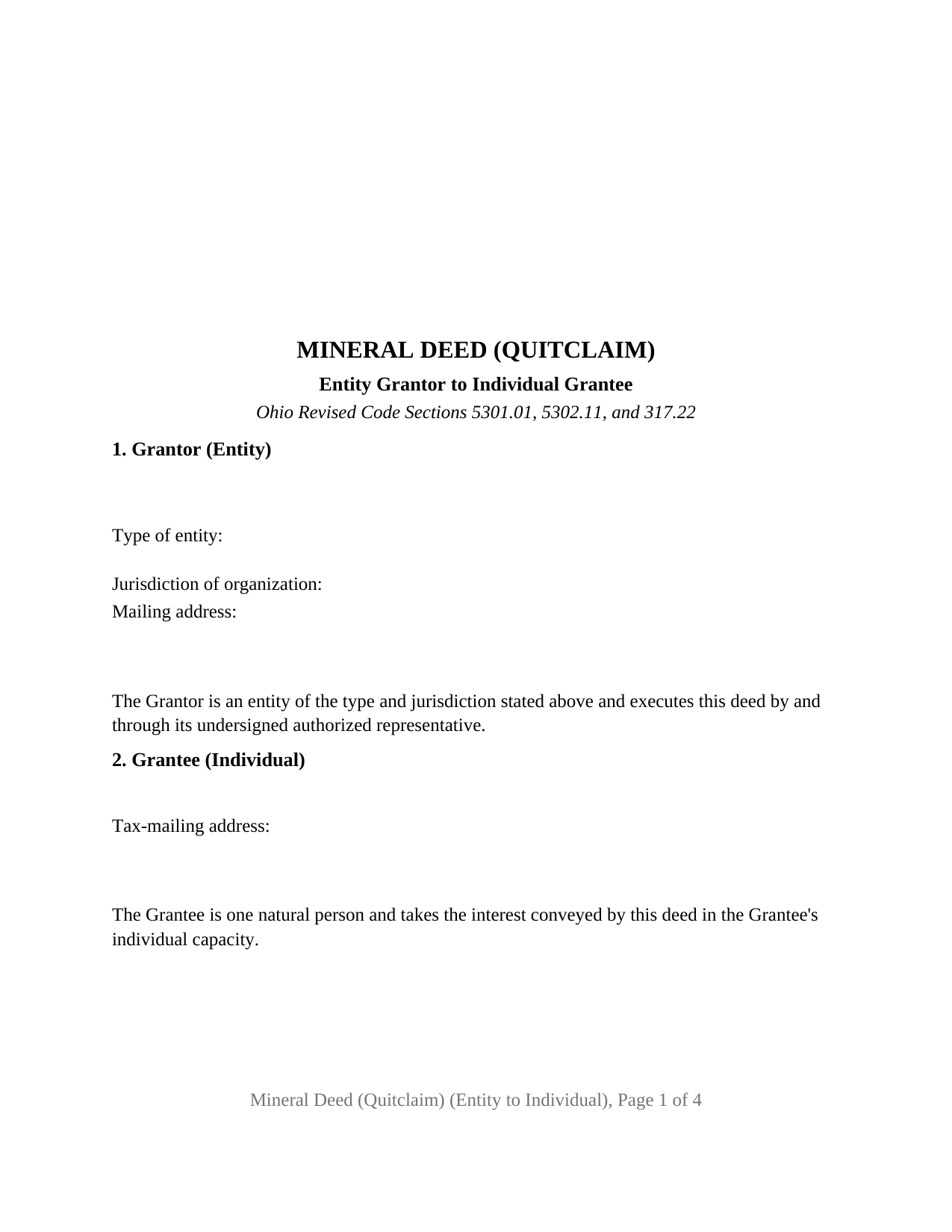
When a company holds Ohio oil, gas, or other mineral rights and moves them to one person, a representative signs the deed in the company's name, and the acknowledgment certificate says so. This Ohio Mineral Deed (Quitclaim) is built for that configuration: a business entity as grantor, acting through its authorized representative, quitclaiming a mineral interest to one individual grantee under Section 5302.11 of the Ohio Revised Code.
A deed signed in the company's name
The grantor section identifies the entity by its legal name, its type (corporation, limited liability company, partnership, or another organized form), its jurisdiction of organization, and its mailing address, and recites that the entity executes the deed by and through its undersigned authorized representative. The signature block is headed for that representative, with the printed name, date, and title under the signature. The entity's authority comes from its own records: an operating agreement, articles and regulations, or a statement of authority filed under Section 1706.19 for a limited liability company or Section 1776.33 for a partnership.
Because the grantor is an entity, two lines of the Section 5302.11 statutory form are absent: the marital status blank and the dower release, since dower under Section 2103.02 is a spouse's right in the other spouse's real property and a company has no spouse.
One certificate, in the entity's own form
Section 147.55 prints separate short forms of acknowledgment for a corporation, a limited liability company, and a partnership, each opening with the same words and then naming the officer, member, or partner who acknowledges on the entity's behalf. The single certificate on this deed prints those opening words and leaves the person acknowledging to a two-line entry, so the completed certificate reads as the statutory form matching the entity type; the example shows the limited liability company form.
What a quitclaim mineral deed conveys
The conveyance section carries the Section 5302.11 grant, for valuable consideration paid, of the mineral interest described in the deed, in and under the described land, with its appurtenant rights and subject to the stated encumbrances, reservations, and exceptions. The deed conveys the grantor's interest in fee simple without covenants of any kind on the part of the grantor; Section 5302.03 adds that the word grant implies no covenant. The mineral interest has its own entry, whether all of the minerals or an undivided fraction, and an existing oil and gas lease of record is listed among the encumbrances.
Why recording a mineral deed matters twice
Recording gives notice under Section 5301.25, as for any Ohio deed, and for a severed mineral interest it does one more thing. Ohio's Dormant Mineral Act, Section 5301.56, lets a surface owner have a mineral interest deemed abandoned if none of the statute's listed events occurred in the twenty years before notice, and the first listed event is a recorded title transaction of which the mineral interest was the subject; Section 5301.47(F) names a quit claim deed among title transactions.
Before the recorder accepts the deed, the county auditor stamps it. Section 317.22 provides that a conveyance of minerals or mineral rights is not admitted to record until it carries the auditor's conveyance fee stamp and transfer endorsement, so the deed goes to the auditor with the DTE 100 conveyance fee statement or the DTE 100EX exemption statement, and the grantor pays the state fee of ten cents per hundred dollars of value plus any county transfer tax. Where surface and minerals are owned by different persons, Section 5713.04 has the auditor list and tax the two interests separately.
The configuration this deed recites
The form recites exactly one grantor, an entity signing through one authorized representative, and exactly one grantee, an individual, with one signature block and one acknowledgment certificate. A holding company distributing an undivided interest to a member, a family company passing a royalty interest to one relative, and a company selling a mineral interest to an individual buyer present the pattern this deed recites. A deed from a natural person or a trustee, a deed to two grantees, and a deed of the land itself follow patterns this form is not set up as.
The package includes the fillable mineral deed, a completed example filled in for a realistic Guernsey County fact pattern, and the guide that walks through each section, the entity acknowledgment forms, and the auditor and recorder steps. This description and the guide describe the form and the governing Ohio statutes in general terms; they are not legal advice.
Important: County-Specific Forms
Our mineral deed (quitclaim) (entity to individual) forms are specifically formatted for each of the 88 counties in Ohio.
After selecting your county, you'll receive forms that meet all local recording requirements, ensuring your documents will be accepted without delays or rejection fees.