Ohio Mineral Deed (Quitclaim) (Trustee to Individual)
County Specific Legal Forms Validated as recently as October 27, 2026 by our Forms Development Team
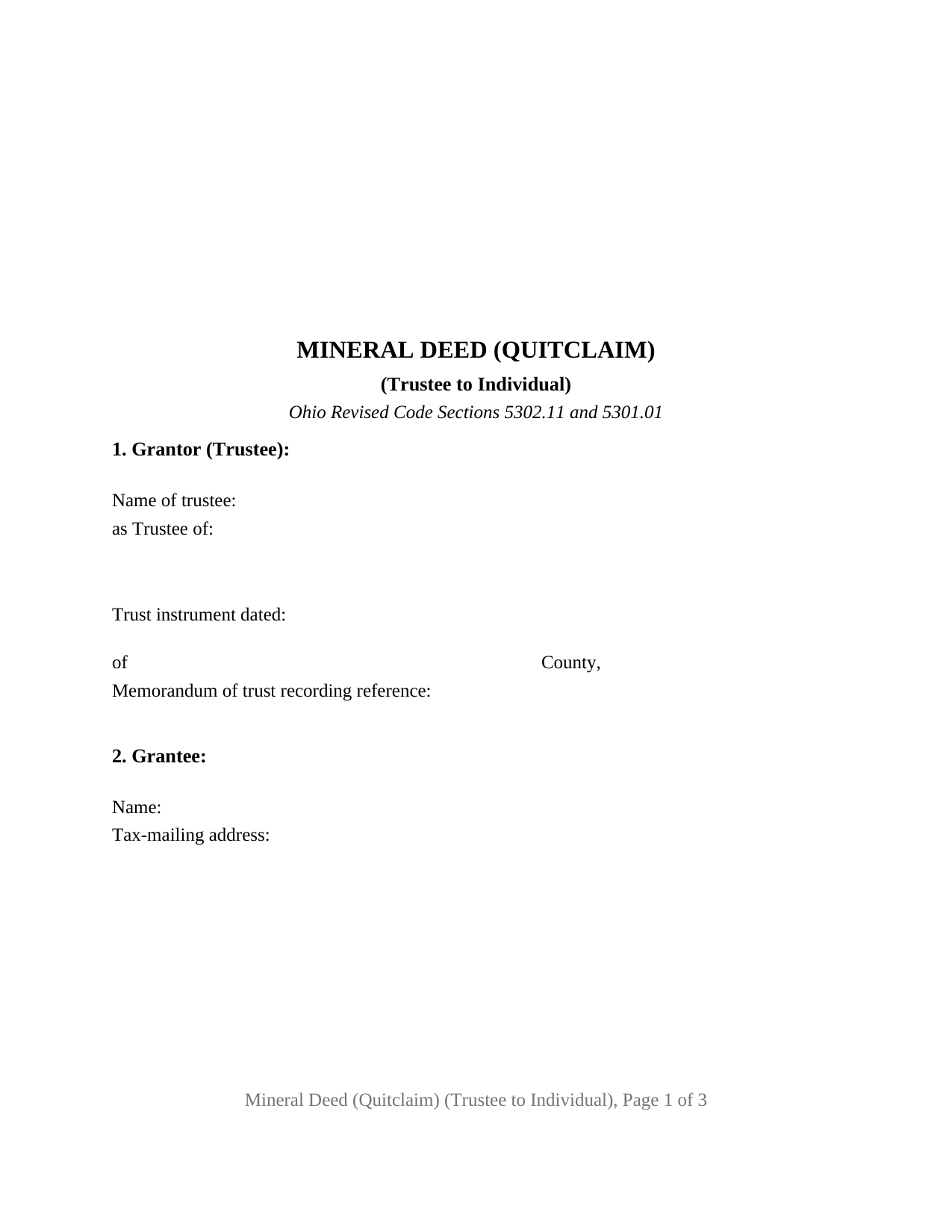
About the Ohio Mineral Deed (Quitclaim) (Trustee to Individual)
How to Use This Form
- Select your county from the list
- Download the county-specific form
- Fill in the required information
- Have the document notarized if required
- Record with your county recorder's office
What Others Like You Are Saying
"Really, really great. Instructions are so helpful."
"very good forms. they covered everything i needed."
"Complete coverage of deeds, laws, etc."
"Easy to use!"
"I came, I saw, I ordered, I downloaded."
4.8/5 from 4,836 reviews. Read all
When Ohio mineral rights are held in a trust, the day comes when the trustee passes them on, to a beneficiary when the trust directs distribution or to a buyer. This Ohio Mineral Deed (Quitclaim) (Trustee to Individual) prepares that conveyance for one trustee and one individual grantee, in substance following the quit-claim deed form in Ohio Revised Code Section 5302.11, so the trustee passes the trust's interest in the oil, gas, or other minerals without covenants of title.
A trustee signs, and the deed says so
The grantor is a named trustee acting solely as trustee of a named trust and not individually. Section 1 identifies the trustee, the trust, the trust instrument's date, and the recording reference of the memorandum of trust. That entry reflects a 2026 change: Section 5301.255, as amended by Senate Bill 101, provides that a memorandum of trust or other qualifying instrument shall be of record when any interest in real property is conveyed by the trustee of a disclosed trust. The memorandum is a separate instrument, recorded separately and not included in this package.
Because the grantor conveys in a fiduciary capacity, the deed follows the pattern of Ohio's statutory trustee deed in Section 5302.09, which prints no marital status line and no dower release line, rather than the individual quit-claim form, which prints both. The capacity is recited; fiduciary covenants are not made. The acknowledgment certificate is the Section 147.55(F) short form for a trustee.
Minerals described twice: the land and the interest
An Ohio mineral interest is a fee interest in at least one mineral, absolute or fractional, divided or undivided, in the words of Section 5301.56(A)(3). A mineral deed therefore carries two descriptions. Section 3 describes the land, copied from the deed by which the trustee acquired the interest. Section 4 describes the interest in the minerals under that land: all of the oil and gas, an undivided one-half of the minerals, a single named mineral, or whatever the trust holds, with any rights of ingress and egress that pass with it. Section 5 lists the recorded lease, reservation, or severance the conveyance is subject to, and Section 6 carries the prior instrument reference.
Why recording a mineral deed matters more than usual
Ohio's Dormant Mineral Act, Section 5301.56, lets a surface owner have a severed mineral interest deemed abandoned unless a saving event occurred in the twenty years before the surface owner's notice. The first saving event listed is that the mineral interest has been the subject of a title transaction filed or recorded with the county recorder, and Section 5301.47(F) names a trustee's deed and a quit claim deed among title transactions. A recorded mineral deed is that event.
The auditor comes first
A conveyance of minerals or mineral rights is one of the instruments Section 317.22 keeps out of the record until the county auditor has stamped it and endorsed it transferred or transfer not necessary, so the conveyance fee statement on form DTE 100, or the exemption statement on DTE 100EX, reaches the auditor before the recorder sees the deed. Several exemptions in Section 319.54(G)(3) speak to trust transfers, including a transfer to the beneficiaries of a trust where the fee was paid on the way in or the transfer follows trust provisions that became irrevocable at the grantor's death. The guide covers the fee, the county transfer tax, the exemptions, and the Section 317.114 format rules.
The configuration this form recites
The form recites one grantor, a natural person signing as trustee, and one grantee, a natural person taking in that person's own name; it carries one signature block and one acknowledgment certificate. A trust distributing a mineral interest to one beneficiary after the settlor's death, and a trustee selling a fractional oil and gas interest to one purchaser, present the pattern this deed recites. The form is not set up as a deed by co-trustees who sign together, a deed by a corporate trustee signing through an officer, a deed to two grantees or to another trust, or a conveyance of the surface; an oil and gas deed from a trust to one person is what it prepares.
The package includes the fillable mineral deed form, a completed example filled in for a Belmont County fact pattern, and the guide that explains every section and the auditor and recorder steps. This description and the guide describe the form and the governing Ohio statutes in general terms; they are not legal advice.
Important: County-Specific Forms
Our mineral deed (quitclaim) (trustee to individual) forms are specifically formatted for each of the 88 counties in Ohio.
After selecting your county, you'll receive forms that meet all local recording requirements, ensuring your documents will be accepted without delays or rejection fees.