Ohio Mineral Deed (Quitclaim) (Individual to Entity)
County Specific Legal Forms Validated as recently as October 27, 2026 by our Forms Development Team
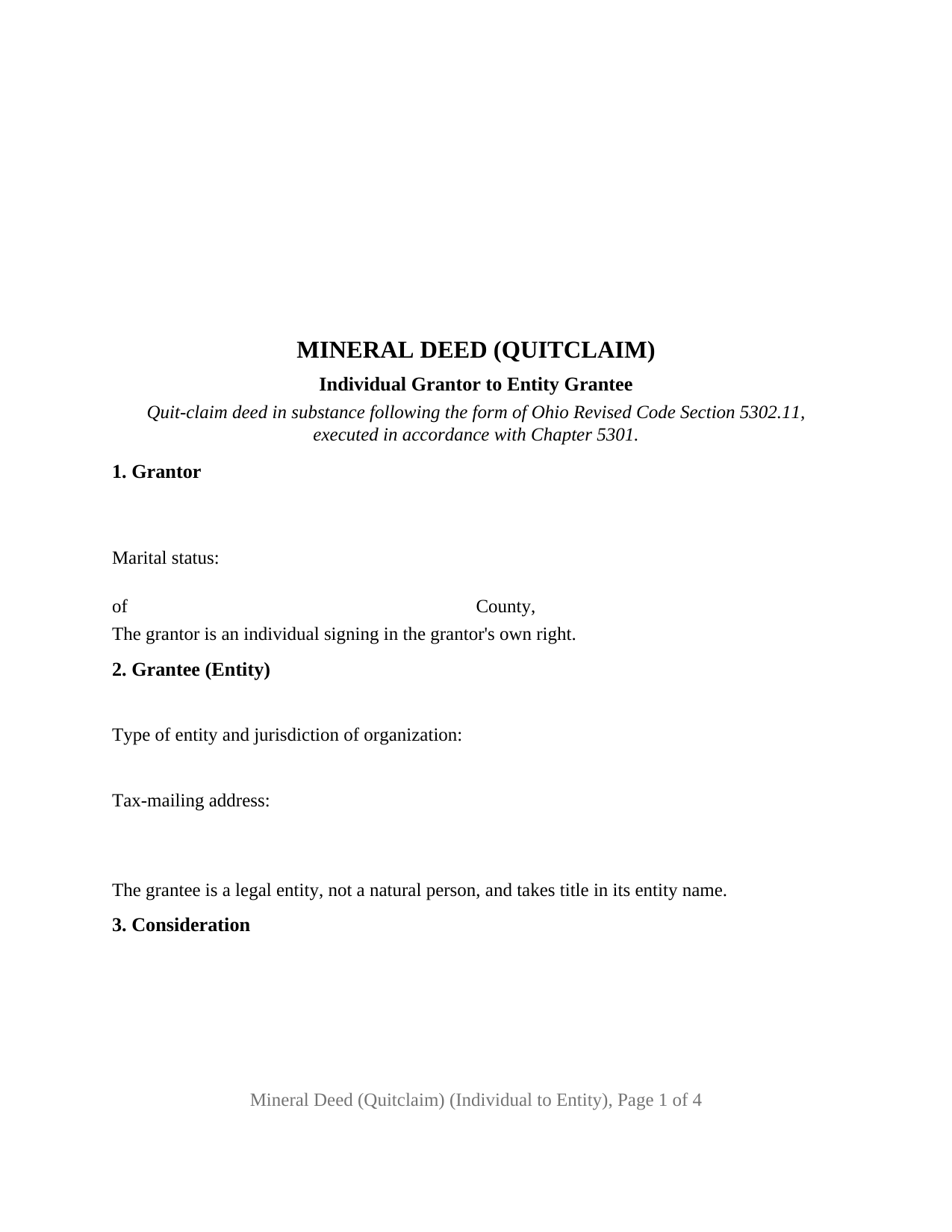
About the Ohio Mineral Deed (Quitclaim) (Individual to Entity)
How to Use This Form
- Select your county from the list
- Download the county-specific form
- Fill in the required information
- Have the document notarized if required
- Record with your county recorder's office
What Others Like You Are Saying
"We love this service - so easy to use and quick. It is the second time we have used Deeds.com, in tw…"
"Great system!"
"Really a simple, quick, professional experience!"
"You guys did a great job for us yday. With the strim coming and the registry being closed to visitor…"
"Excellent! I will be back!"
4.8/5 from 4,836 reviews. Read all
This Ohio mineral deed carries a severed oil, gas, or other mineral interest from one individual owner into a limited liability company, corporation, or other legal entity, in the quit-claim form that Ohio Revised Code Section 5302.11 prints. One natural person signs as grantor, the entity takes title in its own name, and the statutory dower release line stands ready for the grantor's spouse; the form recites that configuration as fixed deed text.
One signer, one entity, and the dower line between them
The deed identifies the grantor by name, marital status, and county of residence in the order the Section 5302.11 form prints them, and recites that the grantor is an individual signing in the grantor's own right. The grantee section takes the entity's exact registered name, its type and jurisdiction of organization, and its tax-mailing address. Above the signature blocks stands the statutory sentence naming the spouse, wife (husband) of the grantor, releasing all rights of dower therein. Ohio dower under Section 2103.02 reaches a severed mineral estate held in fee, so a married grantor's spouse signs the release and acknowledges it in a certificate of the spouse's own; an unmarried grantor leaves those lines blank.
A family placing inherited gas rights into a holding company and an individual selling a mineral share to an acquisition company each present the pattern this deed recites: a natural person on the signing side and an entity on the receiving side. A deed from two spouses, a conveyance out of a trust, or a transfer to another individual follows a different pattern, and the form is not set up as any of them.
What a quitclaim mineral deed passes in Ohio
Section 5302.11 gives a deed in substance following its form the effect of a deed in fee simple to the grantee and its successors, without covenants of any kind on the part of the grantor. The form's description line reads land or interest therein, which is what lets the statutory form carry minerals alone, and the deed passes whatever the grantor holds in the described minerals, subject to the lease, reservation, or easement listed in its encumbrances section.
A recorded title transaction under the Dormant Mineral Act
Severed minerals in Ohio live under Section 5301.56, which deems a mineral interest held by someone other than the surface owner abandoned and vested in the surface owner when the statute's notice and affidavit steps are completed and no saving event has occurred in the preceding twenty years. The first saving event listed is that the mineral interest has been the subject of a title transaction recorded with the county recorder, and Section 5301.47(F) defines a title transaction to include a quit claim deed. A recorded mineral deed to an entity is such a transaction as to the interest it conveys, and the auditor's separate listing of the mineral parcel under Section 5713.04 is another saving event.
Auditor first, then recorder
A conveyance of minerals or mineral rights is not admitted to record in Ohio until the county auditor has stamped it. Section 317.22 holds the deed back from the recorder until it bears the auditor's conveyance-fee stamp and a transferred or transfer not necessary endorsement, and Section 319.202 makes the DTE 100 conveyance fee statement, or the DTE 100EX exemption statement, the filing that earns the stamp. The state conveyance fee under Section 319.54(G)(3) is ten cents per hundred dollars of value, with listed exemptions, and a county may add a Chapter 322 transfer tax. The deed carries the prior instrument reference and grantee tax-mailing address Section 319.20 requires and the preparer statement of Section 317.111, inside the margins of Section 317.114.
Signing and certificates
Section 5301.01 requires the grantor's signing to be acknowledged before a judge or clerk of a court of record, a county auditor, a county engineer, a notary public, or a mayor; no witnesses are required. The form carries two acknowledgment certificates, one captioned for the grantor and one for the spouse, each printing the Section 147.55(A) short form, so the two signers may appear on different dates or before different officers; that separation is the form's architecture, not a rule of Ohio law.
The package includes the fillable mineral deed form, a completed example filled in for a Guernsey County fact pattern, and a guide to every section, the auditor transfer, and recording. This description and the guide describe the form and the governing Ohio statutes in general terms; they are not legal advice.
Important: County-Specific Forms
Our mineral deed (quitclaim) (individual to entity) forms are specifically formatted for each of the 88 counties in Ohio.
After selecting your county, you'll receive forms that meet all local recording requirements, ensuring your documents will be accepted without delays or rejection fees.