Ohio Mineral Deed (Quitclaim) (Individual to Trust)
County Specific Legal Forms Validated as recently as October 27, 2026 by our Forms Development Team
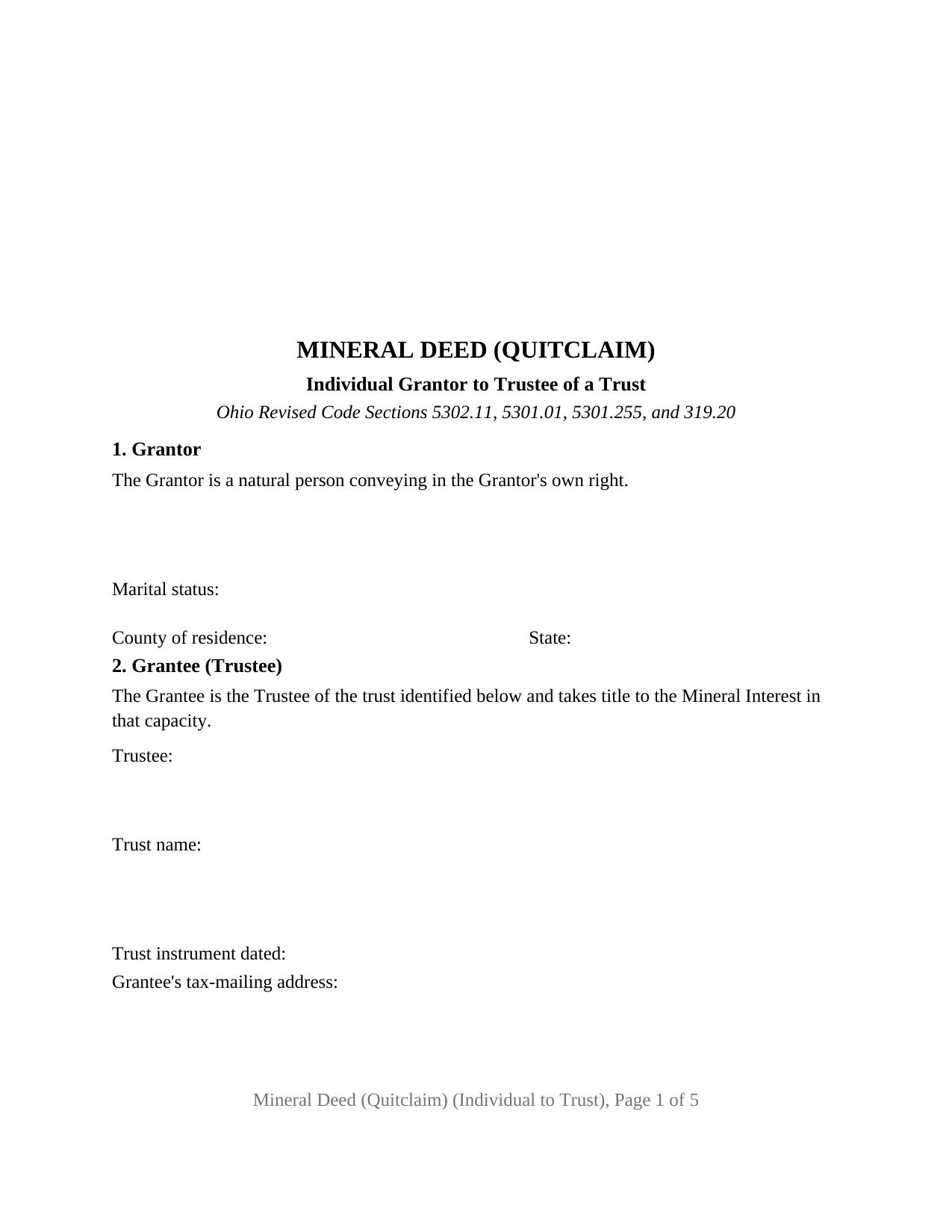
About the Ohio Mineral Deed (Quitclaim) (Individual to Trust)
How to Use This Form
- Select your county from the list
- Download the county-specific form
- Fill in the required information
- Have the document notarized if required
- Record with your county recorder's office
What Others Like You Are Saying
"Easy and fast. Was able to find the documents needed and saved so much money!!"
"It's been a difficult time during my divorce. Glad I was able to get the house related documents eas…"
"Im an out of state realtor, but couldnt believe how quick and easy the process was. Recieved my deed…"
"This site was very easy to use. Great direction on how to complete the form."
"So far everything ive had to do is very simple and easy. Thanks"
4.8/5 from 4,836 reviews. Read all
An Ohio mineral deed in quitclaim form moves whatever oil, gas, coal, or other mineral interest one person holds to a trustee, without any covenant of title and without touching the surface. This fillable form prepares that deed for a single natural-person grantor conveying to the trustee of a trust, drawn in substance on the quit-claim deed form in Ohio Revised Code Section 5302.11 and adapted for a mineral interest.
A mineral interest is land in Ohio
Ohio treats a severed mineral interest as real property: Section 5301.56 defines it as a fee interest in at least one mineral, absolute or fractional, and Section 5713.04 has the county auditor list minerals owned apart from the surface as a separate tax entry. Chapter 5302 prints no separate mineral deed, so this form takes the quitclaim form and makes the property conveyed the minerals and mineral rights under a described tract, with the appurtenant rights Section 5302.04 includes. The mineral description blank holds the interest the grantor actually owns, whether all minerals, oil and gas alone, or an undivided fraction.
Naming the trustee, not the trust
The grantee on this deed is a trustee, named in that capacity, with the trust's name and the date of its trust instrument. That is the shape Ohio's recording statutes expect: Section 5301.255, as amended effective June 16, 2026, requires a memorandum of trust to be of record whenever a trustee later conveys any interest in the real property, and Section 5301.071(E) treats a deed naming the trust itself as a deed to the trustee only where a complying memorandum of trust has been recorded. The trust may be revocable or irrevocable; the deed recites the trust's identity and not its terms.
One grantor, one spouse, two certificates
The form recites that the grantor is a natural person conveying in the grantor's own right, prints the marital status blank the statutory form carries, and follows the statutory release of dower sentence with a signature block and acknowledgment certificate for the grantor's spouse. Dower under Section 2103.02 reaches a fee mineral interest exactly as it reaches the surface, so a married grantor's spouse signs to release it, while an unmarried grantor leaves the spouse blank, the second signature block, and the second certificate empty. The form carries a separate Section 147.55(A) certificate for each signer, so the two may acknowledge on different dates or in different places. An owner of a severed shale interest funding a revocable living trust, a surface owner conveying only the minerals to a family trust, and an heir consolidating an inherited fraction into a trust present the single-grantor-to-trustee pattern this deed recites; a conveyance by two owners, a trustee, an attorney-in-fact, or an entity is not what this form is set up as.
A recorded deed is a title transaction
Under Section 5301.56(B)(3)(a), a mineral interest is not deemed abandoned to the surface owner if, within the twenty years before the surface owner's notice, the interest has been the subject of a title transaction recorded in the county, and Section 5301.47(F) names the quit claim deed among the transactions that qualify; the Supreme Court of Ohio read the term broadly in Chesapeake Exploration, L.L.C. v. Buell, 2015-Ohio-4551. A mineral deed recorded today is therefore also a savings event for the interest it conveys.
The auditor comes first
Section 317.22 keeps a conveyance of minerals or mineral rights out of the record until the county auditor has stamped it and endorsed it transferred or transfer not necessary. The deed goes to the auditor with a conveyance fee statement, DTE 100 where the fee applies or DTE 100EX where an exemption under Section 319.54(G)(3) applies; that section lists a transfer to the trustee of a trust whose grantor reserved an unlimited power to revoke it, a gift in trust between spouses or between parent and child, and a transfer for no consideration that is not a gift among the transfers on which no fee is charged. The recorder then records the deed, formatted to the Section 317.114 standards: a three inch blank top margin on page one, one inch sides and bottom, type no smaller than ten point.
The package includes the fillable mineral deed, a completed example filled in for a Belmont County fact pattern, and the guide that walks through every numbered section, the dower release, and the auditor transfer step. This description and the guide describe the form and the governing Ohio statutes in general terms; they are not legal advice.
Important: County-Specific Forms
Our mineral deed (quitclaim) (individual to trust) forms are specifically formatted for each of the 88 counties in Ohio.
After selecting your county, you'll receive forms that meet all local recording requirements, ensuring your documents will be accepted without delays or rejection fees.