Ohio Mineral Deed (Quitclaim) (Trustee to Entity)
County Specific Legal Forms Validated as recently as October 27, 2026 by our Forms Development Team
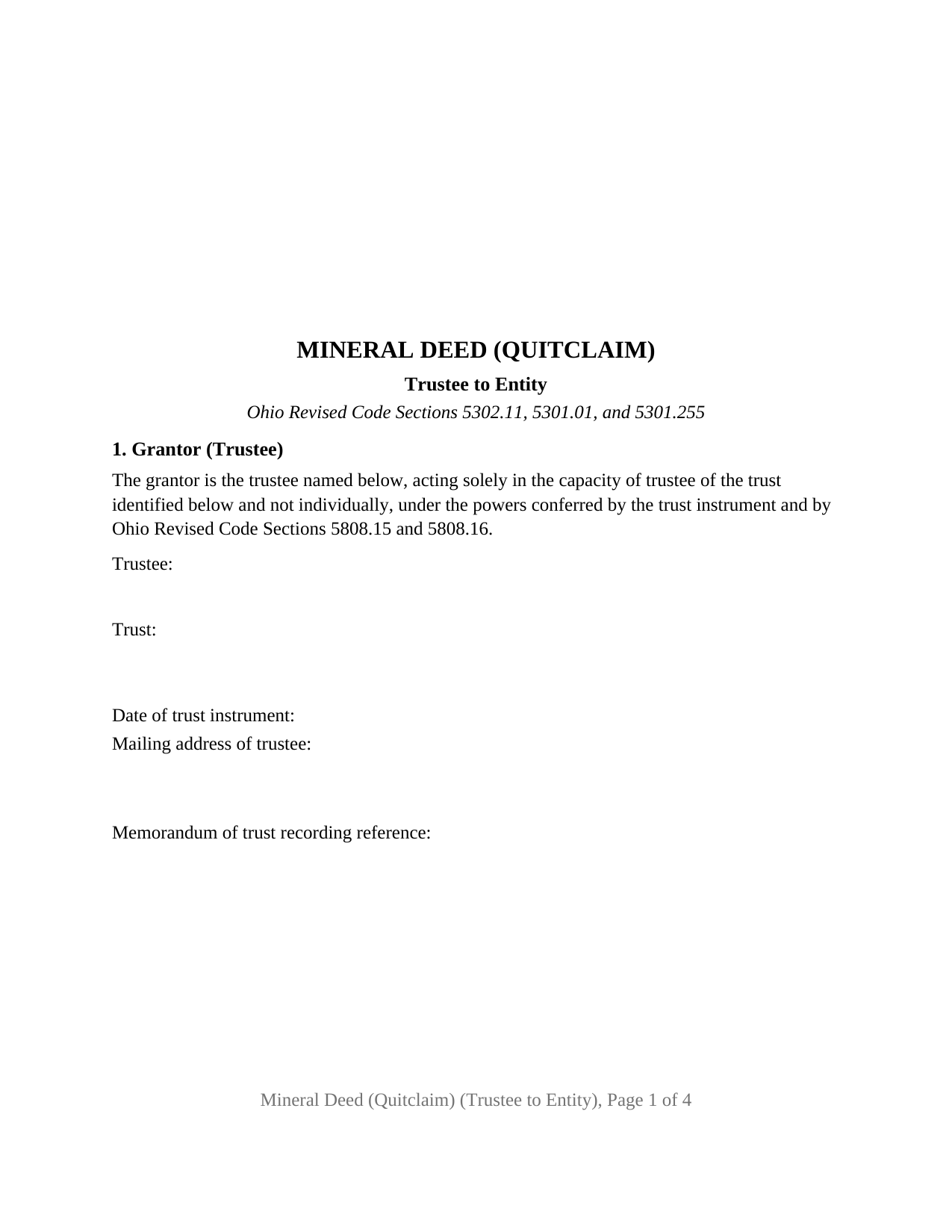
About the Ohio Mineral Deed (Quitclaim) (Trustee to Entity)
How to Use This Form
- Select your county from the list
- Download the county-specific form
- Fill in the required information
- Have the document notarized if required
- Record with your county recorder's office
What Others Like You Are Saying
"Fast turn-around, very efficient!!"
"Easy to use...very informative...ttook care of exactly what I was looking for."
"Fast and easy to use. Easy to print."
"I like the content and the availability to conduct valuable business online"
"Excellent documents, downloaded quick, completed and printed with no problems. Thank you"
4.8/5 from 4,836 reviews. Read all
This Ohio mineral deed is drawn for one transaction shape: the trustee of a trust conveying an interest in the oil, gas, and other minerals under Ohio land to a corporation, limited liability company, or other entity, by quitclaim. The deed conveys the mineral interest the trustee holds, as the trustee holds it, without covenants of any kind, and a recorded mineral deed is a title transaction under Section 5301.47(F) with a defined place in the Dormant Mineral Act's list of saving events in Section 5301.56(B)(3)(a).
A trustee's deed in the quit-claim form
Ohio Revised Code Section 5302.11 prints the statutory quit-claim deed form and gives a deed in substance following it the effect of a deed in fee simple to the grantee, but without covenants of any kind on the part of the grantor. A mineral deed is that form applied to an interest in the land rather than the whole fee. This deed keeps the statutory words, for valuable consideration paid and grants, and adds the one recital the statutory form does not print: that the grantor acts solely as trustee of the trust identified in the deed and not individually, under the powers the trust instrument confers and Sections 5808.15 and 5808.16 of the Ohio Trust Code supply.
The memorandum of trust of record
Since June 16, 2026, Section 5301.255 has provided that a memorandum of trust shall be of record when any interest in real property is conveyed by the trustee of a disclosed trust. The memorandum is a separate instrument stating the trustee's name and address, the trust's date, and its powers and restrictions over real property; it is recorded separately and is not included in this package. The deed's grantor section carries a blank for the memorandum's recording reference beside the trust's name and date, so the deed and the memorandum read together on the record.
Why no dower release appears
The statutory quit-claim form prints a line for the spouse of a married grantor to release dower under Section 2103.02. This deed prints no such line. The grantor conveys as trustee, holding legal title for the trust's beneficiaries, and Section 2103.021 provides that where trustee or as trustee follows the grantee's name in a recorded deed, a later conveyance by that grantee to a bona fide purchaser passes title free from the dower claims of the grantee's spouse unless the spouse recorded an affidavit of interest first and no other recorded instrument put persons dealing with the land on inquiry.
The configuration this deed recites
The deed recites exactly one grantor, a trustee acting for one disclosed trust, and exactly one grantee, an entity. It carries one signature block and one acknowledgment certificate in the Section 147.55(F) short form for a trustee, whose by-line takes the trustee's name and title of position; the grantee entity does not sign. The mineral interest section describes the minerals and the share conveyed, whether all of the minerals or an undivided fraction. A family trust selling a fractional royalty interest to a mineral-buying company, and a trust moving the minerals under its farm into a family limited liability company, present the pattern this deed recites. The form is not set up as a deed by co-trustees, as a deed by an individual grantor with a spouse's dower release, or as a deed to a trust or to an individual; each is a different recital and a different acknowledgment form under Section 147.55.
County auditor first, then the recorder
The auditor transfers mineral rights on the tax list under Section 319.20, reading the grantee's tax-mailing address and the prior instrument reference the deed carries, and receives the conveyance fee statement, DTE 100 or DTE 100EX, with the conveyance fee and any county transfer tax. Section 317.22 then bars the recorder from recording a conveyance of minerals until the auditor's stamps and transfer endorsement appear. The form reserves the three-inch first-page top margin Section 317.114 sets aside for those stamps and carries the preparer statement Section 317.111 requires.
The package includes the fillable form, a completed example filled in for a fictional trust conveying an undivided one-half mineral interest in Guernsey County to an Ohio limited liability company, and the guide that walks through every numbered section and the auditor and recorder steps. This description and the guide describe the form and the governing Ohio statutes in general terms; they are not legal advice.
Important: County-Specific Forms
Our mineral deed (quitclaim) (trustee to entity) forms are specifically formatted for each of the 88 counties in Ohio.
After selecting your county, you'll receive forms that meet all local recording requirements, ensuring your documents will be accepted without delays or rejection fees.