Ohio Mineral Deed (Quitclaim) (Entity to Entity)
County Specific Legal Forms Validated as recently as October 27, 2026 by our Forms Development Team
About the Ohio Mineral Deed (Quitclaim) (Entity to Entity)
How to Use This Form
- Select your county from the list
- Download the county-specific form
- Fill in the required information
- Have the document notarized if required
- Record with your county recorder's office
What Others Like You Are Saying
"Very Good Product. Provided a lot of good info to assist people to DIY various Deed"
"Very easy to use!"
"Thank you fine Deeds Company. I hope all goes well for you and all your team!"
"I was referred to your company, but when i tried to process the recording of a deed to a property in…"
"Forms I was looking for were easy to find, easy to download and accessible at any time in my account…"
4.8/5 from 4,836 reviews. Read all
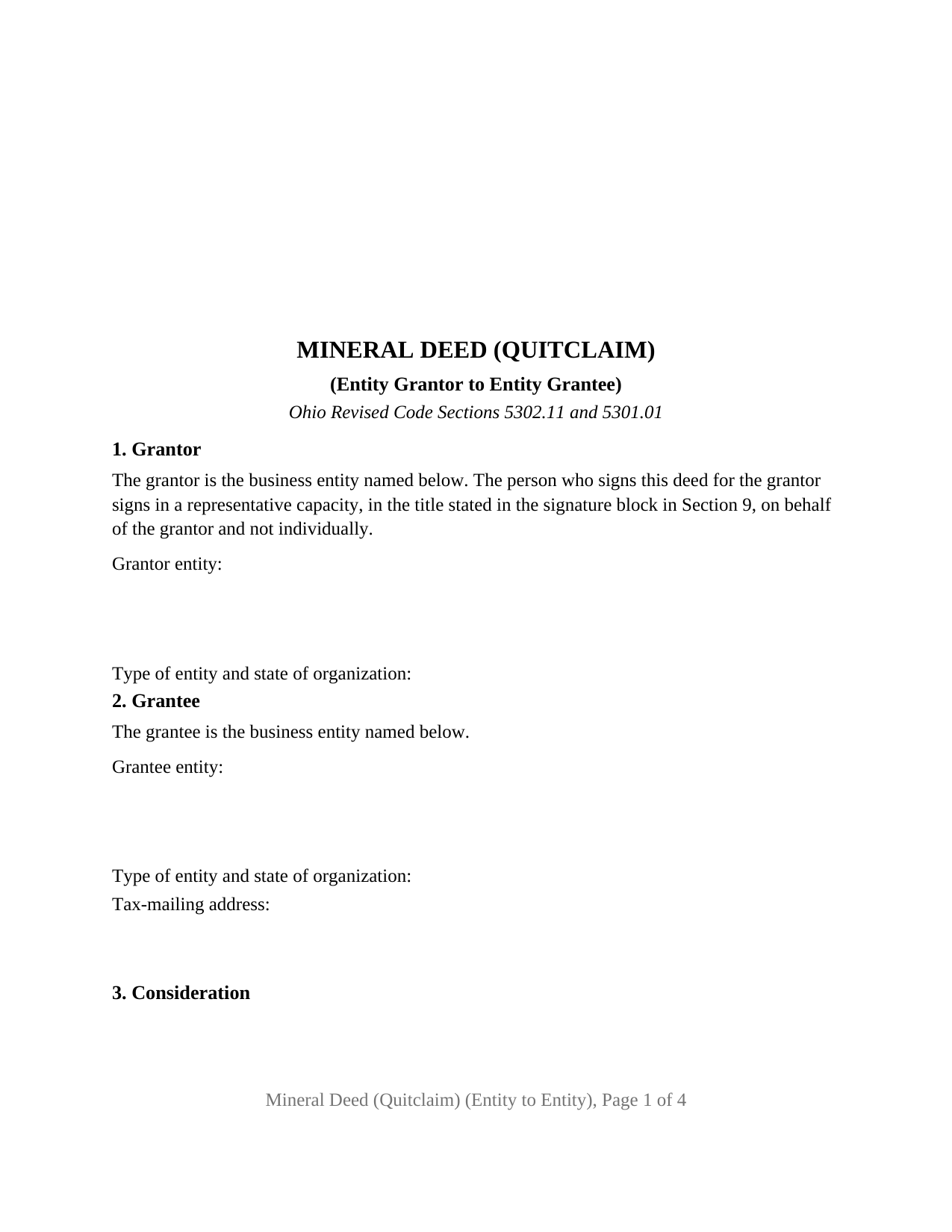
When an Ohio company transfers its oil, gas, or other mineral rights to another company, the deed is signed by a person who owns nothing in the minerals personally: an officer, manager, member, or partner acting for the entity. This Ohio Mineral Deed (Quitclaim) (Entity to Entity) is built around that fact. It names a business entity as grantor and as grantee, carries one signature block headed GRANTOR (by its authorized signer) with lines for the signer's printed name, date, and title, and carries one acknowledgment certificate whose by-line holds the representative wording Ohio's notarial short forms print for a corporation, a limited liability company, or a partnership.
A signature that belongs to the entity, not the signer
Section 5301.01 of the Ohio Revised Code requires a deed to be signed by the grantor and acknowledged before a notary public or another officer the section names. For an entity grantor, the deed's fixed text recites that the person signing signs in a representative capacity, in the title stated in the signature block, on behalf of the grantor and not individually. The deed prints no marital-status recital and no dower release, because the statutory quit-claim form prints those for a married individual and an entity has no spouse.
Every acknowledgment short form in Section 147.55 opens with the words The foregoing instrument was acknowledged before me this (date) by, and the forms for a corporation, a limited liability company, and a partnership differ only in what follows by. The certificate prints that shared opening, and the by-line carries the rest in the applicable pattern: the signer's name and title, the entity's name, its type and state of organization, and the words on behalf of the entity.
What a quitclaim mineral deed conveys in Ohio
Ohio has no separate statutory form for a mineral deed. This form applies the quit-claim deed form of Section 5302.11 to a mineral interest, using the form's own operative words: for valuable consideration paid, the grantor grants to the grantee, whose tax-mailing address is stated, the following real property. Section 5302.03 provides that the word grant implies no covenant, and Section 5302.11 gives the deed the effect of a fee simple conveyance without covenants of any kind on the part of the grantor. The grantee takes whatever mineral title the grantor holds, subject to the recorded leases, reservations, and easements the deed lists. The deed describes the Mineral Interest by the minerals it covers and the share of the grantor's interest it carries, describes the land by county, parcel number, and legal description, and cites the prior recorded instrument as Section 319.20 calls for.
Why recording a mineral deed matters twice
A recorded deed gives notice under Section 5301.25, which makes an unrecorded deed fraudulent as to a later bona fide purchaser without knowledge of it. For a severed mineral interest the record has a second role: Section 5301.56, Ohio's Dormant Mineral Act, lets a surface owner have a severed interest declared abandoned when none of the events the section lists occurred in the twenty years before the surface owner's notice, and the first listed event is a title transaction concerning the interest filed or recorded with the county recorder. A recorded mineral deed is such a transaction. Ohio recording runs through two offices: the county auditor first, with the DTE 100 conveyance fee statement, for the endorsement and transfer stamp Section 317.22 requires before a conveyance of minerals is recorded, and then the county recorder.
The entity-to-entity configuration
The form recites exactly one grantor entity and one grantee entity. A royalty company selling a mineral tract to an operator's land-holding affiliate, a family limited liability company passing its oil and gas rights to a successor company, and two corporations settling a mineral interest between them present the pattern this deed recites. It is not set up as a deed by an individual owner, which carries a marital-status recital and a dower release line; by a trustee, attorney-in-fact, or estate fiduciary, each of which carries a different capacity recital and acknowledgment form; or by two or more grantors or to two or more grantees.
The package includes the fillable mineral deed, a completed example filled in for a Carroll County fact pattern, and the guide that walks through every numbered section, the acknowledgment pattern for each entity type, and the auditor and recorder steps. This description and the guide describe the form and the governing Ohio statutes in general terms; they are not legal advice.
Important: County-Specific Forms
Our mineral deed (quitclaim) (entity to entity) forms are specifically formatted for each of the 88 counties in Ohio.
After selecting your county, you'll receive forms that meet all local recording requirements, ensuring your documents will be accepted without delays or rejection fees.