Ohio Mineral Deed (Quitclaim) (Two Individuals to Trust)
County Specific Legal Forms Validated as recently as October 27, 2026 by our Forms Development Team
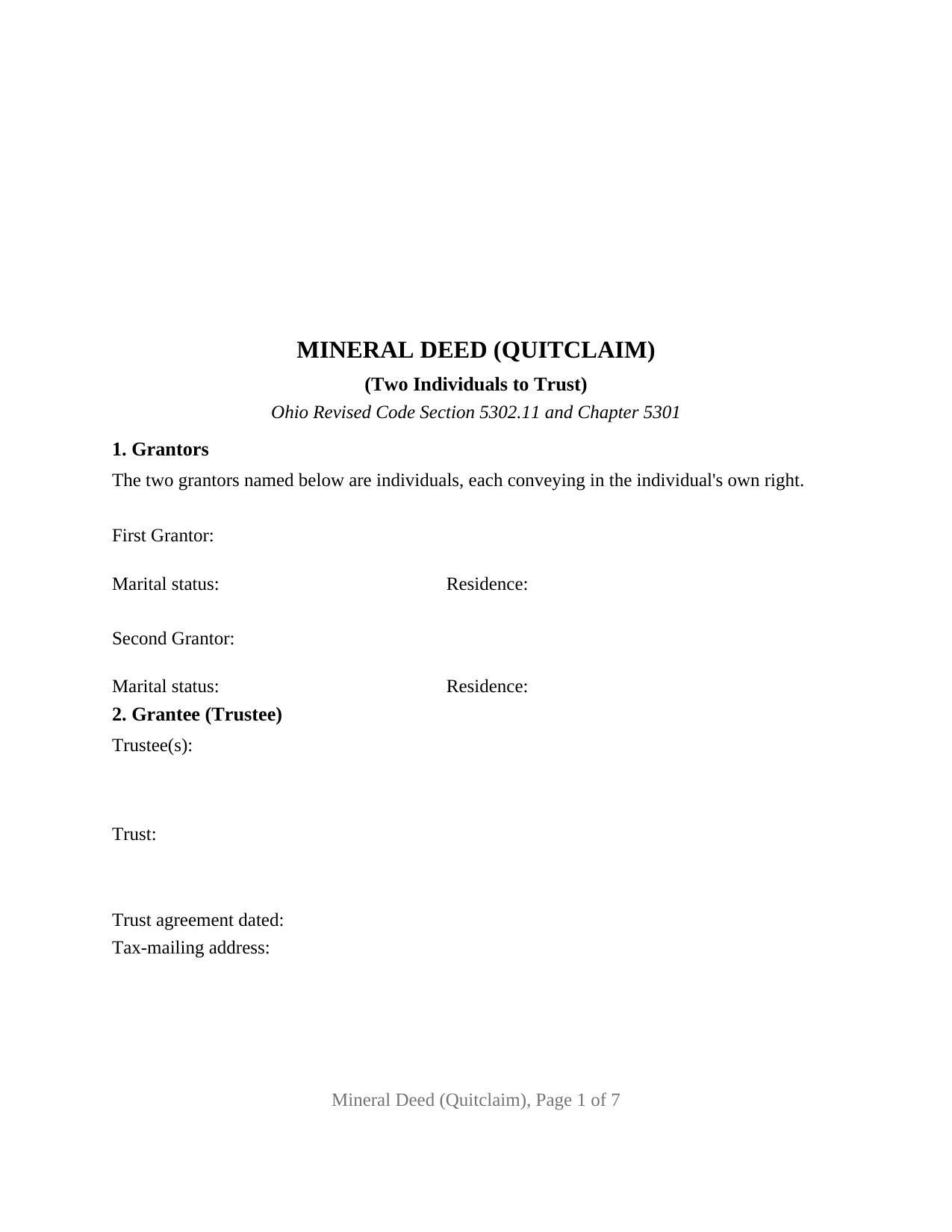
About the Ohio Mineral Deed (Quitclaim) (Two Individuals to Trust)
How to Use This Form
- Select your county from the list
- Download the county-specific form
- Fill in the required information
- Have the document notarized if required
- Record with your county recorder's office
What Others Like You Are Saying
"Very easy to use, responsive help when the document was initially rejected and very fast service (re…"
"Filling out forms was easy....so far, I am happy !"
"This Guys are accurate and FAST, Thanks Staff- KVH.!!!! you were awesome!!"
"User friendly!"
"Awesome service Recorded a deed within 24hrs and saved my self a 14hr+ journey"
4.8/5 from 4,836 reviews. Read all
This Ohio mineral deed conveys the oil, gas, and other mineral rights held by two individuals into a trust. Two grantors sign in their own right, the trustee of a named trust takes the minerals, and the deed is a quitclaim under Ohio Revised Code Section 5302.11, which means it passes exactly the mineral interest the two grantors hold and carries no covenants of any kind on their part.
Two grantors, one trustee, four possible signatures
The deed recites two natural-person grantors, each with a marital status and a county of residence entered as the statutory quitclaim form prints them, and one grantee: the trustee or co-trustees of a trust identified by name and by the date of the trust agreement, with the tax-mailing address Section 319.20 requires. Below the two grantor signature blocks the deed carries the Section 5302.11 release of dower twice, once for the spouse of each grantor, each sentence followed by that spouse's own signature block. Four acknowledgment certificates follow, one for each possible signer. The form is set up for exactly this pattern; a single grantor, three or more grantors, an entity or fiduciary grantor, or a conveyance of the surface along with the minerals follows a different pattern.
Why dower rides a mineral deed
A severed mineral interest is real property in Ohio, and Section 2103.02 gives a spouse a life estate in one third of the real property of which the other spouse was seized during the marriage. The quitclaim form in Section 5302.11 therefore prints a sentence by which the grantor's spouse releases all rights of dower, and Sections 5301.01 and 5301.04 call for that spouse to sign and acknowledge the deed. Two patterns present this configuration in the record. A married couple conveying inherited or reserved minerals into their joint revocable trust are each the other's spouse: each is named in the release sentence as the spouse of the other, each signs once as a grantor, and the spouse blocks stay empty. Two siblings consolidating inherited shares into a family mineral trust each have a spouse named in the release sentence who signs in the matching spouse block. The completed example shows the second pattern.
A quitclaim that still does title work
A mineral quitclaim conveys whatever the grantors hold, whether the entire mineral estate under a tract, an undivided fraction, or a share already subject to an oil and gas lease, and the encumbrances line carries the lease or reserved royalty the conveyance is subject to. Recording the deed is a title transaction under Section 5301.47(F), and under the Dormant Mineral Act, Section 5301.56(B)(3)(a), a mineral interest that has been the subject of a recorded title transaction within the preceding twenty years cannot be deemed abandoned in favor of the surface owner.
From the auditor to the recorder
Section 317.22 keeps a conveyance of minerals or mineral rights out of the record until the county auditor has stamped it and endorsed it transferred or transfer not necessary, so the deed goes to the auditor with the conveyance-fee statement before it goes to the recorder. Section 319.54(G)(3) charges no conveyance fee on a transfer to the trustee of a trust the grantor can revoke without limit, and on a transfer for no money consideration that is not a gift, so the exemption statement on form DTE 100EX commonly accompanies a deed into a revocable trust; the fee otherwise runs ten cents per hundred dollars of value plus any county transfer tax. The deed is formatted to Section 317.114, with the top three inches of the first page left blank for the county endorsements. The trustee who later conveys the minerals needs a memorandum of trust of record under Section 5301.255, as amended effective June 16, 2026; that memorandum is a separate instrument recorded separately and is not included in this package.
What the package includes
The package includes the fillable mineral deed, a completed example filled in for a brother and sister conveying Guernsey County mineral rights into their family trust, and the guide that walks through each of the six sections, the dower release, the auditor transfer step, and the recording rules. This description and the guide describe the form and the governing Ohio statutes in general terms; they are not legal advice.
Important: County-Specific Forms
Our mineral deed (quitclaim) (two individuals to trust) forms are specifically formatted for each of the 88 counties in Ohio.
After selecting your county, you'll receive forms that meet all local recording requirements, ensuring your documents will be accepted without delays or rejection fees.