Ohio Mineral Deed (Quitclaim) (Husband and Wife to Trust)
County Specific Legal Forms Validated as recently as October 27, 2026 by our Forms Development Team
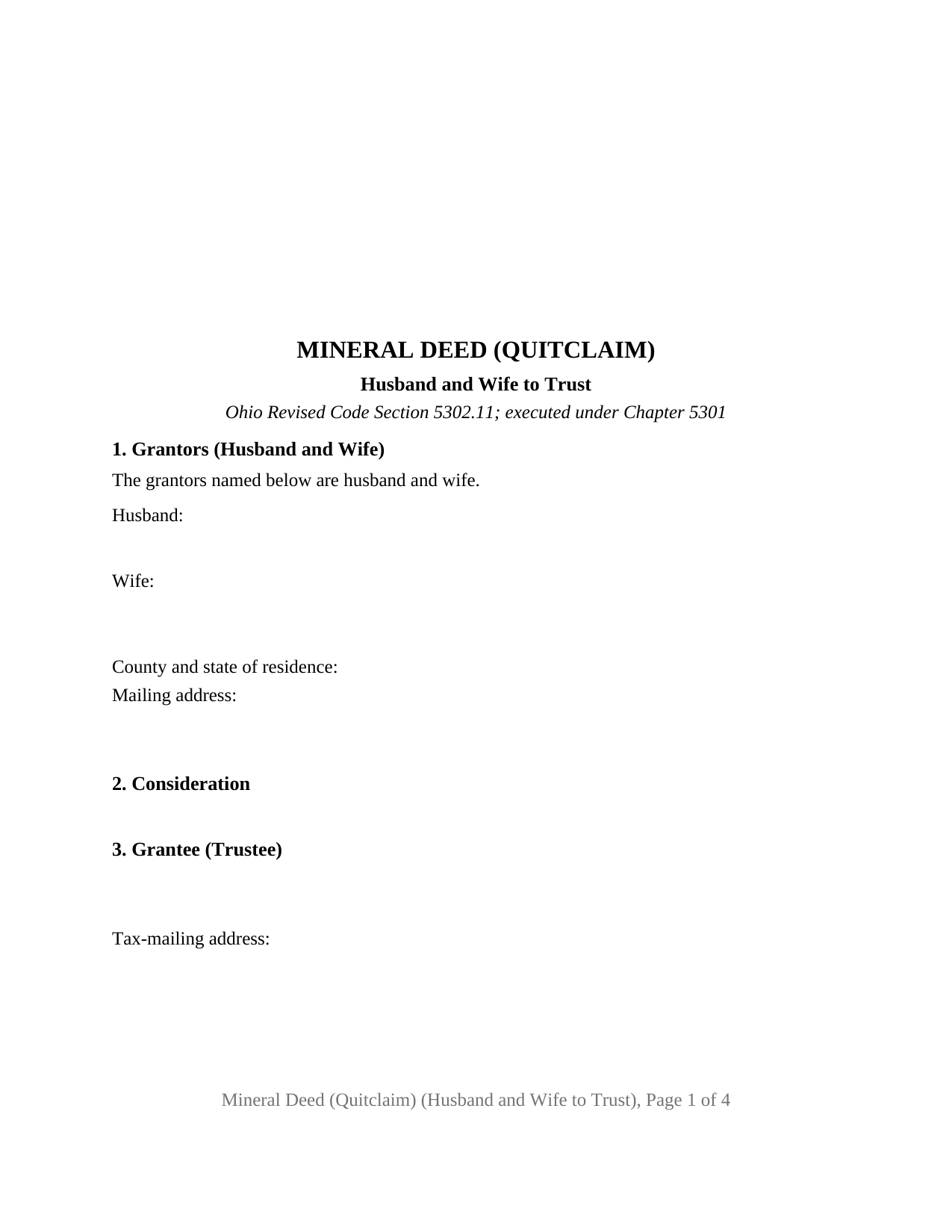
About the Ohio Mineral Deed (Quitclaim) (Husband and Wife to Trust)
How to Use This Form
- Select your county from the list
- Download the county-specific form
- Fill in the required information
- Have the document notarized if required
- Record with your county recorder's office
What Others Like You Are Saying
"Easy download, and super easy to fill out. Had them recorded Friday with zero issues. Recommended."
"Very easy to use, download and print. Thank you!"
"Over all quality of document was good. The issue I had was where it states claimant did not have a c…"
"The website made it very easy to navigate and order what I needed. Thank you."
"Application is not well laid out. I guess it does the job but leaves a lot to be desired. Hard to fo…"
4.8/5 from 4,836 reviews. Read all
This Ohio Mineral Deed (Quitclaim) is built for one configuration: a husband and wife who both sign as grantors, each releasing dower in the other's interest, and who convey their oil, gas, coal, or other mineral rights under described Ohio land to the trustee of a trust. The deed follows the quit-claim form of Ohio Revised Code Section 5302.11 in substance, so it conveys whatever mineral interest the spouses hold, without covenants of any kind on their part.
Two grantors and one mutual release of dower
Ohio keeps dower. Under Section 2103.02 each spouse holds a life interest in one third of the real property the other spouse owned in fee at any time during the marriage, and a severed mineral interest held in fee is real property under Section 5301.56(A)(3). The statutory quitclaim form carries a line by which the grantor's wife or husband releases all rights of dower, and this deed adapts it to the two-grantor pattern: a printed sentence in Section 7 has each grantor, being the wife or husband of the other grantor, release all rights of dower therein. Section 1 identifies the grantors as husband and wife as fixed text. Both spouses sign, and the form carries a separate acknowledgment certificate for each, in the Ohio short form of Section 147.55(A).
Minerals as real property with their own tax listing
Section 317.22 names conveyances of minerals or mineral rights among the instruments the county recorder will not record until the county auditor's stamp and transfer endorsement appear, and Section 5713.04 has the auditor list a severed mineral interest in its own entry and tax it to its own owner. Section 4 describes the mineral interest conveyed, whether all of the grantors' oil, gas, and other minerals or an undivided fraction, with the legal description of the surface tract, the county, and the parcel number; Section 5 carries the prior instrument reference Section 319.20 requires, and Section 6 lists the encumbrances, reservations, and exceptions the conveyance is subject to.
A trustee as grantee
The grantee is named by the trustee's name and the trust's name and date, as in the completed example, where two spouses convey to themselves as trustees of their revocable living trust. The deed vests the mineral interest in the trustee in that capacity and recites nothing about the trust's terms. Section 5301.255, as amended effective June 16, 2026, requires a memorandum of trust to be of record when the trustee later conveys any interest in the real property; the memorandum is a separate instrument, executed and acknowledged by the trustee, and is not included in this package.
The conveyance fee statement and the revocable trust exemption
Before recording, the county auditor receives the deed with a conveyance fee statement of value (DTE 100) or a statement of reason for exemption (DTE 100EX) under Section 319.202. Two exemptions in Section 319.54(G)(3) speak to this configuration: division (t) exempts a transfer to a trustee of a trust when the grantor of the trust has reserved an unlimited power to revoke it, and division (d) exempts a transfer evidencing a gift, in trust or otherwise, between husband and wife. Where neither applies, the state fee is ten cents per hundred dollars of value, plus any county transfer tax under Chapter 322.
What a quitclaim mineral deed conveys
Section 5302.11 gives a deed in its form the force and effect of a deed in fee simple to the grantee, but without covenants of any kind on the part of the grantor, so the trustee takes exactly the interest the spouses held, subject to any lease, reservation, or lien of record. One consequence is specific to minerals: under the Dormant Mineral Act, Section 5301.56, a severed mineral interest that has been the subject of a title transaction recorded in the county within the preceding twenty years is not one the surface owner can declare abandoned, and a recorded mineral deed is a title transaction of record. The deed is laid out to the Section 317.114 format rules, with the three inch blank top margin on the first page and type above the ten point minimum.
The package includes the fillable mineral deed form, a completed example filled in for a realistic Guernsey County fact pattern, and the guide that walks through every section, the dower and signing rules, and the auditor and recorder steps. This description and the guide describe the form and the governing Ohio statutes in general terms; they are not legal advice.
Important: County-Specific Forms
Our mineral deed (quitclaim) (husband and wife to trust) forms are specifically formatted for each of the 88 counties in Ohio.
After selecting your county, you'll receive forms that meet all local recording requirements, ensuring your documents will be accepted without delays or rejection fees.