Ohio Mineral Deed (Quitclaim)
County Specific Legal Forms Validated as recently as October 27, 2026 by our Forms Development Team
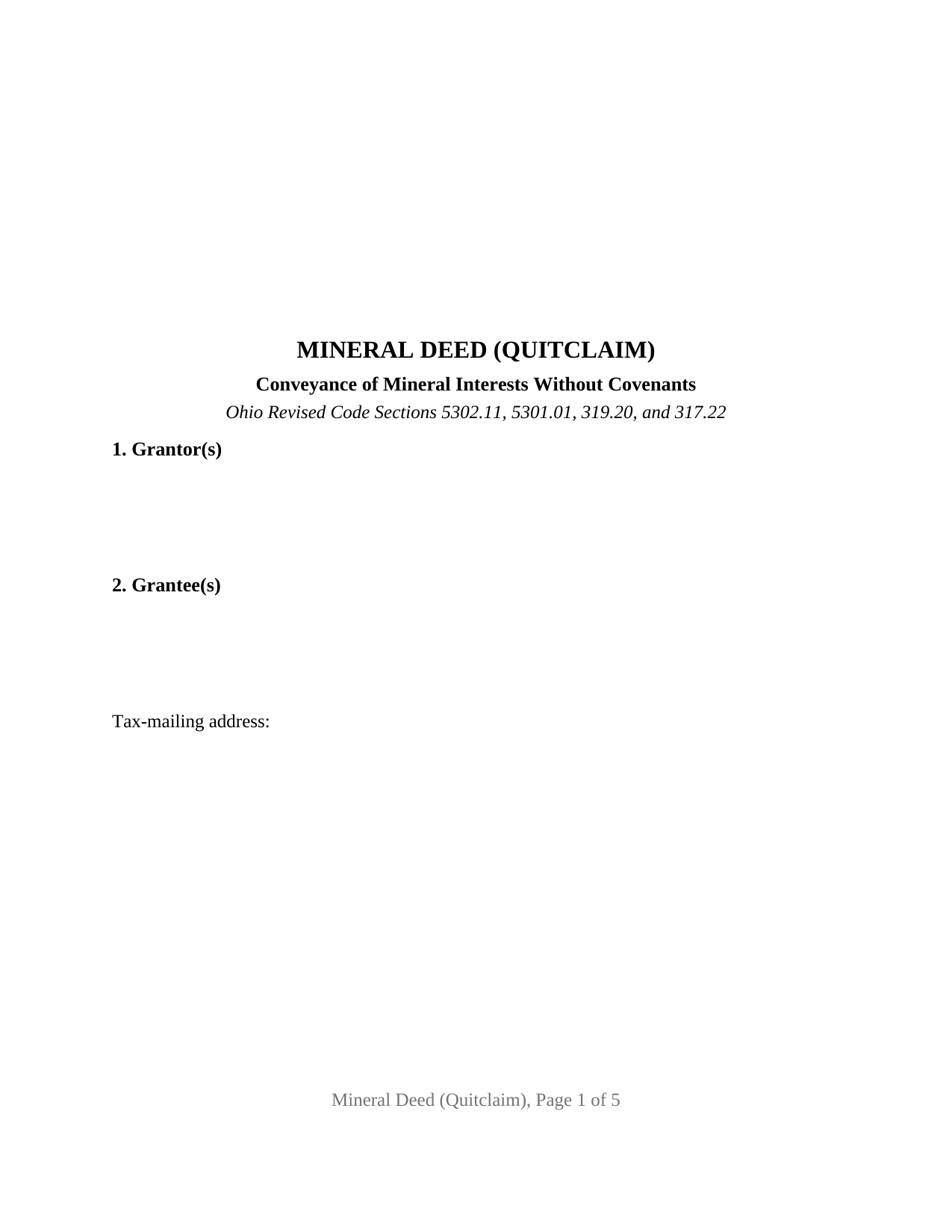
About the Ohio Mineral Deed (Quitclaim)
How to Use This Form
- Select your county from the list
- Download the county-specific form
- Fill in the required information
- Have the document notarized if required
- Record with your county recorder's office
What Others Like You Are Saying
"A little difficult in the beginning but with the messaging back and forth it was very simple and fas…"
"Wow! That was easy! I was expecting a more difficult process. Upload your docs and wait for a respon…"
"Excellent. Everything has gone well and the deed guide has helped so much. Thank you."
"Nice"
"I appreciate the very quick response that I received and I am very impressed with the access that yo…"
4.8/5 from 4,836 reviews. Read all
A severed mineral interest in Ohio passes by deed like any other interest in land, and the quitclaim form in Section 5302.11 of the Ohio Revised Code conveys it without a promise about what it is. This Ohio mineral deed (quitclaim) conveys the grantor's interest in the oil, gas, coal, and other minerals under a described tract, with the grantor's interest under any oil and gas lease covering it, without covenants of any kind. The form is built for one or two natural persons signing in their own right.
A conveyance of whatever the grantor holds
The statutory form uses the word grant, and Section 5302.03 provides that no covenant is implied from it. A deed in substance following the Section 5302.11 form, duly executed under Chapter 5301, has the force and effect of a deed in fee simple to the grantee, but without covenants of any kind. For mineral rights that is often the point: a fractional royalty inherited through three generations rarely comes with a title the holder is prepared to warrant. The deed defines the mineral interest in fixed text as all of the grantor's right, title, and interest in the minerals in, on, and under the land, with the rights and appurtenances belonging to it; a reservation of part of it goes in the encumbrances, reservations, and exceptions section.
Recording as a Dormant Mineral Act event
Ohio's Dormant Mineral Act, Section 5301.56, lets a surface owner have a severed mineral interest deemed abandoned and vested in the surface owner through a notice and affidavit procedure, unless a listed event occurred within the twenty years before the notice. The first listed event is that the mineral interest was the subject of a title transaction filed or recorded with the county recorder, and Section 5301.47(F) names the quit claim deed among its examples of a title transaction. A recorded mineral deed is therefore more than notice to later purchasers under Section 5301.25; it is an entry in the twenty-year record the act measures. The guide describes the act, its coal exception, and the separate tax listing of severed minerals.
Two signature blocks and the dower release
This configuration carries a free-form grantor block, two signature blocks headed GRANTOR and SECOND GRANTOR (if applicable), and two acknowledgment certificates in the Section 147.55(A) short form, one for each signer. The form fixes nothing about marital status or ownership; each grantor's name is followed by a marital status in the grantor block, and a single grantor leaves the second block blank. Ohio dower under Section 2103.02 reaches real property of which a spouse was seized as an estate of inheritance, and a mineral interest held in fee is such property, so a married grantor's spouse signs the deed to release dower. The deed carries that release as fixed text, and Section 5301.071(A) provides that a recorded conveyance is not defective for lack of a specific release where the spouse executed the instrument. A sole owner conveying alone, a married owner with a spouse releasing dower, and two siblings who inherited a severed interest present the one-or-two-signer pattern this deed recites. An entity, a trustee, an attorney-in-fact, or three or more owners present a different pattern.
Through the auditor before the recorder
A conveyance of minerals or mineral rights goes to the county auditor before it can be recorded. Section 319.202 requires the conveyance fee statement, form DTE 100, or the DTE 100EX statement of exemption for a transfer within Section 319.54(G)(3), and the auditor collects the state fee of ten cents per one hundred dollars of value plus any county permissive tax. Section 319.20 requires the grantee's tax-mailing address and a reference to the prior recorded instrument in the grantor's chain of title, which the deed carries in their statutory places, and Section 317.22 bars the recorder from recording the deed until the auditor's stamp and transfer endorsement appear. The deed is laid out to the Section 317.114 standard, with a three inch blank top margin on the first page and twelve point type, and execution follows Section 5301.01: the grantor signs and acknowledges before a notary public or another listed officer, with no witnesses.
The package includes the fillable mineral deed, a completed example prepared for a Belmont County fact pattern, and the guide that walks through each section, the dower release, the auditor's transfer step, and recording. The description and the guide describe the form and the governing Ohio statutes in general terms; they are not legal advice.
Important: County-Specific Forms
Our mineral deed (quitclaim) forms are specifically formatted for each of the 88 counties in Ohio.
After selecting your county, you'll receive forms that meet all local recording requirements, ensuring your documents will be accepted without delays or rejection fees.