Oklahoma Easement Deed
County Specific Legal Forms Validated as recently as September 28, 2026 by our Forms Development Team
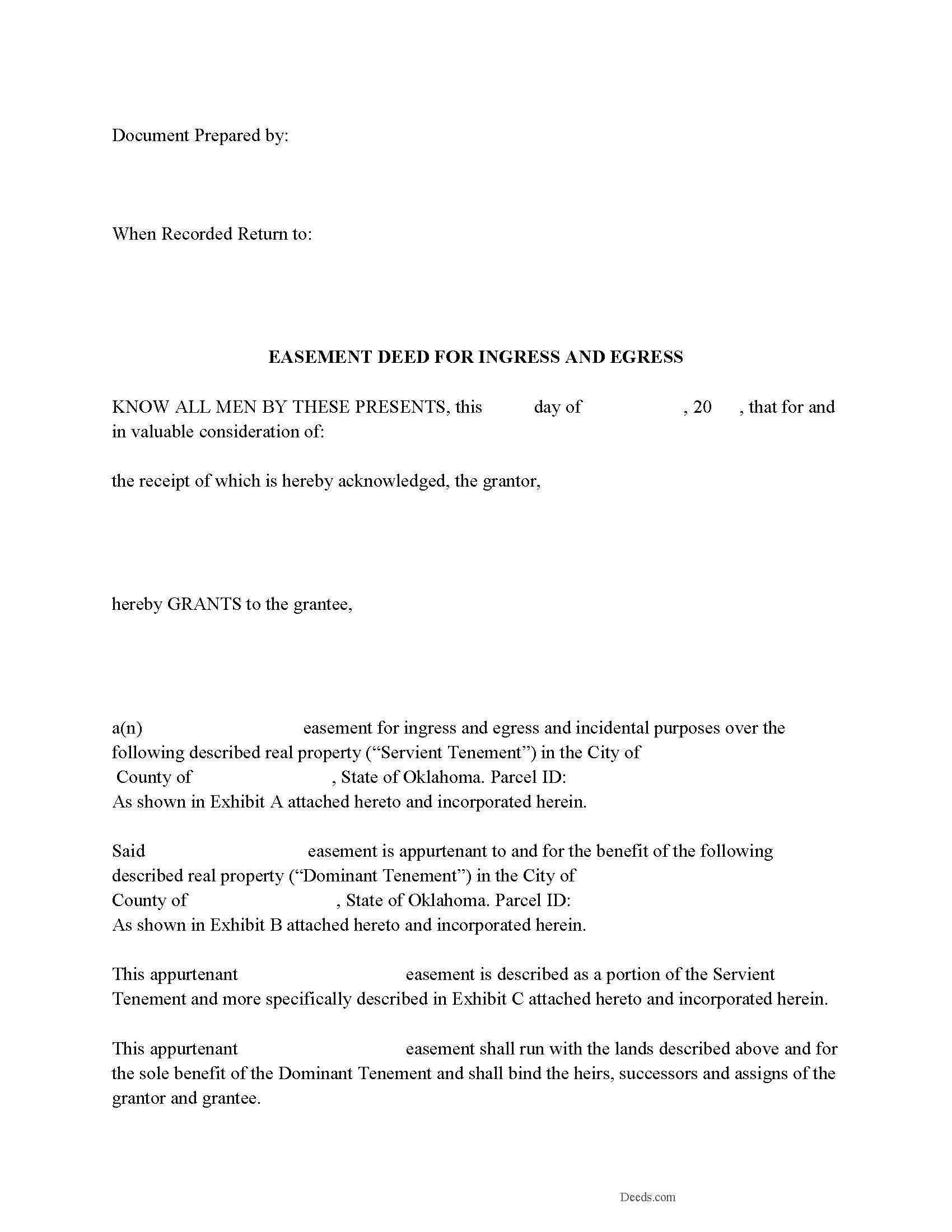
About the Oklahoma Easement Deed
How to Use This Form
- Select your county from the list
- Download the county-specific form
- Fill in the required information
- Have the document notarized if required
- Record with your county recorder's office
What Others Like You Are Saying
"I've never had a problem locating the records I need. I can't imagine what can be done to improve th…"
"The site is a good idea, however, I couldn't find what I needed with just the address alone. I was l…"
"had exactly what i needed and good price"
"Why is Dade County not listed for the Lady Bird Deed?"
"Deeds.com is a very Good company. They helped me when I needed the"
4.8/5 from 4,817 reviews. Read all
In order to operate, an easement needs a dominant estate and a servient tenement. The land that an easement is attached to is called the dominant estate, and the land upon which a burden or servitude is laid is called the servient tenement (60 51). A servitude can only be created by a person who has a vested estate in the servient tenement (60 52). Oklahoma statutes 60-49 lists land burdens or servitudes upon land which may be attached to other land as incidents or appurtenances, and are then called easements. Some land burdens or servitudes upon land may be granted and held, though not attached to land (60 50). A conservation easement is a non-possessory interest of a holder in real property imposing limitations or affirmative obligations for the purpose of retaining or protecting the natural, scenic, or open-space values of real property (60-49.2). This type of easement is created, conveyed, recorded, assigned, released, modified, terminated, or otherwise altered in the same manner as other easements in Oklahoma (60-49.3). The extent of an easement in Oklahoma is determined by the terms of the grant or the nature of enjoyment by which it was acquired (60 54). The easement deed is the specific instrument which creates the rights contained in an easement.
The recording of an easement deed that has not been properly and executed and acknowledged will not be effective for any purpose (16 26). In order for a county clerk in Oklahoma to receive an easement deed for recordation, it must be executed and acknowledged in compliance with Oklahoma statutory laws. An individual form for an acknowledgment is provided in 16-33 of the Oklahoma Statutes. Acknowledgments may be in substantially this form or one provided by the Uniform Law on Notarial Acts. Every acknowledgment must be under seal of the officer taking acknowledgments in order to be valid. In Oklahoma, acknowledgments can be made before a notary public, county clerk, clerk of a district or county court, or a county judge. Out-of-state acknowledgments can be made before any of the authorized officers listed in 16 35 of the Oklahoma Statutes.
No acknowledgment or recording is necessary to the validity of an easement deed as between the parties to the instrument. However, the deed will not be valid against third persons unless it has been acknowledged and recorded as provided by Oklahoma Statute (16 15). A properly acknowledged, certified, and recorded easement deed will serve as constructive notice of the contents thereof to subsequent purchasers, mortgagees, encumbrancers, or creditors from the time it is filed with the register of deeds for recording (16 16). Easement deeds are recorded in the office of the county recorder in the county where the property subject to the easement is located. If property is situated in more than one county and the deed has been recorded in either of such counties, a certified copy can be recorded in the other county, and will be as effective as if the original had been recorded (16 43).
(Oklahoma ED Package includes form, guidelines, and completed example)
Important: County-Specific Forms
Our easement deed forms are specifically formatted for each of the 77 counties in Oklahoma.
After selecting your county, you'll receive forms that meet all local recording requirements, ensuring your documents will be accepted without delays or rejection fees.