Oregon Quitclaim Deed (Married Couple as Grantors)
County Specific Legal Forms Validated as recently as October 9, 2026 by our Forms Development Team
About the Oregon Quitclaim Deed (Married Couple as Grantors)
How to Use This Form
- Select your county from the list
- Download the county-specific form
- Fill in the required information
- Have the document notarized if required
- Record with your county recorder's office
What Others Like You Are Saying
"Very Easy to use, especially since the county recorder's office is closed due to COVID-19"
"I have been researching for months to figure out how to remove deceased owner of property with right…"
"answeed many questions I had."
"Easy to use. Good information. Would use again."
"I have no complaints thank you."
4.8/5 from 4,828 reviews. Read all
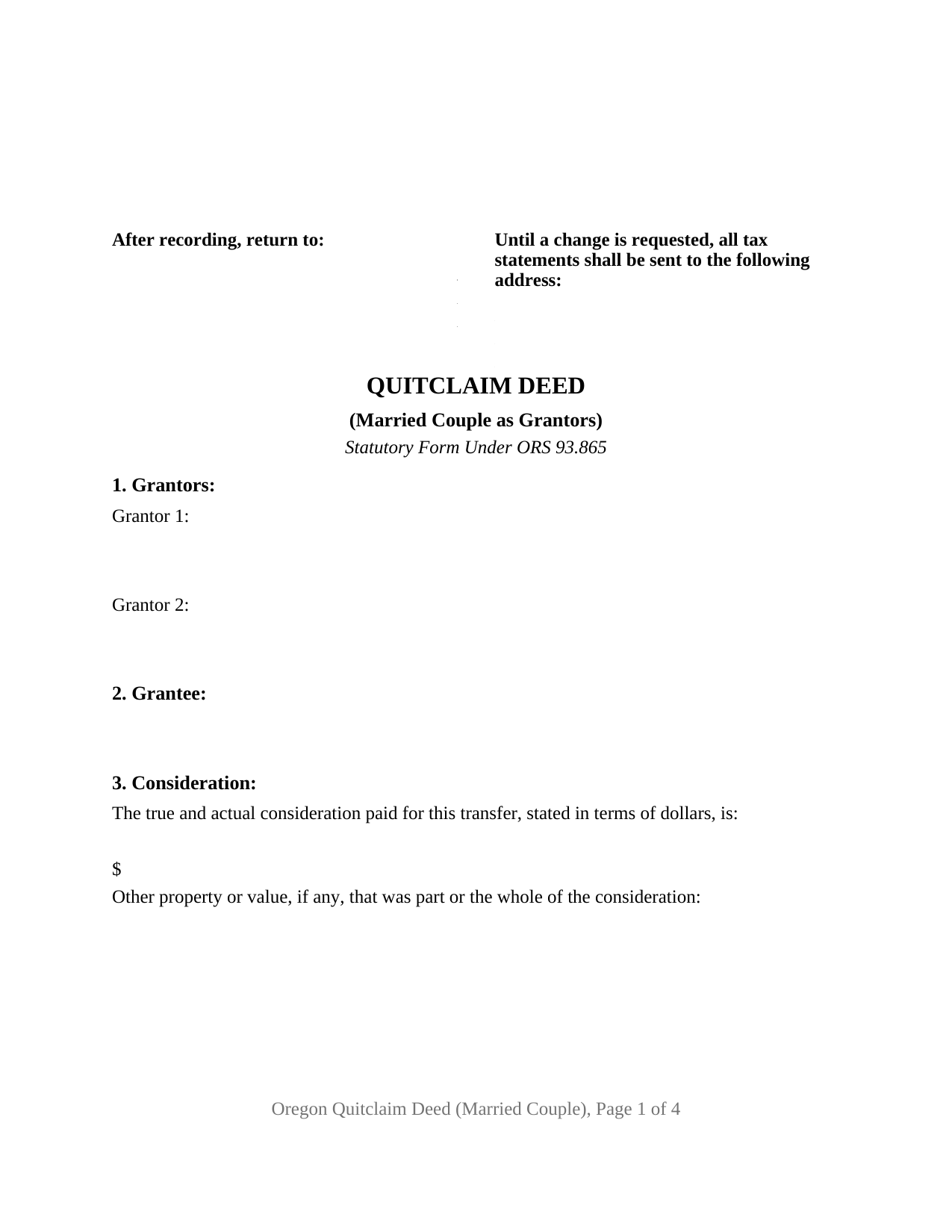
Two spouses, one Oregon deed: this quitclaim form carries a married couple as its grantors, so the release both of them sign reaches the whole estate the marriage holds, survivorship included. The form prepares an Oregon quitclaim deed under ORS 93.865 for exactly two grantors who are married to each other, and the package pairs the fillable PDF with a completed example and a plain language guide.
Why the marriage matters on the grantor side
Oregon gives spouses a co-ownership form of their own. Under ORS 93.180(1)(b), a conveyance to two grantees who are spouses married to each other vests title in them as tenants by the entirety unless the instrument clearly and expressly declares a different estate, so a married couple's Oregon land ordinarily carries survivorship between them. An entirety estate belongs to the two spouses together, and a release of the whole property in the record therefore shows both of them joining in one instrument. That is the architecture this deed recites: two grantors, identified as married to each other, releasing together, so the conveyance reaches the couple's entire holding, the survivorship between the spouses along with it, and whatever separate interest either spouse also holds in the described land.
The married couple configuration
The signature section carries two labeled signature blocks, one for each spouse, each with a printed name and date line, and the notary section follows with an acknowledgment certificate for each grantor in the ORS 194.285 short form, so the spouses may acknowledge on the same afternoon or on different dates, before different officers, in Oregon or elsewhere. Oregon law does not require separate certificates; the two certificate layout is how the form keeps each spouse's acknowledgment independent of the other's schedule. A married couple deeding property to an adult child, spouses conveying land to the trustee of the family's living trust, and a couple releasing a shared interest to resolve a title question with a neighboring owner present the pattern this deed recites. The form recites two grantors married to each other, each signing personally; a sole owner's release, co-owners with no marriage between them, and a signer acting in a trustee, personal representative, or attorney-in-fact capacity each follow a different pattern than this form carries. No signature exists beyond the two spouses: ORS 112.685 abolished dower and curtesy, and the couple themselves hold the title here.
A reach fixed by statute
The operative words, releases and quitclaims, come from the statutory form, and ORS 93.865 fixes what they accomplish: the deed conveys the title or interest, legal or equitable, that the grantors hold on the day of the deed, with no covenant of title, no estoppel, and nothing passing from later acquisitions. The face of the deed carries what Oregon recording law expects of a fee title conveyance, the ORS 93.030 consideration figure in dollars with the statutory other value alternative for gifts, the ORS 93.040 land use statement in current statutory wording, the ORS 93.260 tax statement address, and the ORS 205.234 first page items arranged beneath a reserve for the county's recording label.
From two signatures to the county record
Both spouses sign before a notarial officer; Oregon deeds take no subscribing witnesses, and no seal of any grantor is required. The finished deed is presented to the county clerk of the county where the land lies, and the form sits comfortably inside Oregon's format law, letter size at 12 point against the 8.5 by 14 inch and 10 point limits of ORS 205.232. Recording costs are county figures, reset in a number of counties on July 1, 2026 after 2025 legislation adjusted a component fee, and the deed is ordinarily the whole recording package: Oregon collects no statewide transfer tax, with the grandfathered Washington County levy of a dollar per thousand as the one county exception.
The download contains the fillable married couple quitclaim deed, a completed example filled in for a Lane County transfer from two spouses to their daughter, and a plain language guide to every numbered section, both certificates, and the county recording steps. The materials describe Oregon law in general terms and are not legal advice.
Important: County-Specific Forms
Our quitclaim deed (married couple as grantors) forms are specifically formatted for each of the 36 counties in Oregon.
After selecting your county, you'll receive forms that meet all local recording requirements, ensuring your documents will be accepted without delays or rejection fees.