Oregon Quitclaim Deed (Two Grantors)
County Specific Legal Forms Validated as recently as October 9, 2026 by our Forms Development Team
About the Oregon Quitclaim Deed (Two Grantors)
How to Use This Form
- Select your county from the list
- Download the county-specific form
- Fill in the required information
- Have the document notarized if required
- Record with your county recorder's office
What Others Like You Are Saying
"Love Deeds.com! I was a little confused as to how to go about Quitclaiming, but you made it very eas…"
"Very satisfied. In the middle of COVID19 I was able to complete important paperwork even though I wa…"
"A coworker recommended this service to me and I was hesitant to try it. Turned out to be a life save…"
"This is an Outstanding Website for easy access in expediting my property investment needs. Thank you…"
"Your instructions and sample are geared towards businesses. It would have been helpful to have inclu…"
4.8/5 from 4,833 reviews. Read all
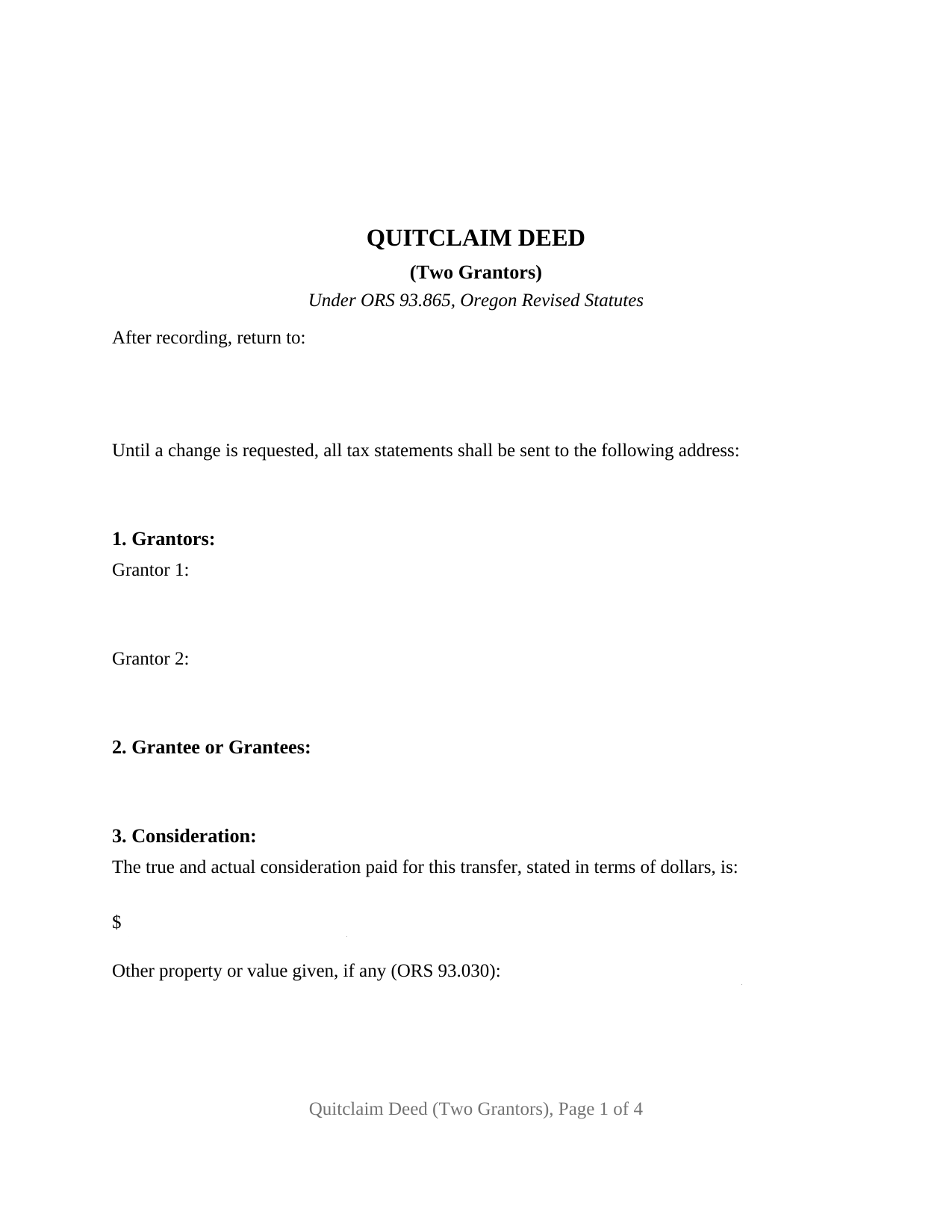
One Oregon quitclaim deed can carry two grantors: each owner releases whatever interest that owner holds in the property, the two releases travel in a single instrument, and the grantee takes both interests in one recording. This form prepares the two-grantor quitclaim deed under ORS 93.865 for Oregon real property, with a fillable PDF, a completed example, and a plain language guide.
Two releases in one instrument
The statutory quitclaim form at ORS 93.865, often typed as a quit claim deed, works through its operative words, releases and quitclaims, and this deed applies them for each of two grantors. What passes is exactly what each grantor holds at the date of the deed, legal or equitable, and nothing more: the quitclaim form comes with no title covenant, no after-acquired-title effect, and no estoppel. ORS 93.110 makes a quitclaim sufficient to pass every estate a grantor could lawfully convey, so where the two grantors together hold the whole title, the whole title moves, and ORS 93.865(3) preserves the grantee's ability to qualify as a good faith purchaser for value.
Two signature lines, two certificates
The form recites exactly two grantors, each signing in a personal capacity. The signature section carries two labeled signature blocks with printed names and dates, followed by two acknowledgment certificates in the ORS 194.285 short form, one for each grantor, so the two owners may sign on different dates, before different notaries, even in different states. Two co-owners passing their combined interests to a single buyer, two relatives releasing inherited fractional shares to one family member, and a pair of title holders moving shared property off the record together present the two-owner pattern this deed recites. The form is not set up for a sole owner's release, for three or more grantors, or for a signer acting as trustee, personal representative, or entity officer; each of those follows a different signature and capacity pattern than this form carries. A spouse who holds no title adds no signature: ORS 112.685 abolished dower and curtesy, and joinder in Oregon tracks the title itself.
The face of an Oregon deed
Oregon writes three requirements onto the deed itself, and the form builds each one in. The ORS 93.030 statement gives the true and actual consideration in dollars, and the county clerk has no authority to accept a fee title deed for recording without it. The ORS 93.040 land use and property rights statement prints in the body of the deed in the wording of the current statute. The ORS 93.260 sentence names the address where property tax statements go until a change is requested. The form also puts every ORS 205.234 first page item, both grantors' names and the consideration among them, on page one beneath a two inch reserve for the county recording label.
Recording with the county clerk
The finished deed records in the Oregon county where the land lies. Under ORS 93.640, Oregon's race notice statute, an unrecorded conveyance is void as against a later good faith purchaser for value whose deed reaches the record first, which is why a delivered deed ordinarily goes to the clerk promptly after signing. Format law caps pages at 8.5 by 14 inches with a 10 point minimum type size; this form is letter size at 12 point. County schedules control the cost, and several counties adjusted recording fees on July 1, 2026 under 2025 legislation, so the current amount appears on the recording county's published schedule. Oregon collects no statewide transfer tax, and local transfer taxes are barred with one grandfathered exception, a Washington County tax of a dollar per thousand of the selling price.
The purchase includes three items and nothing more: the fillable two-grantor deed, a completed example prepared for a Multnomah County transfer by two owners, and a plain language guide covering each numbered section, both acknowledgment certificates, and the recording steps. The materials describe Oregon law in general terms and are not legal advice.
Important: County-Specific Forms
Our quitclaim deed (two grantors) forms are specifically formatted for each of the 36 counties in Oregon.
After selecting your county, you'll receive forms that meet all local recording requirements, ensuring your documents will be accepted without delays or rejection fees.