Oregon Quitclaim Deed (Corrective)
County Specific Legal Forms Validated as recently as October 9, 2026 by our Forms Development Team
About the Oregon Quitclaim Deed (Corrective)
How to Use This Form
- Select your county from the list
- Download the county-specific form
- Fill in the required information
- Have the document notarized if required
- Record with your county recorder's office
What Others Like You Are Saying
"Awesome service. Quick and easy. Complete directions on how to complete the forms with examples for …"
"Our home was in only my husband’s name and as we are getting older, it was time to add my name to th…"
"A real boon to those of us who are not attorneys but wish to protect our assets and avoid probate co…"
"Looks good. We will see how it goes."
"Thorough, efficient, couldn't ask for better support. I refer everyone I know in real estate to use …"
4.8/5 from 4,833 reviews. Read all
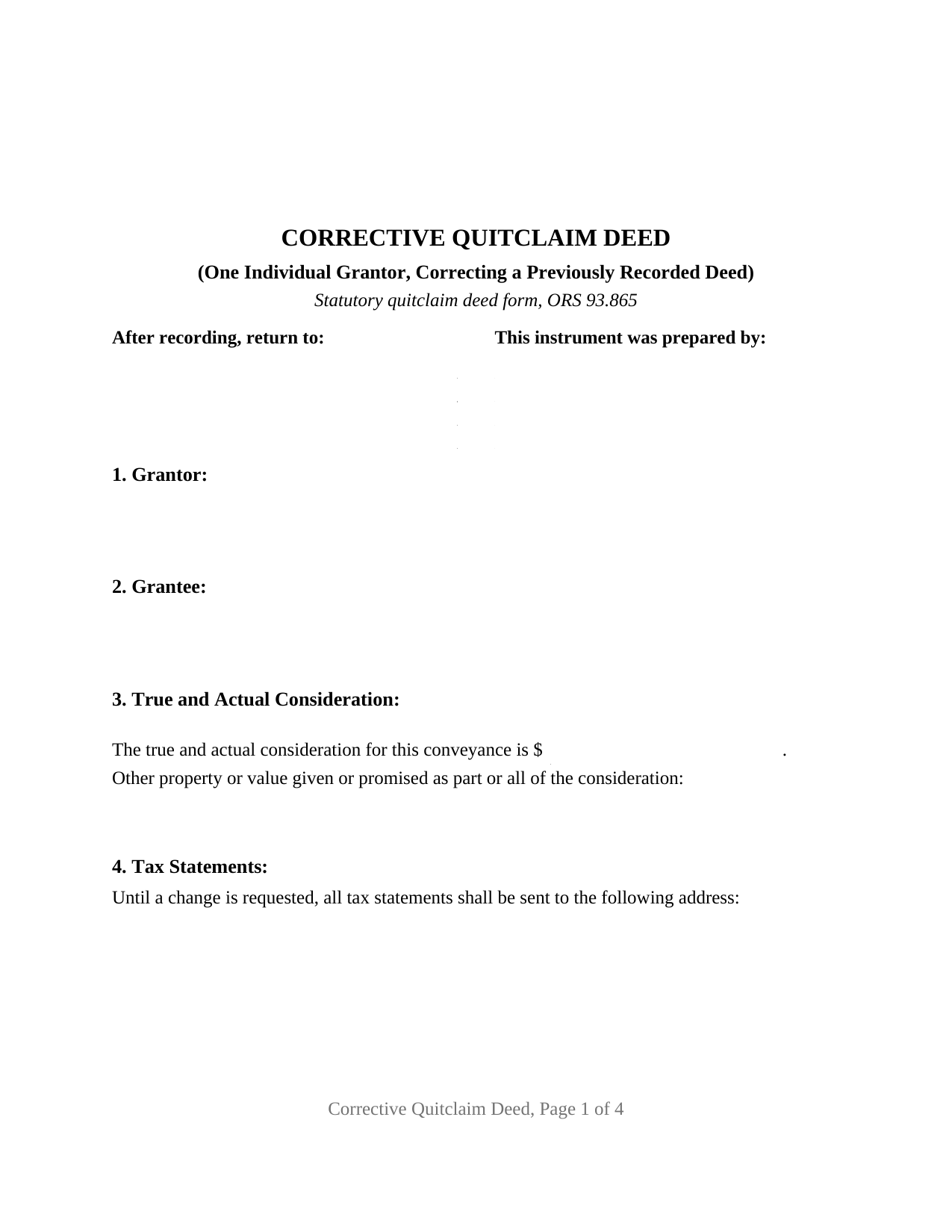
Oregon's records keep both deeds. A correction deed never lifts the earlier instrument out of the county index; it is a second deed, separately signed and separately acknowledged, that names the first one by its recording reference, states the particular being corrected, and releases the grantor's interest on the corrected terms. This corrective quitclaim deed is drawn for one individual grantor around Oregon's statutory quitclaim wording.
Two deeds, read together
Everything follows from that. A later title examiner finds both instruments indexed under the same names and the same property, so the worth of the second lies in how precisely it points backward. Section 5 identifies the earlier deed by title, date, county of recording, date of recording, and its instrument, fee, or book and page reference. Section 6 carries the correction in two parts, the statement as the earlier deed records it and the statement as corrected, so the pair reads without guesswork.
Oregon has no correction deed statute
Research for this form located no provision of the Oregon Revised Statutes that authorizes a corrective deed for conveyances, prescribes a form for one, or gives it a special effect. The single statutory correction instrument in the deed and mortgage records is ORS 86.722, reaching an error in the status or effect of a recorded trust deed. Correcting an ordinary conveyance therefore runs on general Oregon conveyancing law, which is why this instrument is built as a quitclaim deed that also identifies the earlier deed and states the change.
Two other routes exist for a deed gone wrong. ORS 205.244 allows a previously recorded instrument to be rerecorded to make corrections, under a rerecording certificate affixed to the first page or to an ORS 205.234(2) cover sheet, with no fresh acknowledgment; that certificate and cover sheet are prepared separately and are not part of this package. Reformation is the other, a court remedy and not a recording step, which Jensen v. Miller, 280 Or 225, 570 P2d 375 (1977), conditions on an antecedent agreement, a qualifying mistake, and no gross negligence.
What the corrective configuration recites
The form recites one individual grantor, the person who signed the earlier deed, signing personally, and one grantee, named as that deed named the grantee. The signature section carries a single signature line with printed name and date, then a single acknowledgment certificate in the ORS 194.285 short form. A grantee's surname misspelled in the recorded text, a plat reference copied incompletely from an older instrument, and a lot or block number transposed by a scrivener's error all present the single grantor pattern this deed recites. The form is not set up for two grantors, a company officer, a trustee, or an agent under a power of attorney, each of which states a different capacity and takes different certificate wording.
How far a second quit claim deed reaches
ORS 93.865(2) measures the operative words against what the grantor holds on the date of the correction, not the date of the deed being corrected. Whatever interest the grantor still holds passes, a later acquisition does not follow it, no estoppel arises, and no title covenant is given. That measure bites here as it does not elsewhere: where a corrected description reaches ground the earlier deed never described, this deed works as a present conveyance of what the grantor still holds there, and a grantor who has parted with everything conveys nothing. Interests recorded between the two deeds keep the priority ORS 93.640 gives them.
Face statements, then the same county counter
An Oregon fee title conveyance carries a dollar figure under ORS 93.030, with the statutory line for other property or value that a correction passing no new money commonly uses, the ORS 93.260 sentence directing tax statements, and the ORS 93.040 land use statement in capitals. The ORS 205.234 first page items sit under a two inch band held clear for the recording label. Filing goes to the clerk of the county that already holds the earlier deed. Charges are county figures, several reset on July 1, 2026 after 2025 legislation lifted the cap on the Public Land Corner Preservation fee, and the grandfathered Washington County transfer tax publishes exemption categories that include re-recording of documents.
The download holds the fillable corrective deed, a completed example prepared for a Klamath County correction of a misnamed grantee, and a plain language guide covering every numbered section, the certificate, and the recording steps. These materials describe Oregon law in general terms and are not legal advice.
Important: County-Specific Forms
Our quitclaim deed (corrective) forms are specifically formatted for each of the 36 counties in Oregon.
After selecting your county, you'll receive forms that meet all local recording requirements, ensuring your documents will be accepted without delays or rejection fees.