Oregon Quitclaim Deed (Divorce)
County Specific Legal Forms Validated as recently as October 9, 2026 by our Forms Development Team
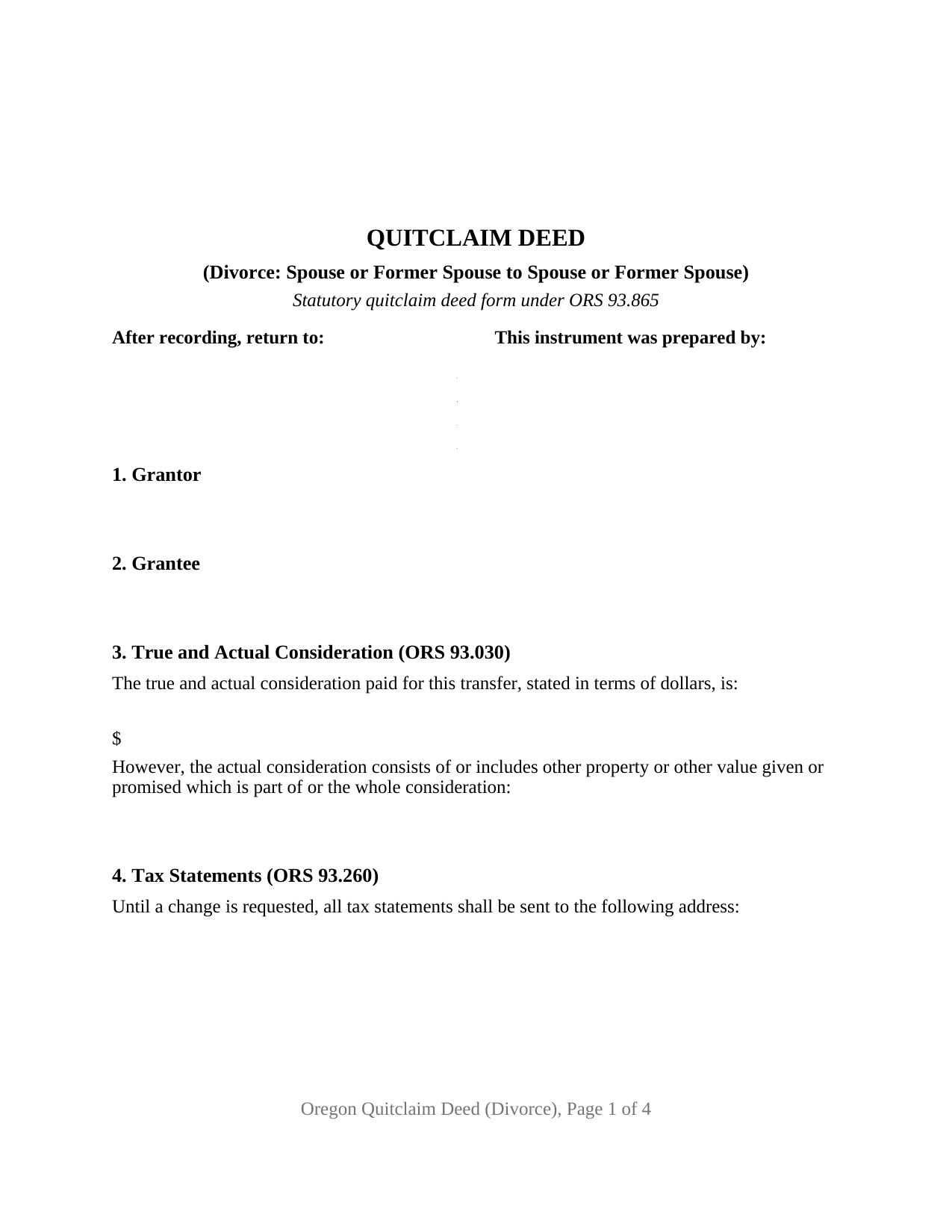
About the Oregon Quitclaim Deed (Divorce)
How to Use This Form
- Select your county from the list
- Download the county-specific form
- Fill in the required information
- Have the document notarized if required
- Record with your county recorder's office
What Others Like You Are Saying
"Very good service......"
"Locating the deed I needed was not too hard. I love that you can download and complete it on your ti…"
"Deeds.com recorded documents for me without any issue. It's a good service and provides a lot of ass…"
"The process was easy, and efficient. There was a person available to help if needed. Very pleased, w…"
"I LOVE that very concise directions and a sample completed deed were included. They were incredibly …"
4.8/5 from 4,833 reviews. Read all
A dissolution judgment can move Oregon land between the parties, and the county deed records will not hear about it. ORS 107.105(3) makes the property division effective for all purposes upon the filing of the judgment, while ORS 93.643 gives constructive notice of an interest in real property only through recordation in the county indices maintained under ORS 205.130, and through no other record. This form prepares the instrument that carries a division out of the court file and into the land records: an Oregon quitclaim deed under ORS 93.865, indexed in some counties as a quit claim deed, running from one spouse or former spouse to the other.
Two records, two audiences
The circuit court file settles matters between the parties. The land records answer a different question, put by a lender underwriting a refinance and by a buyer's title company: who owns this parcel of record. That search runs through the grantor and grantee indexes of ORS 205.160, under the names of the people who signed, and ORS 93.640 measures priority from the filing. Oregon does admit the judgment itself, since ORS 93.680(1)(b) lists judgments of courts in this state requiring the execution of a conveyance of real estate among the instruments entitled to be recorded in the record of deeds; a certified copy comes from the court and is recorded separately from this package. A deed reaches the same shelf under the parties' own names.
The divorce configuration
One party signs, and Section 7 is where this form parts company with an ordinary release: it takes the court, the case number, the judgment or order, and the date of entry, so the recorded deed and the court file can be read against each other. Where the deed is signed at the settlement stage before anything is entered, that blank reads None entered. Section 8 releases all right, title and interest of the grantor and names what a marriage leaves behind in the record: any right of survivorship, and any contingent or expectant interest, the interests ORS 107.131 contemplates when a judgment requires conveyance or release to effectuate a division of assets. The grantee takes under the deed and signs nothing, so the signature area carries one block and one certificate in the individual short form of ORS 194.285. A party awarded the residence who wants the record to show it before a refinance, a party signing while the case is still open, and an old vesting that surfaces years afterward when the property goes on the market all present the single signer pattern this deed recites. Two grantors signing together, an agent under a power of attorney, a trustee, a personal representative, and an entity officer each state a different capacity and take certificate wording this form does not draw.
What the release reaches, and what it leaves behind
ORS 93.865(2) measures the operative words against the grantor's actual holding on the date of the deed: legal or equitable title passes, nothing acquired afterward follows it, no estoppel arises, and no covenant of title is given. Where the parties held as tenants by the entirety, the estate ORS 93.180(1)(b) creates for two grantees married to each other, the survivorship travels with the release. Debt does not travel at all. A trust deed, a judgment lien and a recorded easement outlive the transfer, and the promissory note stays where it was, which is why a refinance and a deed are two separate errands.
Consideration, statements, and the county counter
The dollar figure ORS 93.030 calls for sits on page one beside the statutory alternative line for other property or value, which a property division commonly uses; the ORS 93.260 sentence routes the annual tax statement; and the ORS 93.040 land use and property rights statements print in capitals in the body. Charges are county figures, a number of them reset on July 1, 2026 after Oregon Laws 2025 chapter 98 removed the ceiling on the Public Land Corner Preservation fee. No transfer tax reaches an Oregon deed statewide, and in Washington County, home of the one grandfathered levy, the published exemption categories reach transfers ordered in a dissolution.
Three files arrive with the purchase: the fillable divorce quitclaim deed, an example filled in for a Josephine County release following a general judgment of dissolution, and a guide walking each numbered section, the certificate, and the trip to the clerk. These materials describe Oregon law in general terms and are not legal advice.
Important: County-Specific Forms
Our quitclaim deed (divorce) forms are specifically formatted for each of the 36 counties in Oregon.
After selecting your county, you'll receive forms that meet all local recording requirements, ensuring your documents will be accepted without delays or rejection fees.