Oregon Quitclaim Deed (Individual Grantor)
County Specific Legal Forms Validated as recently as October 9, 2026 by our Forms Development Team
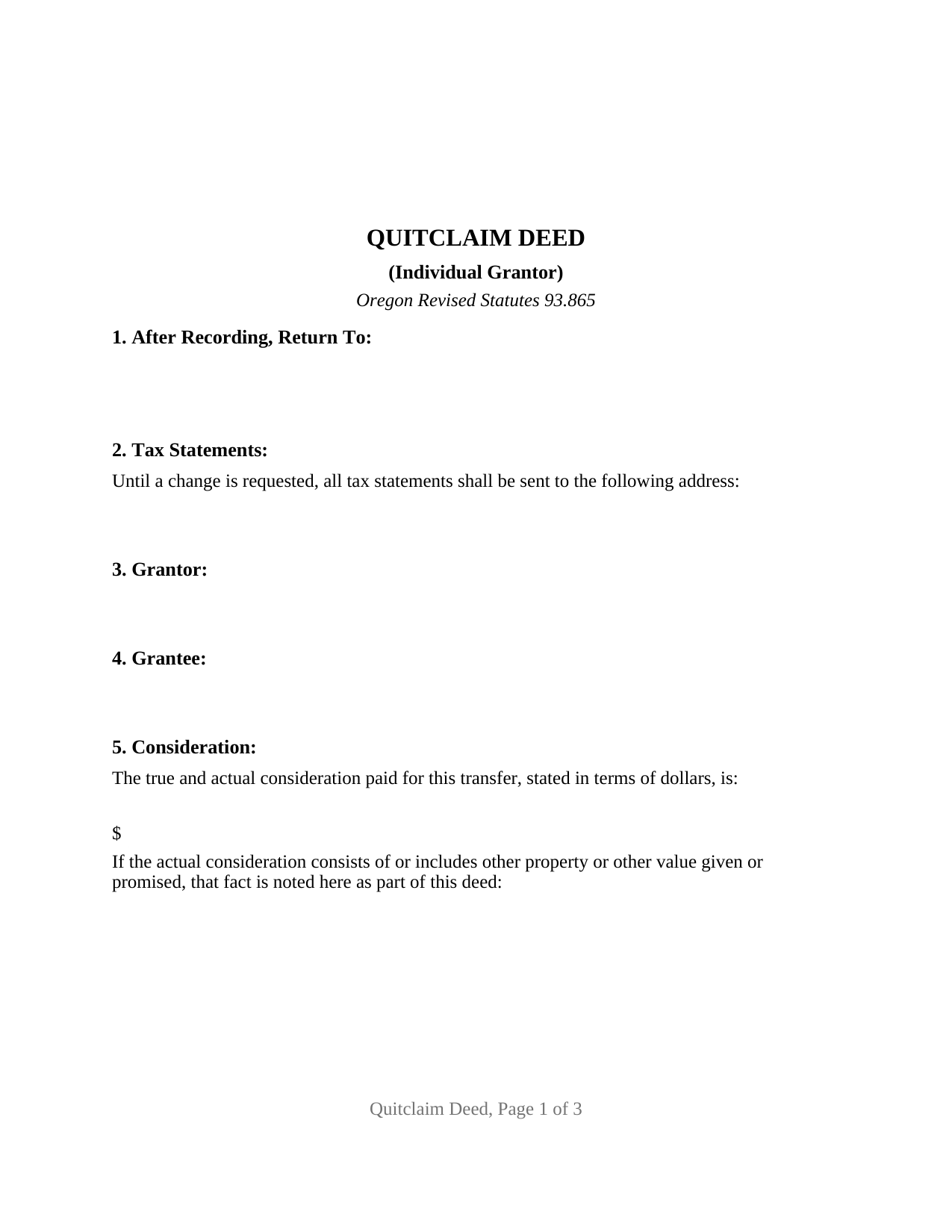
About the Oregon Quitclaim Deed (Individual Grantor)
How to Use This Form
- Select your county from the list
- Download the county-specific form
- Fill in the required information
- Have the document notarized if required
- Record with your county recorder's office
What Others Like You Are Saying
"Not difficult at all! Which is great for me..."
"Very fast and easy to use!"
"Great process and very easy to complete"
"I found exactly the perfect forms that I needed with Deeds, and much more. I definitely will be usin…"
"Outstanding. There is nothing worse than finding the correct forms or having to hire an atty to do w…"
4.8/5 from 4,828 reviews. Read all
One person signs this deed, and the deed says so. An Oregon quitclaim deed, or quit claim deed, signed by a single individual carries one signature line and one notary acknowledgment, and this form fixes that configuration in the instrument: the grantor is recited as an individual signing personally, and the release moves whatever interest that one grantor holds in Oregon real property under ORS 93.865.
A recital that fixes who is signing
Oregon indexes a recorded deed under the names of its parties, through the grantor and grantee indexes of ORS 205.160, and an examiner reads the instrument for the signer's capacity. Section 9 answers in a printed sentence ahead of the operative words: the Grantor is an individual who signs this deed personally and not in a representative capacity. The sentence recites the configuration the form carries; the record shows the title. The signature block is headed GRANTOR, the certificate is the ORS 194.285(1) individual capacity short form, and nothing on the sheet invites a second signer.
The individual grantor configuration
The form recites exactly one grantor, named in Section 3 and signing in Section 10. Section 4 is a free form grantee block for one grantee, or for two or more with the designation they select; ORS 93.180(1)(a) reads a deed to two or more persons as a tenancy in common unless survivorship is clearly and expressly declared, and ORS 93.180(1)(b) vests two grantees married to each other by the entirety unless the deed says otherwise. A co-owner releasing an undivided half to the other co-owner when a shared purchase ends, an owner deeding a rental house to the company formed to hold it, and an heir releasing an inherited fraction to the relative who lives in the property all present the single individual signer this deed recites. Two owners signing together, an entity conveying through an officer or member, a trustee or personal representative, and an agent under a power of attorney each state a different capacity and take the ORS 194.285(2) representative capacity certificate, which this form does not draw.
What releases and quitclaims carries
ORS 93.865(2) fixes what the operative pair accomplishes: the deed conveys whatever title or interest, legal or equitable, the grantor has at the date of the deed, transfers no later acquired title, and does not operate as an estoppel. The instrument restates that effect and adds that it carries no covenant or warranty of title. ORS 93.110 lets the words pass every estate the grantor could lawfully convey, and ORS 93.865(3) keeps a grantee taking by quitclaim eligible as a good faith purchaser for value. Liens and easements of record remain on the land after the release.
Face statements and a first page built to statute
The form prints the three statements Oregon writes onto a conveyance of fee title: the ORS 93.030 consideration in dollars, with a second line for the notation that other property or value made up part or all of it; the ORS 93.260 sentence naming where property tax statements go; and the ORS 93.040 land use and property rights statement in capital letters, in the wording that reflects Oregon Laws 2025 chapter 209. ORS 205.234 names what the first page of a recorded instrument carries, and the return address, tax statement address, party names, and consideration all sit on page one beneath the top two inches left clear for the recording label, on a letter sheet at twelve point within the limits of ORS 205.232.
Signing and recording
Under ORS 93.410 the grantor signs and acknowledges the deed before a qualified officer; no witness signs, and no seal is required. The venue line records where the acknowledgment was taken, which may be outside Oregon, since ORS 194.260 gives an act before another state's officer the same effect. The deed then goes to the clerk of the county where the land lies, and under ORS 93.640 an unrecorded conveyance is void against a later good faith purchaser for value whose deed is first filed. Fees are county figures, several reset on July 1, 2026 under Oregon Laws 2025 chapter 98, and the grandfathered Washington County transfer tax is the one local levy ORS 306.815 leaves standing.
The download delivers the fillable quitclaim deed, a completed example filled in for a Multnomah County conveyance from one individual to one grantee, and a guide to every section, the certificate, and the recording steps. The materials describe Oregon law in general terms and are not legal advice.
Important: County-Specific Forms
Our quitclaim deed (individual grantor) forms are specifically formatted for each of the 36 counties in Oregon.
After selecting your county, you'll receive forms that meet all local recording requirements, ensuring your documents will be accepted without delays or rejection fees.