Oregon Quitclaim Deed (Married Grantor with Non-Owner Spouse Joinder)
County Specific Legal Forms Validated as recently as October 9, 2026 by our Forms Development Team
About the Oregon Quitclaim Deed (Married Grantor with Non-Owner Spouse Joinder)
How to Use This Form
- Select your county from the list
- Download the county-specific form
- Fill in the required information
- Have the document notarized if required
- Record with your county recorder's office
What Others Like You Are Saying
"Fast and easy and saved me $240. What's not to like? Five stars."
"Awesome service Recorded a deed within 24hrs and saved my self a 14hr+ journey"
"Worked exactly like it was supposed to. No glitches"
"Excellent and timely responses. Do you offer an annual rate? Thank you."
"easy to use and understand forms. saved completed on my computer with no issues, even emailed them t…"
4.8/5 from 4,828 reviews. Read all
Only one spouse is on title, and both spouses sign. That is the architecture of this Oregon quitclaim deed: the record owner releases and quitclaims the property under ORS 93.865, and the person married to that owner, who holds no record title at all, signs the same instrument to give up whatever claim that spouse might have in it.
A signature Oregon law does not ask for
Oregon gives a spouse who is not on title remarkably little to sign away. Dower and curtesy, inchoate versions included, are abolished by ORS 112.685. Oregon runs no community property regime, so marriage does not convert one spouse's separately held land into shared property. And no located Oregon statute conditions the recording of a lifetime deed on the signature of a spouse holding no record interest, homestead or not; ORS 18.395 shields a homestead from creditors, not from a deed.
The signature gets asked for anyway, by the people who examine title rather than by the legislature. A title company that finds a married owner on a vesting deed can except the possible interest of that spouse, and a purchaser or lender may want the question answered inside the instrument. This form answers it there, on its own signature line and under its own certificate.
What the joining spouse actually releases
The joinder is not a consent or an approval. It is a second quitclaim. Section 8 has the joining spouse release and quitclaim all right, title, interest and claim of that spouse, if any, including any claim arising from the marriage. ORS 93.865(2) fixes what those words accomplish: whatever title or interest, legal or equitable, a signer holds at the date of the deed passes, nothing acquired afterward passes, no estoppel arises, and no warranty of title is given. Where the joining spouse holds nothing, nothing moves and the record shows the release. Where that spouse does hold something, the release reaches it with no need to describe or value it.
One record owner, one joining spouse
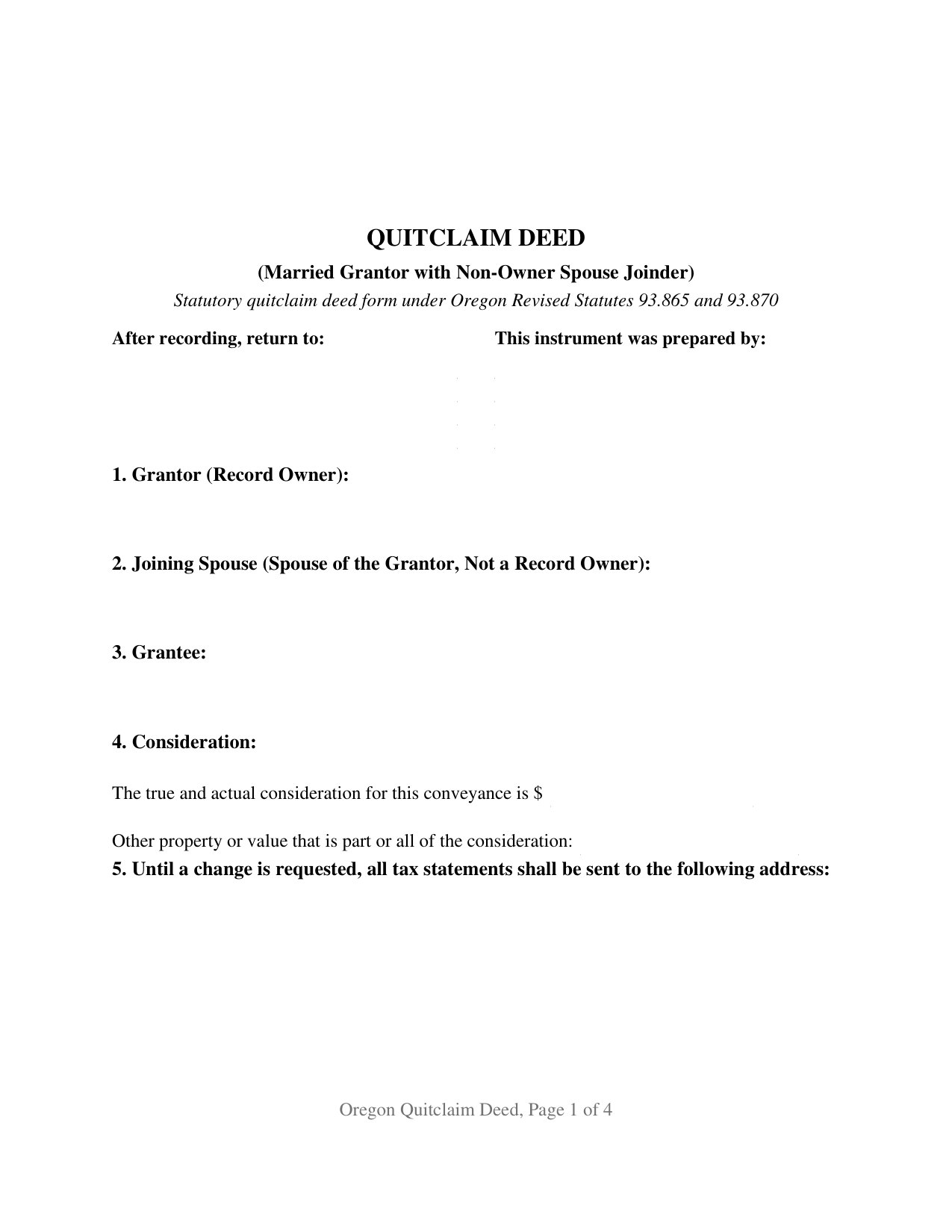
Section 1 names a single record owner as Grantor, and Section 2 names the Joining Spouse, the Grantor's spouse who is not a record owner. Section 10 carries two labeled signature blocks with printed name and date lines, and two certificates follow in the short form wording of ORS 194.285, one per signer, so each may appear before a notarial officer separately. The two certificate layout is this form's own architecture, the Oregon short form being written for one or more individuals.
Property held separately because it arrived before the marriage or came by gift or inheritance during it, a title report that flags the interest of a record owner's spouse before closing, and a lender conditioning funding on the signature of the spouse off title all present the one owner plus joinder pattern this deed recites. The form recites exactly one record owner and one joining spouse, both signing personally; a sole owner with nobody joining, two record owners signing as co-grantors, and a signer acting as trustee, personal representative, or attorney-in-fact each follow a different pattern than this form carries.
First page, and then the county clerk
ORS 205.234 tells an Oregon recorder what belongs on page one, and this quit claim deed is laid out around that list: the after recording delivery block, the party names, the ORS 93.030 consideration in dollars with its statutory line for other property or value, and the ORS 93.260 tax statement sentence. The land use and property rights statement of ORS 93.040 prints in capital letters in the body. ORS 205.232 sets ten point as the floor for type; this deed prints letter size at twelve point, the top two inches of page one left clear for the recording label.
Filing happens with the clerk of the county where the land sits, and promptness matters: under the race notice rule of ORS 93.640 a conveyance left off the record is void against a later good faith purchaser for value who records first. Costs are county figures, several of which moved upward on the first of July in 2026 after a 2025 change to the county Public Land Corner Preservation fee. Oregon imposes no transfer tax on a deed, Washington County grandfathered in.
The download delivers the fillable spouse joinder quitclaim deed, a completed example prepared for a Clackamas County conveyance, and a guide to every numbered section, both certificates, and the recording steps. The materials describe Oregon law in general terms and are not legal advice.
Important: County-Specific Forms
Our quitclaim deed (married grantor with non-owner spouse joinder) forms are specifically formatted for each of the 36 counties in Oregon.
After selecting your county, you'll receive forms that meet all local recording requirements, ensuring your documents will be accepted without delays or rejection fees.