Oregon Quitclaim Deed (Interspousal)
County Specific Legal Forms Validated as recently as October 6, 2026 by our Forms Development Team
About the Oregon Quitclaim Deed (Interspousal)
How to Use This Form
- Select your county from the list
- Download the county-specific form
- Fill in the required information
- Have the document notarized if required
- Record with your county recorder's office
What Others Like You Are Saying
"I was able to get the documents I wanted, and very quickly. Good service."
"Prompt and helpful"
"My card was charged twice in error, I contacted deeds.com and within minutes, the error was correcte…"
"Very convenient online document recording with great and quick service. Thank you!"
"Good but knocked off a star because the download file names are mostly numbers instead of recognizab…"
4.8/5 from 4,833 reviews. Read all
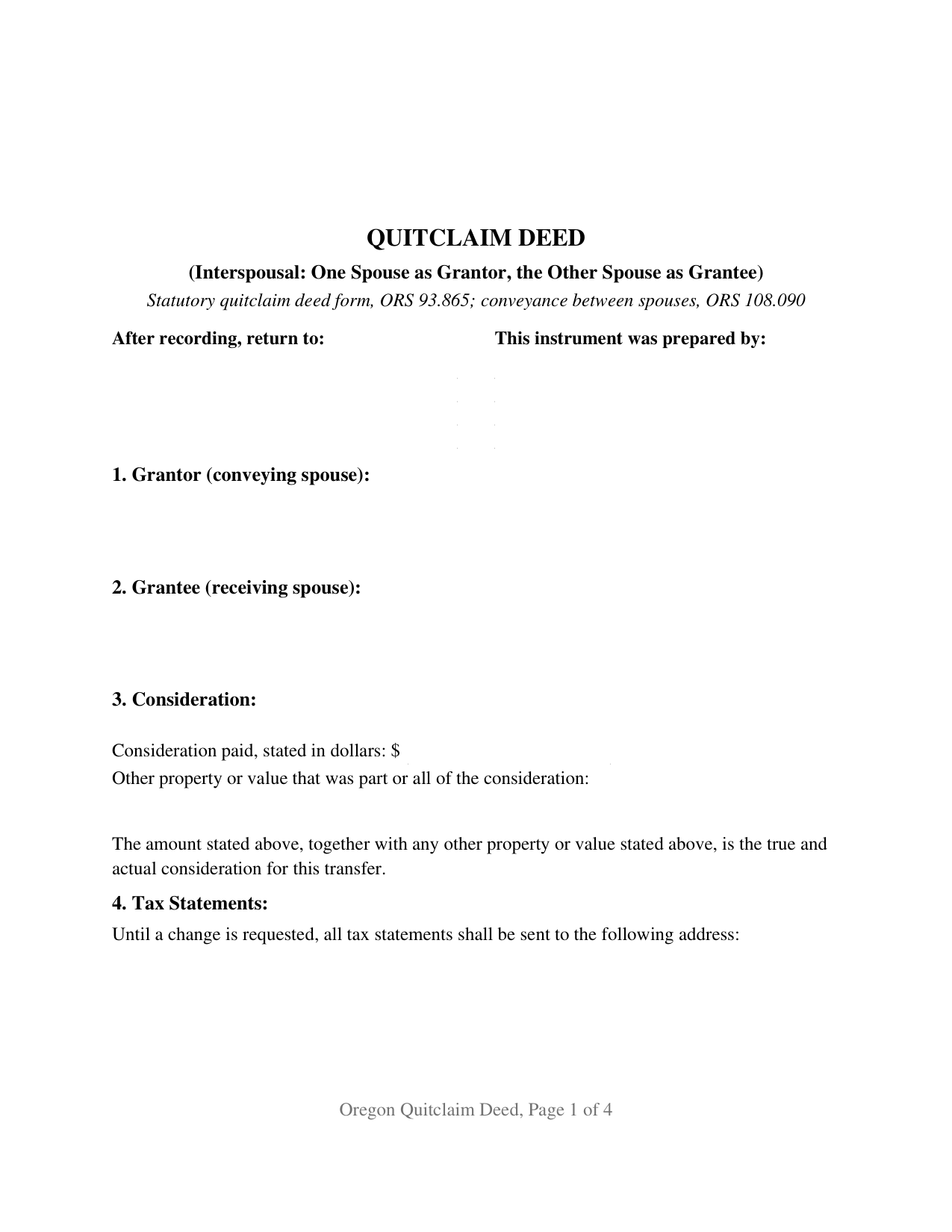
An Oregon quitclaim deed can run from one spouse to the other, and ORS 108.090 treats that transfer as valid between them to the same extent as between any other persons. This form prepares that deed: one spouse signs as Grantor, the other takes as Grantee, and the release carries whatever interest the signing spouse holds on the day the deed is dated.
What ORS 108.090 settles about a deed between spouses
ORS 108.090(1) makes a conveyance, transfer or lien executed by either spouse in favor of the other valid to the same extent as between other persons. Subsection (3) supplies the rule that gives this deed most of its work: a conveyance from a spouse to the other spouse of that spouse's interest in an estate held by entirety is valid, and it dissolves the estate by entirety. Because ORS 93.180(1)(b) makes tenancy by the entirety the estate produced by a conveyance to two grantees married to each other, unless the deed clearly and expressly declares otherwise, an Oregon home in both names ordinarily carries survivorship, and a deed running one direction between the spouses ends that arrangement.
The interspousal configuration
The form recites one Grantor and one Grantee married to each other, so the signature section carries a single signature line with a printed name and date, followed by one acknowledgment certificate in the ORS 194.285 short form wording. The Grantee takes under the deed without signing. Section 6 states the marriage between the parties before performing the release. A spouse conveying separately owned property to the other as a gift, a spouse passing along an interest inherited during the marriage, and spouses ending an entirety estate so that title stands in the receiving spouse's name alone all present the one to one pattern this deed recites. The form is not set up for co-owners with no marriage between them, for two spouses conveying together to someone else, for a non-owner spouse signing beside an owner, for a release that names a dissolution case, or for a signer acting as trustee, personal representative or attorney in fact; each follows a different signature and capacity pattern.
Releases and quitclaims: the reach of the statutory words
This deed uses the statutory quitclaim wording, and ORS 93.865 limits the effect to whatever legal or equitable title or interest the grantor has at the date of the deed, with no covenant or warranty of title, no after acquired title and no estoppel; ORS 93.110 adds that a quitclaim passes all the estate the grantor could lawfully convey, and ORS 93.865(3) keeps the grantee's standing as a good faith purchaser for value intact. Mortgages, trust deeds, judgment liens and easements stay attached through the transfer.
Oregon face statements, then the county clerk
Three statements ride on the face of an Oregon fee title conveyance, and the form builds each one in: the ORS 93.030 consideration figure in dollars, with a companion line for the statutory notation that other property or value made up part or all of it, which a gift between spouses commonly uses; the ORS 93.260 sentence naming where property tax statements go until a change is requested, printed in the header beside the return address, where ORS 205.234 wants that information on the first page; and the ORS 93.040 land use and property rights statement, printed in capital letters in the body in current statutory wording. The remaining ORS 205.234 first page items sit on page one under a two inch reserve for the recording label, and the deed prints letter size at twelve point inside the ORS 205.232 limits.
Filing happens promptly with the clerk of the county where the land lies, because ORS 93.640 leaves an unrecorded conveyance void against a later good faith purchaser for value who records first. No statewide transfer tax reaches an Oregon deed, and ORS 306.815 keeps local governments out of that field apart from one grandfathered levy in Washington County, where a dollar per thousand of selling price is paid or exempted within fifteen days of recording, with a published gift exemption for a transfer whose only consideration is love and affection.
The download holds three items: the fillable interspousal quitclaim deed, a completed example prepared for a Washington County gift between spouses, and a plain language guide to every section, the certificate and the recording steps. These materials explain Oregon law in general terms and are not legal advice.
Important: County-Specific Forms
Our quitclaim deed (interspousal) forms are specifically formatted for each of the 36 counties in Oregon.
After selecting your county, you'll receive forms that meet all local recording requirements, ensuring your documents will be accepted without delays or rejection fees.