Oregon Quitclaim Deed (Reserving Life Estate)
County Specific Legal Forms Validated as recently as October 9, 2026 by our Forms Development Team
About the Oregon Quitclaim Deed (Reserving Life Estate)
How to Use This Form
- Select your county from the list
- Download the county-specific form
- Fill in the required information
- Have the document notarized if required
- Record with your county recorder's office
What Others Like You Are Saying
"I found this sight very helpful. All the information that one needs to file a quit claim deed. thank…"
"I got what I needed and did exactly what I needed. All legal and no hassle. Thanks Deeds.com, you ma…"
"great experience so far! Im using Deeds.com for e-recording. Easy to use website, document upload is…"
"Extremely easy to use. The sample completed document was very helpful. I really appreciated not havi…"
"Afficavit worked kind of pricey"
4.8/5 from 4,833 reviews. Read all
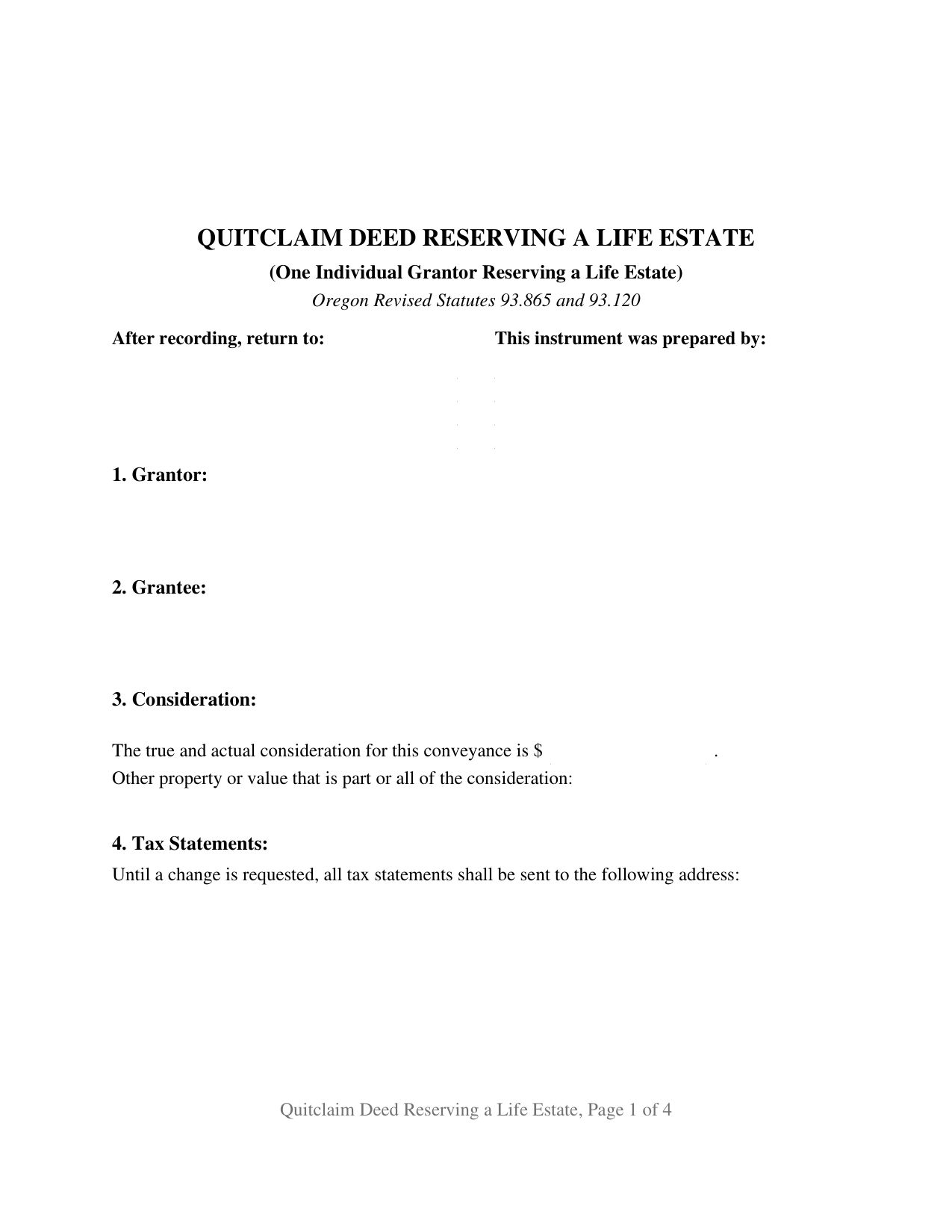
A life estate reserved in an Oregon quitclaim deed does two things in one sentence: the grantee's ownership begins immediately and shows in the county record, while the grantor keeps the right to occupy the property, rent it, and take its income for life. The form draws that instrument for a single individual grantor under ORS 93.865.
Two estates out of one, on the day the deed is delivered
ORS 93.120 supplies the baseline an Oregon deed works against: any conveyance of real estate passes all the estate of the grantor, unless the intent to pass a lesser estate appears by express terms or is necessarily implied in the terms of the grant. The express reservation in Section 9 is that lesser estate term. What crosses to the grantee is the remainder, an interest owned now whose possession waits; what stays behind is the life estate, measured by the grantor's own life. At the grantor's death the remainder ripens into possession under the deed already of record. Nor can the grantor undo it alone, the remainder having vested on delivery: under ORS 93.150 a later deed from a life tenant passes only the estate that tenant could lawfully convey.
How far the quitclaim words reach
Whatever title or interest, legal or equitable, the grantor holds on the date of the deed is what the reservation carves and the remainder carries; nothing acquired afterward follows it, no estoppel arises, and no title covenant is given, since ORS 93.140 rules out implied covenants outside the statutory deed forms. The split into two estates disturbs no encumbrance: a trust deed, a judgment lien, a recorded easement, and the note the grantor signed all survive it.
The reserved life estate configuration
Section 1 names one individual grantor, signing personally. Section 2 names the grantee or grantees who take the remainder, with room for the co-ownership among them, since ORS 93.180(1)(a) makes a conveyance to two or more persons a tenancy in common unless the deed clearly and expressly declares a right of survivorship. Section 9 performs the release and states the reservation for the term of the grantor's natural life. Section 10 allocates the burdens ahead: taxes, insurance premiums, ordinary maintenance and repair; ORS 105.805 supplies an action for waste against a life tenant but allocates nothing in advance. One signature line, one printed name and date, and one ORS 194.285 short form acknowledgment certificate close the deed. A parent keeping the right to live in the family home while the remainder moves to an adult child, an owner passing the remainder in acreage to the neighbor who farms it, and an owner settling the future of a rental while still collecting its rents present the pattern this deed recites. The form recites one individual grantor reserving a life estate for that grantor's own life; a trustee, personal representative, attorney in fact, or entity officer states a different capacity, and two owners conveying together follow a different signature pattern.
Face statements, then the recording counter
Oregon writes three things onto a deed that transfers fee title, and this one carries them all: the ORS 93.030 consideration in dollars, plus a second line for the statutory notation about other property or value that a family conveyance often uses; the ORS 93.260 sentence routing the annual tax statement until a change is requested, which here frequently names the life tenant; and the ORS 93.040 land use and property rights statement in capital letters, in wording that reflects Oregon Laws 2025 chapter 209. Page one answers the ORS 205.234 list beneath a two inch strip left blank for the county label, and the sheet prints letter size at twelve point inside the limits ORS 205.232 sets.
The signed deed is taken to the clerk of the county where the land sits, and the trip matters: under ORS 93.640 a conveyance that stays off the record gives way to a later good faith purchaser for value whose deed is filed first. Charges are county figures, and a number of Oregon counties moved theirs on July 1, 2026, when Oregon Laws 2025 chapter 98 lifted the ceiling on the Public Land Corner Preservation fee.
Three items make up the download: the fillable life estate quitclaim deed, a completed example prepared for a Polk County conveyance subject to a reserved life estate, and a guide covering each section, the certificate wording, and the recording counter. The materials describe Oregon law in general terms and are not legal advice.
Important: County-Specific Forms
Our quitclaim deed (reserving life estate) forms are specifically formatted for each of the 36 counties in Oregon.
After selecting your county, you'll receive forms that meet all local recording requirements, ensuring your documents will be accepted without delays or rejection fees.