Vermont Easement Deed (Ingress and Egress)
County Specific Legal Forms Validated as recently as October 8, 2026 by our Forms Development Team
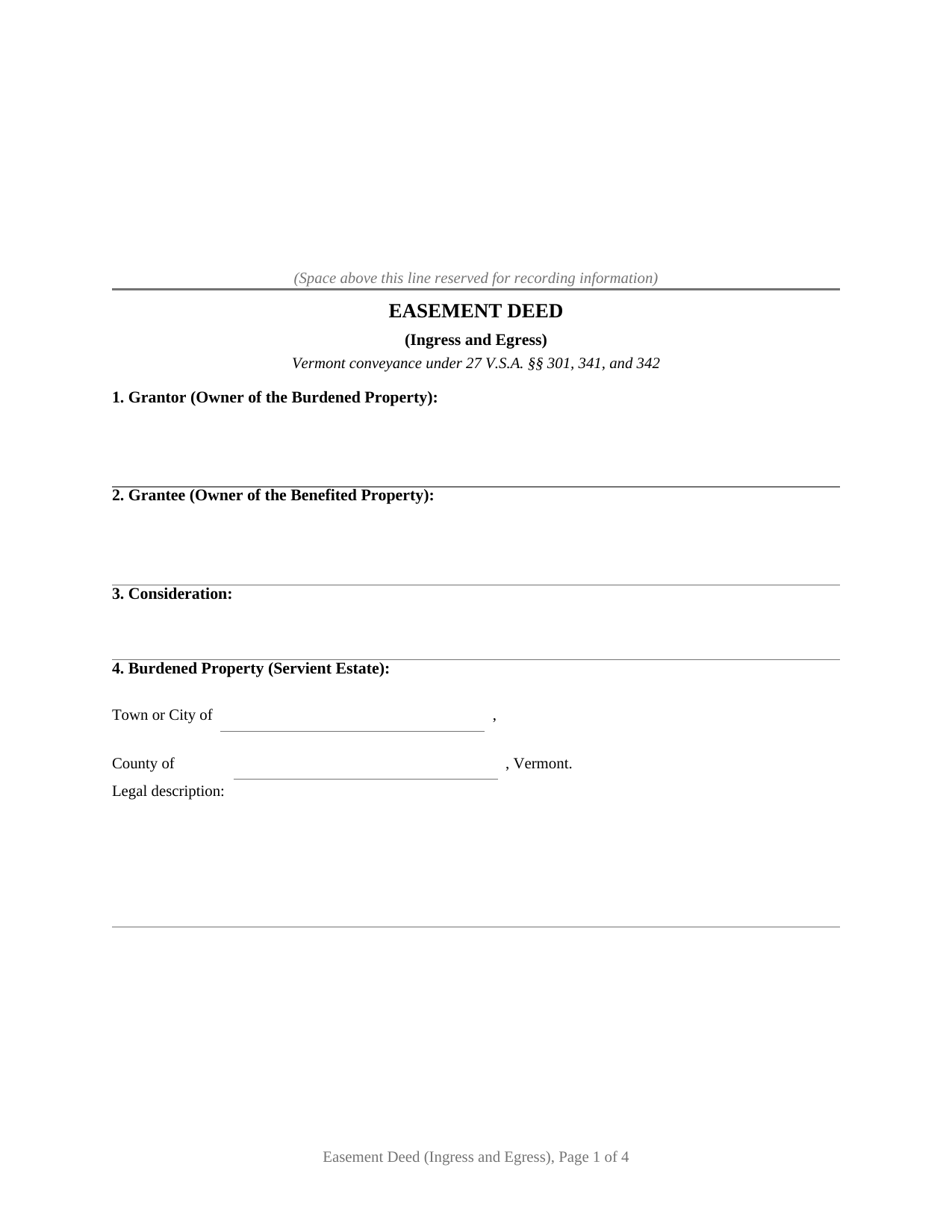
About the Vermont Easement Deed (Ingress and Egress)
How to Use This Form
- Select your county from the list
- Download the county-specific form
- Fill in the required information
- Have the document notarized if required
- Record with your county recorder's office
What Others Like You Are Saying
"Where has this site been my entire career? Very helpful. This site made what would normally take thr…"
"This is an excellent service..thank you"
"The form was exactly what we needed and the directions were spot on and perfectly clear. Filling out…"
"Easy to use."
"Exactly what I needed"
4.8/5 from 4,819 reviews. Read all
A deeded right of ingress and egress turns informal permission to cross a neighbor's land into a recorded property right. This Vermont Easement Deed grants a perpetual right-of-way for access, on foot and by vehicle, over a described strip of one parcel for the benefit of an adjoining parcel. The form is set up for a single grantor, the owner of the burdened land, and it carries a joinder block for the grantor's spouse for the situation where the burdened parcel is homestead property.
A right-of-way that runs with the land
The deed recites both parcels: the burdened property the way crosses, and the benefited property it serves. That pairing is what makes the easement appurtenant, the construction Vermont courts favor over a merely personal right (Scott v. Leonard, 119 Vt. 86 (1956); Barrett v. Kunz, 158 Vt. 15 (1992)). An appurtenant easement attaches to the benefited land itself: it passes automatically with every later sale or inheritance of that land, and the benefit cannot be split off and transferred separately. The deed states the appurtenance expressly, together with a habendum to the grantee's heirs, successors, and assigns, so nothing about the easement's character is left to presumption. A recorded easement instrument also enjoys lasting record protection, since Vermont's marketable record title law excepts easements created by recorded instrument from extinguishment (27 V.S.A. § 604(a)(7)).
Built around the driveway and access pattern
The form describes the right-of-way in practical terms: a defined easement area with its width, course, and endpoints, commonly a strip along an existing drive, with room to cite a recorded survey plat by volume and page, the citation 27 V.S.A. § 341(b) contemplates for a deed that refers to a survey. The grant is perpetual and nonexclusive, so the grantor keeps every use of the burdened land that does not unreasonably interfere with passage, and an optional terms section holds maintenance and snowplowing arrangements. The deed's covenant is a limited one, reaching claims that arise by, through, or under the grantor. A back lot reached over a neighbor's gravel lane, a parcel without practical road frontage, and a shared drive serving two homes present the pattern this deed recites. The form recites one grantor of record; a burdened parcel owned by two people, including spouses holding as tenants by the entirety, presents a pattern with additional grantor signatures rather than a single grantor block.
One signature, and sometimes a second
The grantor signs before a notary public: 27 V.S.A. § 341(a) makes signature, acknowledgment, and town recording the Vermont execution formula, with no witness requirement for an ordinary deed. Where the burdened parcel is the homestead of a married grantor, Vermont law makes the conveyance inoperative as to the homestead unless the spouse joins in the execution and acknowledgment (27 V.S.A. § 141), so the deed carries a labeled spouse joinder section with its own acknowledgment certificate, and the two signers can appear before different notaries on different dates. Printed names appear under the signature lines, the detail 32 V.S.A. § 1405 lets a recording official require.
Recorded in the town, taxed as a transfer
Vermont records land documents with the clerk of the town or city where the land lies; there is no county recording system. The statewide fee is $15.00 per page. A perpetual easement counts as title to property under the transfer tax definitions (32 V.S.A. § 9601(3)(A)), so a Vermont Property Transfer Tax Return, Form PTT-172, accompanies the deed at the counter, and the clerk cannot record without a complete return (32 V.S.A. § 9608). The general rate, including the clean water surcharge, is 1.47 percent of the consideration paid for the easement, and the statute lists exemptions for particular transfers.
The download contains three pieces: the easement deed as a fillable PDF, a completed example showing every section filled in for a realistic Vermont fact pattern, and a plain language guide that explains each blank, the signing and joinder mechanics, and the recording and transfer tax process step by step. The materials are informational and are not legal advice.
Important: County-Specific Forms
Our easement deed (ingress and egress) forms are specifically formatted for each of the 14 counties in Vermont.
After selecting your county, you'll receive forms that meet all local recording requirements, ensuring your documents will be accepted without delays or rejection fees.