Vermont Easement Deed (Utility, In Gross, Non-Owner Spouse or Civil Union Partner Joins)
County Specific Legal Forms Validated as recently as September 25, 2026 by our Forms Development Team
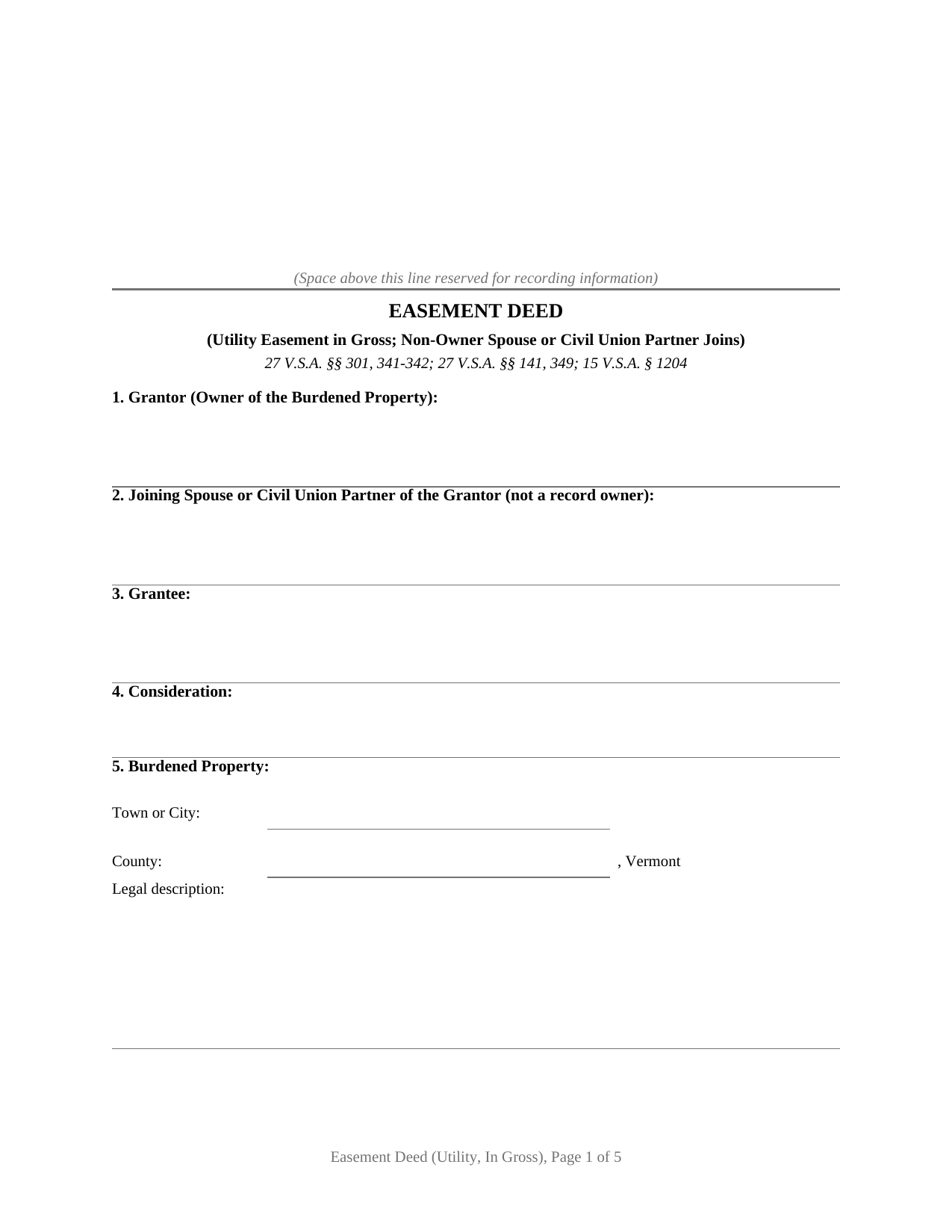
About the Vermont Easement Deed (Utility, In Gross, Non-Owner Spouse or Civil Union Partner Joins)
How to Use This Form
- Select your county from the list
- Download the county-specific form
- Fill in the required information
- Have the document notarized if required
- Record with your county recorder's office
What Others Like You Are Saying
"So far, so good. Great looking site."
"Very convenient, glad I discovered this website."
"Very fast and smooth process, thank you for your quick answers and follow up."
"Easy to use."
"The instructions were really clear and the site user friendly"
4.8/5 from 4,818 reviews. Read all
One signature on this Vermont easement deed conveys the easement; the other conveys nothing of its own, and the deed does not hold together without it. The form prepares a perpetual utility easement in gross over Vermont land owned of record by one person, with the owner's spouse or civil union partner joining in the execution and acknowledgment the way 27 V.S.A. Section 141 describes.
A second signature that owns nothing of record
Vermont homestead law reaches conveyances of an interest in the homestead, and an easement corridor across a house lot is exactly that kind of interest. Under 27 V.S.A. Section 141, a married owner's conveyance of the homestead or an interest in it is inoperative as to the homestead unless the spouse joins in both the execution and the acknowledgment, and 27 V.S.A. Section 349 bars conveying an interest in homestead property to anyone but the spouse without that joinder. Estate of Girard v. Laird, 159 Vt. 508 (1993), treats a conveyance made without the joinder as inoperative and subject to being set aside by the spouse who never signed, a defect that surfaces years later, in a title search, over land a utility has already built on. A civil union partner stands in the same statutory position: 15 V.S.A. Section 1204 gives parties to a civil union the same protections as spouses and folds them into every statutory use of the word spouse. The joinder section of this deed recites the relationship and the joinder, releases the homestead interest to the extent of the easement, and gives the joining partner's signature its own acknowledgment certificate.
An easement the deed calls personal, in so many words
Vermont courts favor reading an easement as appurtenant, one that serves a neighboring parcel, rather than in gross; Scott v. Leonard stated the preference in one sentence in 1956, and Barrett v. Kunz and Rowe v. Lavanway draw an easement's character from the deed's own language. A utility easement runs the other way: it belongs to the utility itself, not to any dominant estate. So this deed says so expressly: the grant runs to the grantee and its successors and assigns, no dominant estate is created, the easement may be transferred, and the burden runs with the burdened land. The numbered sections collect the easement area, typically a surveyed strip of stated width, the facilities and purpose, the survey recording reference 27 V.S.A. Section 341(b) contemplates, and any negotiated provisions on vegetation or restoration; the operative section grants construction, operation, maintenance, replacement, and access rights bounded by those entries. The deed conveys the easement without covenant or warranty of title, and the grantor keeps every use of the land that does not unreasonably interfere with the rights granted.
Town recording and the transfer tax on a perpetual easement
Vermont records land documents with the clerk of the town or city where the land lies; there is no county recording office. Recording costs $15.00 per page under 32 V.S.A. Section 1671. A perpetual easement is title to property under 32 V.S.A. Section 9601(3)(A), so the deed travels with a completed Property Transfer Tax Return, Form PTT-172, and 32 V.S.A. Section 9608 stops the clerk from recording without it. The general rate with the clean water surcharge is 1.47 percent of the consideration, paid by the transferee, and 32 V.S.A. Section 9603(17) exempts a utility line easement granted to a public utility or a municipality for $500.00 or less, claimed as exemption 17 on the return.
What this form is set up as
The form recites exactly one grantor holding record title alone, one joining spouse or civil union partner with no record interest, and one grantee taking in gross. Owners who both hold record title present a different pattern, with both conveying as grantors, and an access easement benefiting a neighboring lot presents an appurtenant grant this deed expressly disclaims. A homeowner granting a distribution-line corridor to an electric cooperative while a civil union partner joins, and a sole-title owner granting the town a water main easement, present the pattern this deed recites.
The download delivers the easement deed as a fillable PDF opening with a non-recorded instructions page, a completed example filled in for a Shelburne, Chittenden County fact pattern, and a plain-language guide covering each numbered section, the joinder statutes, the notary certificates, and the path through the town clerk's office and the transfer tax return. The materials describe Vermont law in general terms and are not legal advice.
Important: County-Specific Forms
Our easement deed (utility, in gross, non-owner spouse or civil union partner joins) forms are specifically formatted for each of the 14 counties in Vermont.
After selecting your county, you'll receive forms that meet all local recording requirements, ensuring your documents will be accepted without delays or rejection fees.