Vermont Easement Deed (Ingress and Egress - Trustee Grantor)
County Specific Legal Forms Validated as recently as September 18, 2026 by our Forms Development Team
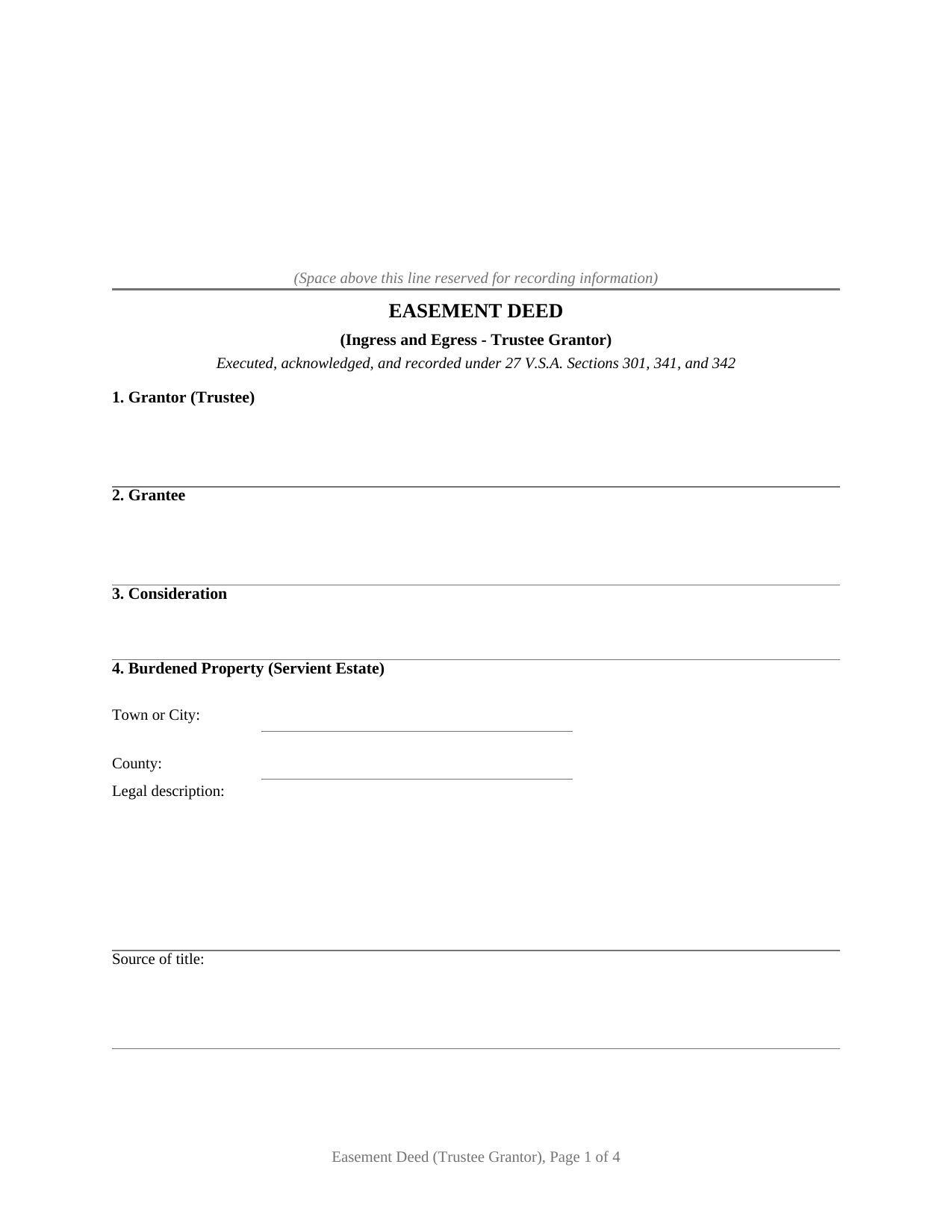
About the Vermont Easement Deed (Ingress and Egress - Trustee Grantor)
How to Use This Form
- Select your county from the list
- Download the county-specific form
- Fill in the required information
- Have the document notarized if required
- Record with your county recorder's office
What Others Like You Are Saying
"This was my first time using Deeds.com and I was very impressed on the professionalism and the exped…"
"I was so happy to be able to print the Quit Claim Deed form and learn about other forms. Very please…"
"Seems to be just what I needed. I will certainly keep your services handy in the future. I will reco…"
"A+"
"Could not have been any easier to download the quit claim forms. The provided instructions and sampl…"
4.8/5 from 4,819 reviews. Read all
On this Vermont easement deed, the grantor line is built for a trustee: the deed recites one grantor acting solely as trustee of a named trust, and the granting clause conveys a perpetual, nonexclusive easement for ingress and egress across the trust-held land. The form prepares a recordable right-of-way grant from a trust to a neighboring owner: one trustee signature, one acknowledgment certificate in the representative capacity, and a defined access strip that benefits the grantee's parcel.
An access easement that runs with the land
The deed identifies two parcels: the burdened property the trust holds, and the benefited property the right-of-way serves, each by town, county, and legal description taken from the recorded vesting deeds. A separate section describes the easement area itself, the strip where passage happens, by width, location, and a recorded survey plat reference; under 27 V.S.A. Section 341(b), a deed that refers to a post-1988 survey is accompanied by the survey or cites the book and page where the plat is recorded. Because the grant is appurtenant, the easement attaches to the benefited parcel and passes automatically with every later conveyance of it; the operative language states that the right runs with the land, benefits and binds heirs, successors, and assigns, and does not exist in gross.
The grant is nonexclusive and perpetual: pedestrian and vehicular access over the strip, with the grantee maintaining and improving the surface at the grantee's own cost unless the additional terms section states a different arrangement, and with the trust retaining every use of its land that does not unreasonably interfere with passage. The configurations that appear in the record with this pattern include a shared driveway serving a neighboring house, a back lot reached across a front parcel held in trust, and a subdivided lot taking a defined right-of-way over the seller's retained land.
Signing as trustee, not individually
The trustee capacity is the deed's defining configuration. Section 1 identifies the trustee and the trust by name and instrument date, the granting clause conveys solely in that capacity, and a dedicated capacity section states that no personal liability attaches to the trustee or any successor trustee and that the deed's covenants bind only the trust estate. The warranty is limited to match: the trustee warrants and defends the easement against persons claiming by, through, or under the grantor, and against no others. The acknowledgment certificate carries the signer's name with the representative capacity, in the style Vermont's short-form certificates recognize for representative acknowledgments. Vermont's trust statutes supply a companion instrument for documenting a trustee's authority, the certification of trust under 14A V.S.A. Section 1013, which is prepared, sworn, and recorded separately and is not included in this package.
Recording with the Vermont town clerk
Vermont records deeds town by town, not by county. The signed and notarized easement deed goes to the clerk of the town or city where the burdened land lies, with the statewide $15.00 per page recording fee under 32 V.S.A. Section 1671. A perpetual easement counts as title to property under Vermont's transfer tax definitions, so the deed is presented with a completed Vermont Property Transfer Tax Return, Form PTT-172, and the Act 250 certificate; under 32 V.S.A. Section 9608 the town clerk cannot record without them. The guide walks through the return, the tax rates and the clean water surcharge, the exemption list in 32 V.S.A. Section 9603, and the fair market value rule for nominal-consideration grants. The form itself reserves the top of its first page for the clerk's recording information and keeps its text within Vermont's fee-page dimensions.
The download delivers the easement deed as a blank fillable PDF, a completed example showing the deed filled in for a realistic Chittenden County fact pattern, and a plain-language guide that explains each numbered section, the trustee signing formalities, and the town recording process step by step. The materials describe Vermont law in general terms and are not legal advice; a Vermont attorney can apply these rules to a specific trust or parcel.
Important: County-Specific Forms
Our easement deed (ingress and egress - trustee grantor) forms are specifically formatted for each of the 14 counties in Vermont.
After selecting your county, you'll receive forms that meet all local recording requirements, ensuring your documents will be accepted without delays or rejection fees.