Vermont Easement Deed (Utility - In Gross - Individual Grantor)
County Specific Legal Forms Validated as recently as October 8, 2026 by our Forms Development Team
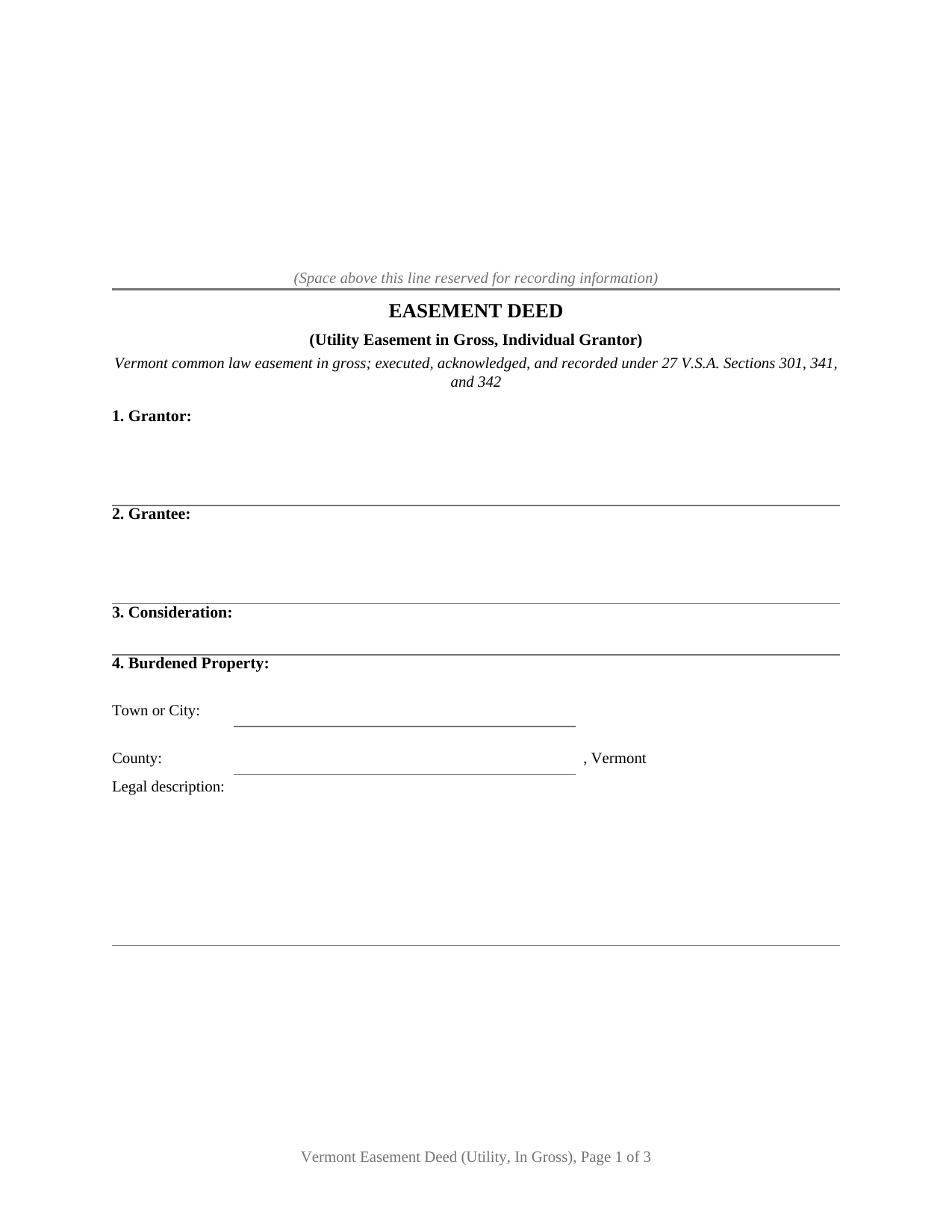
About the Vermont Easement Deed (Utility - In Gross - Individual Grantor)
How to Use This Form
- Select your county from the list
- Download the county-specific form
- Fill in the required information
- Have the document notarized if required
- Record with your county recorder's office
What Others Like You Are Saying
"Very convenient way to record documents without leaving the office. Responses to any questions have …"
"That was easy!"
"The Deed of trust form was fine but the promissory note was less user friendly since I needed to cha…"
"This is an excellent service. And very easy to use."
"Thank you for helping. Deeds online service is so good. I would refer to my friends or whoever if th…"
4.8/5 from 4,823 reviews. Read all
Most easements attach to land: the benefit belongs to a neighboring parcel and passes with it, owner after owner. The easement in this Vermont easement deed follows the other pattern. Prepared for a perpetual utility easement in gross, granted by one individual owner, it vests the right in the grantee itself, typically an electric, communications, or energy company that owns no land near the burdened parcel, with no dominant estate anywhere in the picture.
An easement that belongs to the holder, not to neighboring land
Vermont courts favor reading an easement as appurtenant when a deed leaves room for doubt; decisions from Scott v. Leonard (1956) through Barrett v. Kunz (1992) and Rowe v. Lavanway (2006) repeat the point. A utility corridor is the classic situation where that favored reading misses, since the company holding the line owns no nearby parcel for the right to serve. This deed removes the doubt in its own text: the grant section names the easement as an easement in gross, states that no dominant estate exists or is intended, and makes the easement expressly assignable, so the right follows the utility through mergers, reorganizations, and system sales under the deed's own terms rather than under a default rule.
One owner, one signature, one certificate
The form recites exactly one individual grantor, with a single signature line and a single acknowledgment certificate: the configuration of a sole owner granting rights over that owner's own parcel. A parcel held by two or more owners, or by spouses as tenants by the entirety, presents a joinder pattern with more signatures than this deed carries; under 27 V.S.A. Sections 141 and 349, an interest in entireties property passes to a nonspouse only with both spouses joining, and a married owner's conveyance of an interest in the homestead without the spouse joining is inoperative as to the homestead.
Ten numbered sections collect the working content: the parties, the consideration, the burdened parcel by town, county, and legal description, the easement area within it, a survey or plat of record line, the grantor's source of title, the utility purposes and covered facilities, and optional additional provisions such as surface restoration terms. The grant section then conveys a perpetual easement in gross over, under, and across the easement area, with reasonable ingress and egress, binding the parcel in the hands of later owners while the grantor keeps every use that does not unreasonably interfere with the granted rights. The deed carries no covenant or warranty of title except as expressly stated in it.
Recorded by town, taxed by the state
Vermont records land documents with the clerk of the town or city where the land lies; there is no county recording system. The statewide fee is $15.00 per page under 32 V.S.A. Section 1671. A Vermont Property Transfer Tax Return, Form PTT-172, prepared separately and not included in this package, accompanies the deed at recording: the town clerk cannot record a deed without the completed return, and the property transfer tax definitions expressly count a perpetual easement among the interests the tax reaches. The statute carves out transfers of utility line easements to a public utility or a municipality for a consideration of $500.00 or less; above that figure, or with a private grantee, the general rate of 1.25 percent plus the 0.22 percent clean water surcharge applies to the value of the easement. Acknowledgment before a notary public is the signing formality, and Vermont deeds carry no witness requirement.
The download prepares a Vermont utility easement, the instrument sometimes searched as a right of way agreement, easement agreement, or utility easement form, on the in-gross pattern described above. It includes the fillable blank easement deed as a PDF, a completed example showing the deed filled in for a Chittenden County fact pattern, and a plain language guide that walks through every numbered section, the notary block, and the town recording process. The materials describe Vermont law in general terms and are not legal advice.
Important: County-Specific Forms
Our easement deed (utility - in gross - individual grantor) forms are specifically formatted for each of the 14 counties in Vermont.
After selecting your county, you'll receive forms that meet all local recording requirements, ensuring your documents will be accepted without delays or rejection fees.