Vermont Easement Deed (Ingress and Egress - Joint Grantors)
County Specific Legal Forms Validated as recently as September 30, 2026 by our Forms Development Team
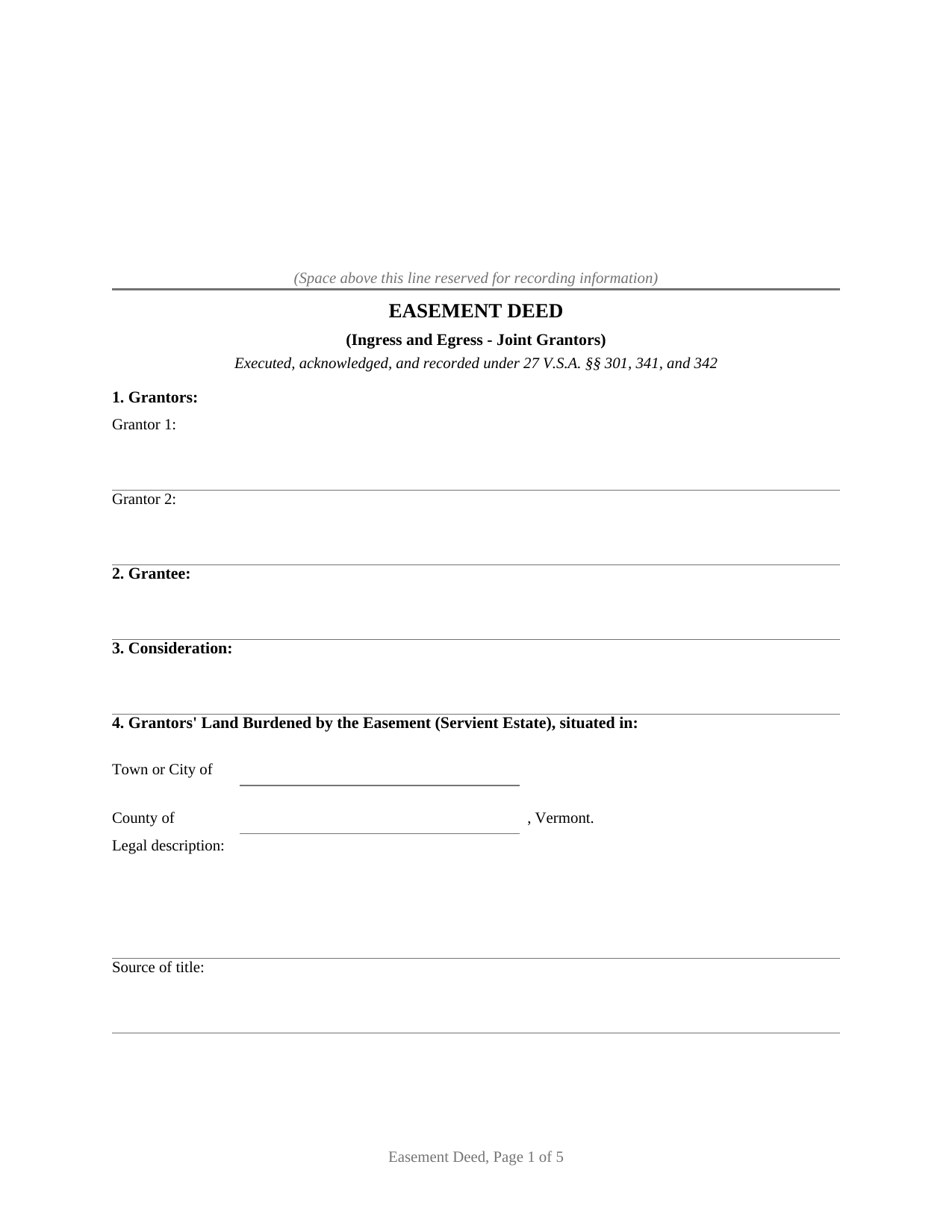
About the Vermont Easement Deed (Ingress and Egress - Joint Grantors)
How to Use This Form
- Select your county from the list
- Download the county-specific form
- Fill in the required information
- Have the document notarized if required
- Record with your county recorder's office
What Others Like You Are Saying
"I needed to cut and paste my phone number with the dashes in order to use this website with my iPhon…"
"It was a wonderful experience. Thank you for your help."
"Easy and affordable. I would recommend deeds.com"
"Deeds.com supplied me with forms I needed immediately."
"Very Fast and simple process for finding documents and downloading"
4.8/5 from 4,818 reviews. Read all
When the land under a driveway or access strip belongs to two people, a right-of-way over it takes both of their signatures. This Vermont easement deed conveys a perpetual, nonexclusive easement for ingress and egress, meaning access on foot and by vehicle, over land owned by two grantors, and it carries a signature line and a separate notary certificate for each of them.
Two grantors, one burdened parcel
The form recites exactly two record owners of the burdened land, joining in a single deed to grant one easement to the owner of a neighboring benefited parcel. An easement burdens the whole parcel, so every record owner joins in granting it; the deed's two signature blocks and two acknowledgment certificates let the grantors sign on different dates, before different notaries, or in different states. Co-owner pairs present this pattern throughout Vermont land records: siblings holding inherited road frontage as tenants in common, spouses holding as tenants by the entirety, and unmarried co-owners whose shared drive crosses a neighbor's lot line. A burdened parcel with a single record owner, or with three or more owners, presents a different signature pattern than this deed recites, and an easement in gross, one granted without a benefited parcel, follows a different structure as well.
A right-of-way that runs with the land
The deed is built as an appurtenant easement, the kind Vermont practice uses for driveway easements and private access easements between neighbors. It describes three pieces of land in sequence: the grantors' burdened parcel, the grantee's benefited parcel, and the easement area itself, the strip of stated width and location over which the right-of-way runs. Identifying the benefited parcel inside the deed is what ties the easement to that land, so the right-of-way passes automatically with every later sale of the benefited property. Where the easement area appears on a survey plat, Vermont's recording statute has a specific expectation: under 27 V.S.A. Section 341(b), a deed referring to a survey prepared or revised after July 1, 1988 is accompanied by the survey or cites the volume and page where the plat is recorded, and the completed example shows that citation style. The deed also carries an optional additional-terms section for maintenance, plowing, and cost-sharing provisions, and a limited express covenant in which the grantors warrant the easement against claims arising by, through, or under themselves.
Recording with the town clerk, with Vermont's transfer tax return
Vermont records land documents by town and city rather than by county, so the deed goes to the clerk of the municipality where the burdened land lies. Under 27 V.S.A. Sections 341 and 342, the deed is signed, acknowledged before a notary public, and recorded, and an unrecorded conveyance is not effectual against anyone but the grantor and the grantor's heirs, which is why an easement of this kind is placed of record promptly. Recording costs $15.00 per page statewide. One step surprises many first-time filers: Vermont's property transfer tax reaches a perpetual easement, because 32 V.S.A. Section 9601 defines title to property to include it, so the deed is presented together with a completed Property Transfer Tax Return, Form PTT-172, and the clerk cannot record the deed without it. The guide walks through the tax rates, the exemption list, and the return's $15.00 filing fee at the point in the process where they arise.
The download includes the blank easement deed as a fillable PDF, a line-by-line guide to every numbered section, and a completed example showing the entire deed filled in for a realistic Vermont fact pattern. The materials describe the form and the governing statutes in general terms; they are informational and are not legal advice.
Important: County-Specific Forms
Our easement deed (ingress and egress - joint grantors) forms are specifically formatted for each of the 14 counties in Vermont.
After selecting your county, you'll receive forms that meet all local recording requirements, ensuring your documents will be accepted without delays or rejection fees.