Vermont Easement Deed (Ingress and Egress, Entity Grantor)
County Specific Legal Forms Validated as recently as September 10, 2026 by our Forms Development Team
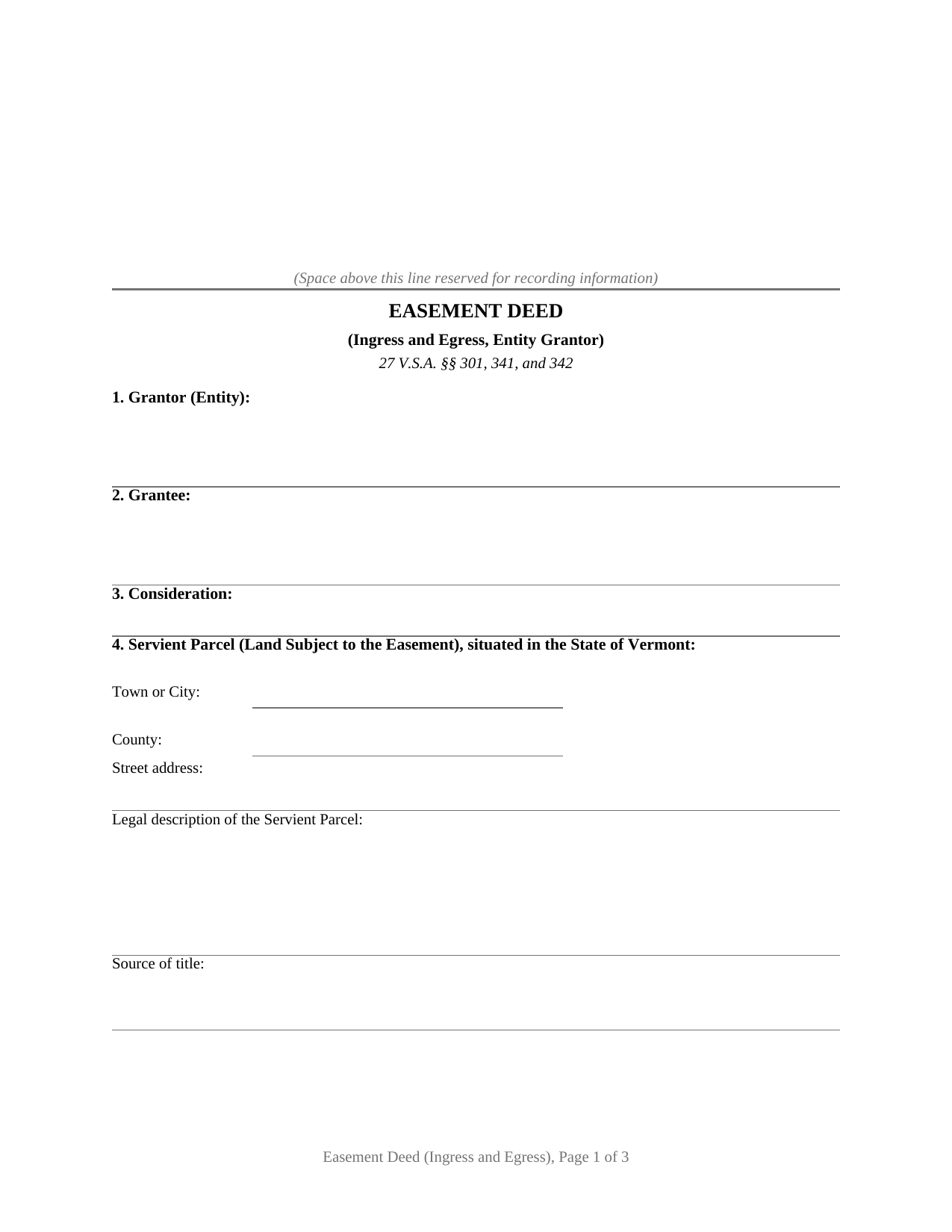
About the Vermont Easement Deed (Ingress and Egress, Entity Grantor)
How to Use This Form
- Select your county from the list
- Download the county-specific form
- Fill in the required information
- Have the document notarized if required
- Record with your county recorder's office
What Others Like You Are Saying
"Very pleasantly pleased so far. Hope to hear from the town registrar Transfer On Death Deed accepted…"
"Good system fairly easy to use"
"This was the easiest, quickest, most understandable way I've seen yet to retrieve deeds from various…"
"Fantastic forms, thanks for making them available."
"No issues with the forms."
4.8/5 from 4,820 reviews. Read all
An easement deed with an entity in the grantor block carries one distinctive piece of architecture: the entity itself grants the easement, and a single authorized representative signs on its behalf, with the acknowledgment completed in a representative capacity. This Vermont form prepares that instrument, a deed granting a perpetual, nonexclusive easement for ingress and egress, with a limited liability company, corporation, partnership, or other organization as the grantor of record.
A recorded right of way over Vermont land
An ingress and egress easement, searched in everyday language as an access easement, a right of way, or a driveway easement, is a recorded right to pass on foot and by vehicle over a defined portion of one parcel for access to and from another. The deed identifies three pieces of land: the servient parcel that carries the burden, the defined easement area within it, and the dominant estate that takes the benefit. Because the grant is appurtenant, it runs with the land. Later owners of the benefited parcel inherit the access automatically, and later owners of the burdened parcel take subject to it.
Vermont supplies no statutory form for an easement deed, so the instrument does its work in express language: a grant of a perpetual, nonexclusive easement for ingress and egress, a habendum, express title covenants, and a reservation letting the grantor continue every use of the easement area that does not unreasonably interfere with the granted access. Under 27 V.S.A. § 341, the deed is signed, acknowledged before a notary public, and recorded with the clerk of the town where the land lies, and under 27 V.S.A. § 342 an unrecorded conveyance holds against no one beyond the grantor and the grantor's heirs. Recording is what makes the access good against a future buyer of the burdened land.
One entity grantor, one representative signature
The form recites the entity grantor by full legal name, entity type, state of organization, and mailing address, and its operative section states that the deed is executed and delivered as the act of the entity through a representative signing in a representative capacity and not individually. The signature section carries the entity name, the representative's signature, printed name, title, and date, and the notary certificate tracks the representative capacity elements of 26 V.S.A. § 5368(2): the signer's name, the type of authority, and the party on whose behalf the record was executed. An entity holds no marital homestead, so the form carries no spousal joinder block; Vermont's homestead joinder statute reaches married individual owners. A deed from individual owners or from cotrustees presents a different signature and acknowledgment pattern than the single entity configuration this form recites.
The town clerk, the transfer tax return, and the survey rule
Vermont records land instruments by town or city rather than by county, at a statewide fee of $15.00 per page under 32 V.S.A. § 1671. A perpetual easement counts as title to property under 32 V.S.A. § 9601(3)(A), so the Vermont Property Transfer Tax Return, Form PTT-172, is prepared separately and accompanies the deed at recording; 32 V.S.A. § 9608 bars a town clerk from recording a transfer document without a complete return and its Act 250 certificate. The general transfer tax rate is 1.25 percent of value plus the 0.22 percent clean water surcharge, with the transferee liable for payment to the Department of Taxes. Access easements are also frequently drawn from a survey, and 27 V.S.A. § 341(b) permits a deed that refers to a survey prepared or revised after July 1, 1988 to be recorded only when the survey accompanies the deed or the deed cites the volume and page where the survey is already of record. The form carries a survey and plat reference blank in its easement area section for exactly that citation.
What arrives in the download
An encumbrances section states what the easement is subject to, and an optional provisions section accepts terms the parties place in the deed itself, such as the driveway maintenance allocation shown in the completed example. The package contains the blank easement deed as a fillable PDF, a completed example filled in for a realistic Lamoille County fact pattern, and a plain language guide that walks through every numbered section, the representative capacity acknowledgment, and the recording steps at the town clerk's office. The materials describe Vermont law in general terms and are not legal advice.
Important: County-Specific Forms
Our easement deed (ingress and egress, entity grantor) forms are specifically formatted for each of the 14 counties in Vermont.
After selecting your county, you'll receive forms that meet all local recording requirements, ensuring your documents will be accepted without delays or rejection fees.