Vermont Easement Deed (Utility, In Gross, Joint Grantors)
County Specific Legal Forms Validated as recently as October 19, 2026 by our Forms Development Team
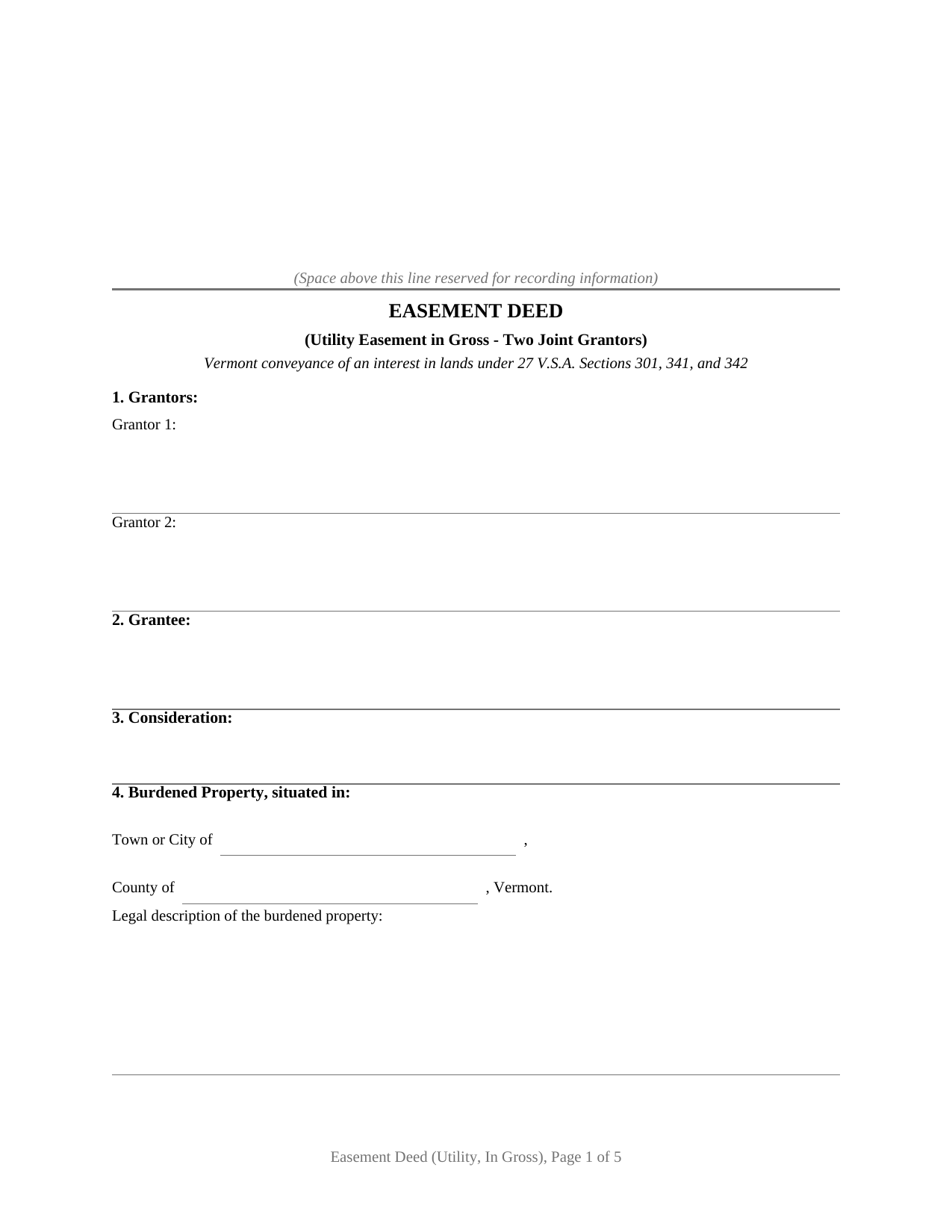
About the Vermont Easement Deed (Utility, In Gross, Joint Grantors)
How to Use This Form
- Select your county from the list
- Download the county-specific form
- Fill in the required information
- Have the document notarized if required
- Record with your county recorder's office
What Others Like You Are Saying
"Easy to find what I needed and a good price. Very satisfied."
"Got the forms I needed after getting forms for the wrong county and paying twice. My bad!"
"Very easy to use and I had no issues submitting my deed."
"would have been smart to give each pdf a name instead of unintelligible numbers..."
"Quick, easy and the most resonably priced!"
4.8/5 from 4,836 reviews. Read all
This Vermont easement deed grants a perpetual utility easement in gross over land that two record owners hold together. The form recites exactly two grantors, one grantee, and one defined easement area within a single burdened parcel, with a signature block and an acknowledgment certificate for each grantor.
An Easement That Belongs to the Utility, Not to Neighboring Land
Most Vermont easements are appurtenant: they serve a neighboring parcel and pass automatically with it. An easement in gross works differently. It belongs to its holder directly, names no dominant estate, and exists so that a company can run its facilities across land it does not own. Utility corridors are the classic case: an electric cooperative, a telecommunications carrier, or a water district holds the right of way itself, not as an owner of adjoining land.
Vermont case law makes the express language matter. The Vermont Supreme Court favors the construction that an easement is appurtenant rather than in gross (Scott v. Leonard, 119 Vt. 86 (1956); Barrett v. Kunz, 158 Vt. 15 (1992)), so a grant intended to stand on its own says so plainly. The operative section of this deed declares the easement in gross, states that it benefits the grantee and the grantee's successors and assigns, and makes it assignable by its own terms, since no Vermont statute supplies a transferability rule for an express easement in gross.
Two Grantors, One Burdened Parcel
The deed is built around co-owned land. Spouses holding as tenants by the entirety, two joint tenants, and two tenants in common all present the two owner pattern this form recites: both record owners are named in the grantor section, both sign, and each signature carries its own acknowledgment certificate, so the two grantors may appear before different notaries on different dates. Where the grantors are spouses holding the parcel as tenants by the entirety, both signatures also supply the spousal joinder that 27 V.S.A. Section 349 requires before an entireties interest passes to anyone but a spouse. The form recites exactly two record owners; a parcel held by a sole owner, or by three or more co-owners, presents a different signature pattern.
What the Deed Grants and What the Owners Keep
The grant is measured by the deed's own entries: a described easement area, commonly a strip of stated width along a boundary or centerline, and a stated set of utility purposes and facilities. The operative language carries the working rights a utility easement needs, including ingress and egress across the parcel, the right to keep the corridor clear of interfering vegetation and structures, and a surface restoration obligation after entry. The grantors keep ownership of the land and the reserved right to use the easement area for purposes that do not interfere, with new structures and material grade changes in the corridor conditioned on the grantee's written consent. The conveyance passes without covenants of title except any covenant expressly stated, a posture the deed states in words because Vermont implies no title covenants from a deed's operative language.
Recording With the Town Clerk
Vermont records land instruments by municipality, so the deed goes to the clerk of the town or city where the parcel lies, at the statewide fee of $15.00 per page under 32 V.S.A. Section 1671. An easement conveyance travels with a Vermont Property Transfer Tax Return, Form PTT-172, which lists an easement or right of way among the interests a transfer may convey; under 32 V.S.A. Section 9608 the clerk cannot record the deed without a complete return. The exemption list includes transfers of a utility line easement to a public utility or municipality for $500 or less, and an exempt transfer still files the return with the exemption number entered. Where the easement description refers to a survey, 27 V.S.A. Section 341(b) calls for the survey to accompany the deed or for the deed to cite the volume and page where the survey is recorded.
The package contains the easement deed as a fillable PDF, a completed example showing the entire document filled in for a fictional Chittenden County electric distribution easement, and a plain language guide that walks through every numbered section. The materials describe Vermont law in general terms and are not legal advice.
Important: County-Specific Forms
Our easement deed (utility, in gross, joint grantors) forms are specifically formatted for each of the 14 counties in Vermont.
After selecting your county, you'll receive forms that meet all local recording requirements, ensuring your documents will be accepted without delays or rejection fees.