Pima County Affidavit of Death Form
Last validated July 31, 2026 by our Forms Development Team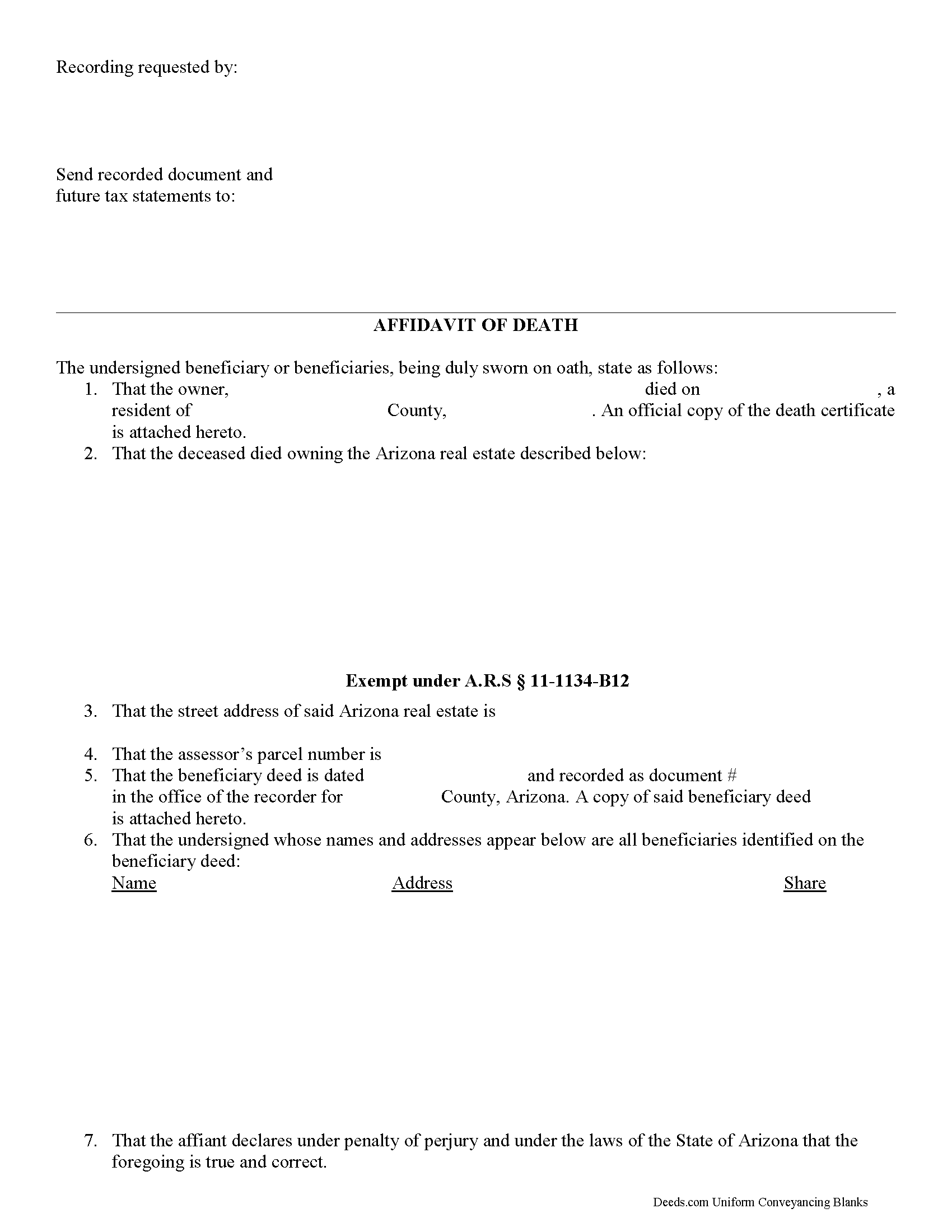
Pima County Affidavit of Death Form
Fill in the blank form formatted to comply with all recording and content requirements.
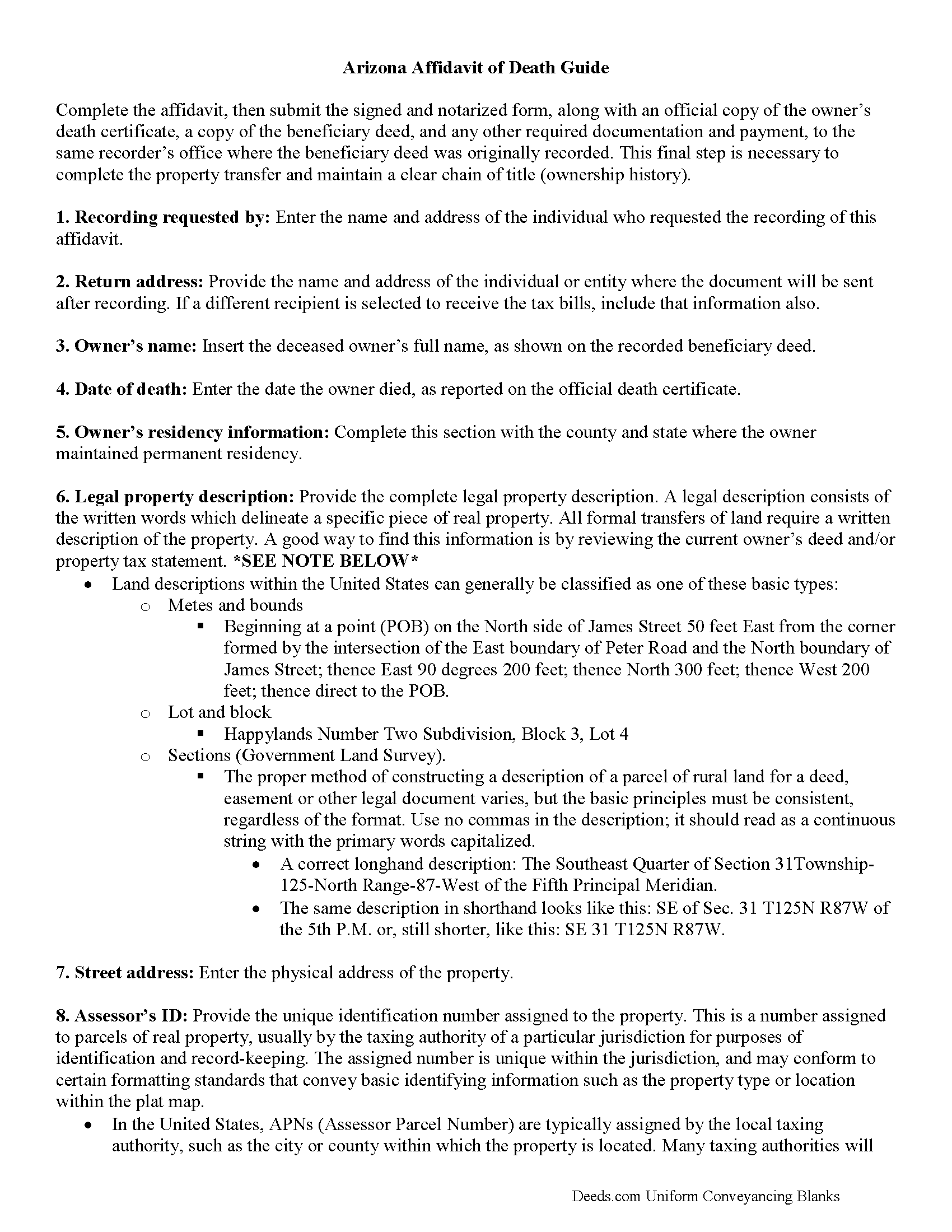
Pima County Affidavit of Death Deed Guide
Line by line guide explaining every blank on the form
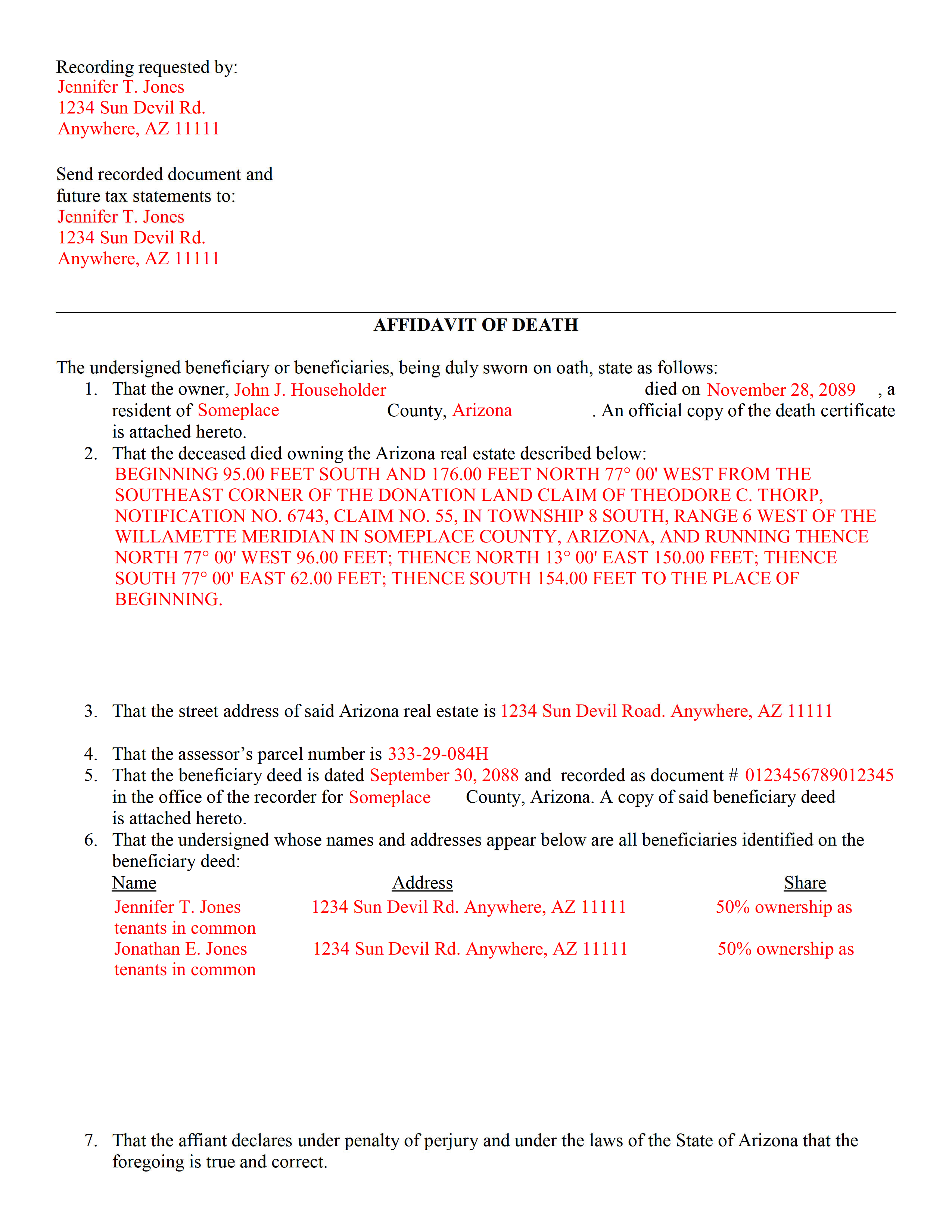
Pima County Completed Example of the Affidavit of Death Document
Example of a properly completed form for reference.
All 3 documents above included • One-time purchase • No recurring fees
Immediate Download • Secure Checkout
Additional Arizona and Pima County documents included at no extra charge:
Where to Record Your Documents
Recorder: Main Office
Tucson, Arizona 85701
Hours: Monday through Friday 8:00 am to 5:00 pm
Phone: 520) 740-4350
Recorder: Eastside Office
Tucson, Arizona 85710
Hours: Monday through Friday 8:00 to noon & 1:00 to 5:00
Phone: 520) 740-4350
Recording Tips for Pima County:
- Verify all names are spelled correctly before recording
- Check that your notary's commission hasn't expired
- Documents must be on 8.5 x 11 inch white paper
Cities and Jurisdictions in Pima County
Properties in any of these areas use Pima County forms:
- Ajo
- Arivaca
- Catalina
- Cortaro
- Green Valley
- Lukeville
- Marana
- Mount Lemmon
- Rillito
- Sahuarita
- Sasabe
- Sells
- Topawa
- Tucson
- Vail
Hours, fees, requirements, and more for Pima County
How do I get my forms?
Forms are available for immediate download after payment. The Pima County forms will be in your account ready to download to your computer. An account is created for you during checkout if you don't have one. Forms are NOT emailed.
Are these forms guaranteed to be recordable in Pima County?
Yes. Our form blanks are guaranteed to meet or exceed the applicable formatting requirements used for recording in Pima County, including margin requirements, font requirements, and other layout standards. This guarantee applies to formatting, not to the legal sufficiency of information entered by the user or the suitability of a form for a particular transaction.
Can I reuse these forms?
Yes. You can reuse the forms for your personal use. For example, if you have multiple properties in Pima County you only need to order once.
What do I need to use these forms?
The forms are PDFs that you fill out on your computer. You'll need Adobe Reader (free software that most computers already have). You do NOT enter your property information online - you download the blank forms and complete them privately on your own computer.
Are there any recurring fees?
No. This is a one-time purchase. Nothing to cancel, no memberships, no recurring fees.
How much does it cost to record in Pima County?
Recording fees in Pima County vary. Contact the recorder's office at 520) 740-4350 for current fees.
Questions answered? Let's get started!
The Arizona Affidavit of Death is the sworn instrument a beneficiary records to perfect title after the original owner of an Arizona beneficiary deed dies. Arizona's beneficiary deed statute at ARS 33-405 transfers the property to the named beneficiary automatically at the owner's death — no court order, no probate, no closing — but the county recorder's index still shows the deceased owner as the titleholder until something new is recorded. The affidavit of death, filed together with a certified copy of the owner's death certificate and a reference to the recorded beneficiary deed, is the mechanism that updates the record and gives future title examiners, lenders, and buyers the chain they need to see. Without that recorded update, the beneficiary technically owns the property but cannot cleanly sell, mortgage, or insure title to it.
When the Arizona Affidavit of Death Is Used
This affidavit is used after the death of the owner who recorded the original beneficiary deed, by the surviving beneficiary (or successor beneficiary) who is claiming the property. It is also used in related scenarios that arise under Arizona's non-probate transfer framework: when the primary beneficiary named in a beneficiary deed predeceased the owner and a successor beneficiary is now taking, when multiple beneficiaries took concurrent interests and one has died, and when the property was held in joint tenancy or community property with right of survivorship and the beneficiary deed operates only after the death of the last co-owner. The instrument is not a vehicle for transferring property that was not already subject to a recorded beneficiary deed — it perfects the transfer that the deed itself put in motion; it does not create one.
What the Affidavit Establishes
The affidavit is a sworn statement that locks the facts required to confirm the beneficiary's title. The content typically includes the identity of the deceased owner, the date and place of death, the identity of the affiant (usually the beneficiary) and the affiant's relationship to the deceased, a reference to the beneficiary deed by recording date, recording number, and county of recording, the legal description of the property matching the description in the beneficiary deed, and a statement that the affiant is the beneficiary entitled to take under ARS 33-405. When the primary beneficiary predeceased the owner, the affidavit should explicitly recite that fact and identify the successor beneficiary claiming under the deed; when multiple beneficiaries took concurrent interests, each should be identified together with the form of concurrent ownership specified in the deed.
Documents Recorded Alongside the Affidavit
The affidavit is typically not recorded alone. A certified copy of the owner's death certificate accompanies it — "certified" meaning issued by the vital records office with the official seal, not a photocopy. A reference to or copy of the recorded beneficiary deed is usually included so the title chain reads cleanly from the recorder's index without requiring a title examiner to pull documents from storage. When a successor beneficiary is taking because the primary predeceased the owner, a certified copy of the primary beneficiary's death certificate should accompany the affidavit as well, so the record shows exactly why the successor is claiming and not the primary.
AHCCCS Estate Recovery
Arizona's beneficiary deed statute does not shield the property from a valid estate recovery claim by the Arizona Health Care Cost Containment System (AHCCCS) against the deceased owner's estate for Medicaid benefits paid during the owner's lifetime. ARS 33-405 specifically preserves AHCCCS's right to pursue recovery, and Arizona Department of Health Services regulations treat beneficiary deed property as reachable for estate recovery in the same way probate property is reachable. A beneficiary who proceeds to record the affidavit and treat the property as fully owned without addressing a pending or likely AHCCCS claim can find the property encumbered, or can find themselves personally liable up to the value received, depending on the circumstances. When the deceased owner received Medicaid or long-term care benefits during life, the beneficiary should coordinate with counsel and with AHCCCS's estate recovery unit before taking possession and certainly before selling the property.
Creditor Claim Periods
Even though a beneficiary deed avoids formal probate administration, the deceased owner's creditors retain claims that can reach the property. Under Arizona's non-probate transfer rules, creditors whose claims are not satisfied through the probate estate can pursue non-probate transferees — including beneficiary deed recipients — up to the value of the property received. The practical consequence is that a beneficiary is well advised to allow the statutory creditor claim periods to run before selling the property or otherwise treating it as unencumbered. Title insurers handling resales of recently transferred beneficiary deed property often impose their own waiting periods and may require additional affidavits or indemnity before insuring marketable title.
What the Beneficiary Takes Subject To
The beneficiary takes the property in whatever condition it was in at the owner's death. Mortgages, deeds of trust, judgment liens, tax liens, mechanic's liens, easements, CC&Rs, and other encumbrances recorded during the owner's life survive the transfer. The beneficiary deed and the affidavit of death do not strip these interests; they pass through to the beneficiary along with the fee. When a mortgage or deed of trust is in place, the beneficiary generally takes subject to it, and many loan documents contain due-on-sale clauses — although the Garn-St Germain Act's federal exemption for transfers on death to a related person usually prevents acceleration of an owner-occupied residential mortgage in this situation.
Who Signs and Execution
An affidavit is a sworn statement, and the person making it must have personal knowledge of the facts sworn to. The affiant is typically the beneficiary, because the beneficiary is the person whose title the instrument is perfecting, but in appropriate circumstances the affidavit may be made by the successor beneficiary, by a personal representative of an intermediate deceased beneficiary's estate, or by another person with direct knowledge. The affiant signs under penalty of perjury, and the signature must be acknowledged before a notary public or other officer authorized to take acknowledgments under ARS 33-401 and ARS 33-501. Arizona does not require subscribing witnesses.
Affidavit of Property Value Exemption
Arizona generally requires an Affidavit of Property Value to accompany instruments affecting interests in real property (ARS 11-1133), but an affidavit of death recorded to perfect a beneficiary deed transfer qualifies for an exemption under ARS 11-1134 because the underlying transfer is exempt. As with any exempt instrument, the exemption should be claimed on the face of the affidavit with a statement that the transfer is exempt and a citation to the specific exemption subsection, placed below the legal description. Recorders routinely reject exempt instruments that fail to include the recital even though the transfer itself plainly qualifies.
Formatting and Recording
ARS 11-480 sets the formatting requirements for every recordable instrument: legible type of at least ten points, white paper no larger than 8.5 by 14 inches, a caption identifying the document (for example, "Affidavit of Death"), a top margin of at least two inches on the first page reserved for the recorder's stamp, and minimum half-inch margins elsewhere. Record the affidavit in the same county where the original beneficiary deed was recorded. When the property sits in more than one county — rare for residential real estate but common for ranch or agricultural parcels — the affidavit should be recorded in each county where the beneficiary deed was recorded. Confirm current recording fees and accepted forms of payment with the county recorder's office in advance.
What's Included in the Download Package
The Arizona Affidavit of Death package includes the affidavit form built to reference the recorded beneficiary deed, identify the deceased owner and the claiming beneficiary, and claim the ARS 11-1134 exemption on the face of the instrument, detailed guidelines covering the Arizona-specific drafting and recording requirements and the documents to record alongside the affidavit, and a completed example showing how the form should look for a typical beneficiary-deed perfection. All files are available for instant download after purchase.
Important: Your property must be located in Pima County to use these forms. Documents should be recorded at the office below.
This Affidavit of Death meets all recording requirements specific to Pima County.
Our Promise
The documents you receive here are guaranteed to meet or exceed the applicable Pima County recording format requirements. If there is a rejection caused by our formatting, we will correct the issue or refund your payment. This guarantee applies to document formatting only and does not extend to information entered by the user, the selection of the form, or the legal effect of the completed document.
Save Time and Money
Get your Pima County Affidavit of Death form done right the first time with Deeds.com Uniform Conveyancing Blanks. At Deeds.com, we understand that your time and money are valuable resources, and we don't want you to face a penalty fee or rejection imposed by a county recorder for submitting nonstandard documents. We constantly review and update our forms to meet rapidly changing state and county recording requirements for roughly 3,500 counties and local jurisdictions.
4.8 out of 5 - ( 4772 Reviews )
Paul S.
October 23rd, 2020
Directions were good. It was an easy process. Thank You.
We appreciate your business and value your feedback. Thank you. Have a wonderful day!
Marlin M.
March 10th, 2025
all round GREAT!
Always great to hear kind words from such a long time customer Marlin, thank you.
Don B.
November 2nd, 2020
This was my first experience with Deeds. Web site instructions are detailed and easy to understand. This was a smooth process. Highly recommend to anyone.
Thank you for your feedback. We really appreciate it. Have a great day!
Ronald W.
March 31st, 2026
Outstanding website, very refreshing to use. Thank you
We’re glad to hear things went well. Thank you for the review.
MARILEE S.
June 24th, 2019
A very easy website....consumer friendly, which is what is so important to me. I will be using your service again. Thank you
Thank you!
Jackqueline S.
August 25th, 2020
I received my property deed quickly. All pertinent information required was received in less than 30 minutes.
Thank you for your feedback. We really appreciate it. Have a great day!
Chelsie F.
April 3rd, 2020
Super customer service and communication! Fast service and more informative than expected! Can't say thanks enough.
Thank you!
Sharon S.
June 18th, 2021
very satisfied...
Thank you!
Dallas S.
July 19th, 2023
Very easy
Thank you!
David K.
April 4th, 2019
Excellent instructions to guide one through the warranty deed.
Thank you for your feedback. We really appreciate it. Have a great day!
Truc T.
October 19th, 2021
great DIY site.
Thank you!
Debra W.
January 13th, 2021
I was trying to get a lien released for the last 3 month with Maricopa County and once I utilized your system it was complete within 24 hours of my filing. Great company and customer service, thank you!
Thank you for your feedback. We really appreciate it. Have a great day!
nannette b.
October 27th, 2019
got what I needed quick and easy thank you!!!
Thank you for your feedback. We really appreciate it. Have a great day!
Ann D.
December 16th, 2024
I found what my lawyer recommended and was able to download it easily.
We appreciate your business and value your feedback. Thank you. Have a wonderful day!
Maxine P.
August 24th, 2020
This is so amazing and I truly thank you for what I needed for my documents. This is a great company and will take care of what you needs.
Thank you for your feedback. We really appreciate it. Have a great day!