Pima County Personal Representative Deed of Distribution Form
Last validated September 14, 2026 by our Forms Development TeamFormatted for recording in Pima County, for property anywhere in the county: rural and unincorporated areas as well as Ajo, Arivaca, Catalina, Cortaro, Green Valley, Lukeville, Marana, Mount Lemmon and 7 more.
- 3 documents included
- Immediate PDF download
- Formatting guarantee
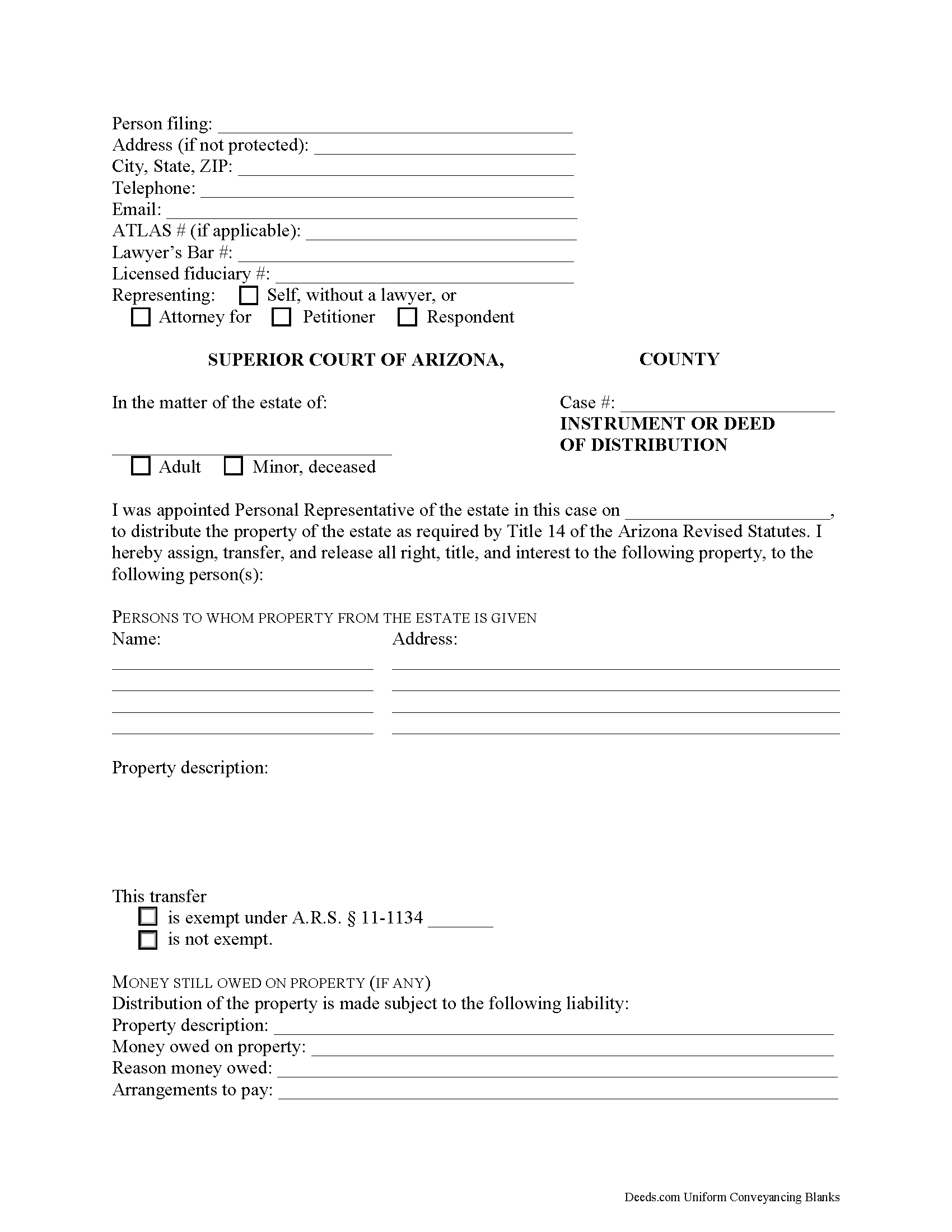
Pima County Personal Representative Deed of Distribution Form
Fill in the blank Personal Representative Deed of Distribution form formatted to comply with all Arizona recording and content requirements.
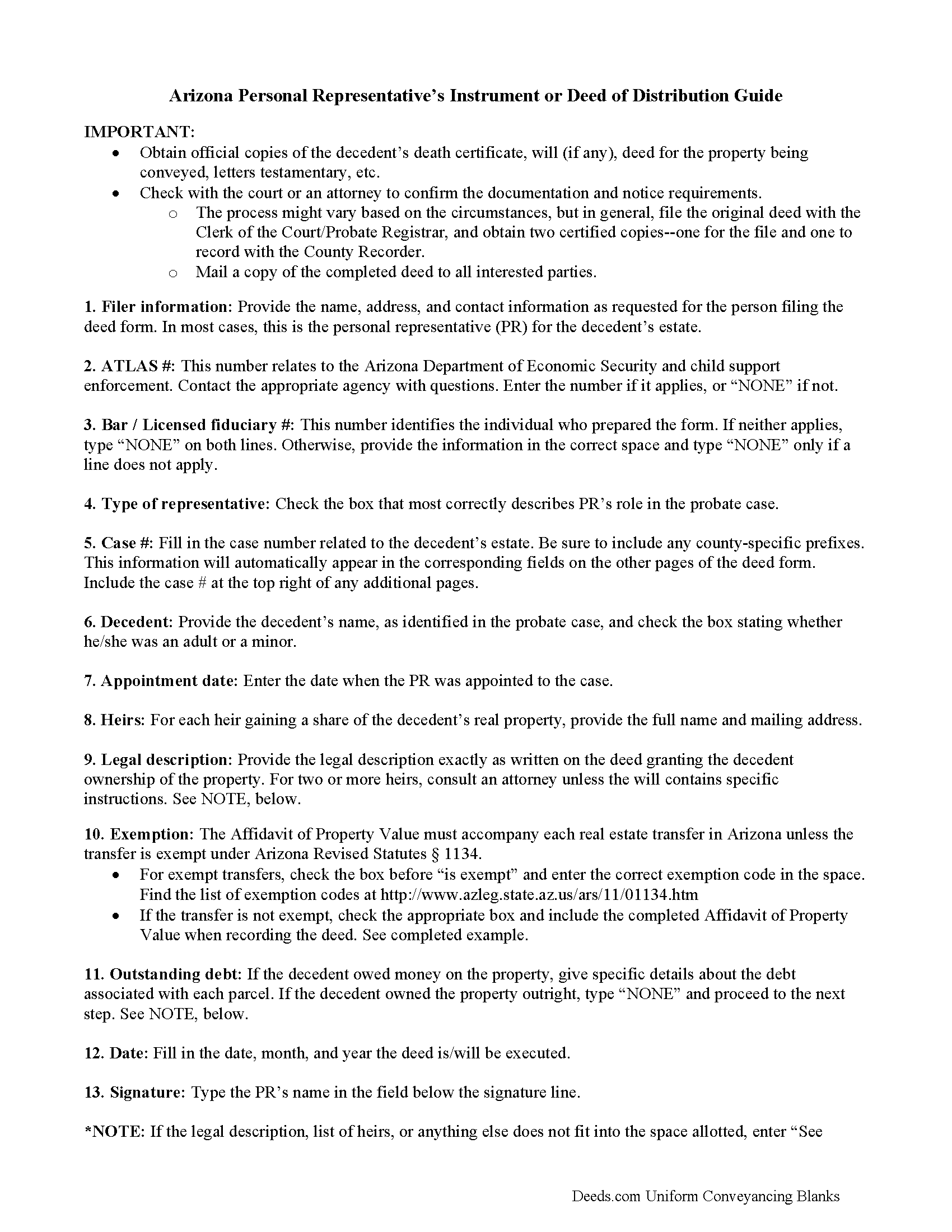
Pima County Personal Representative Deed of Distribution Guide
Line by line guide explaining every blank on the Personal Representative Deed of Distribution form.
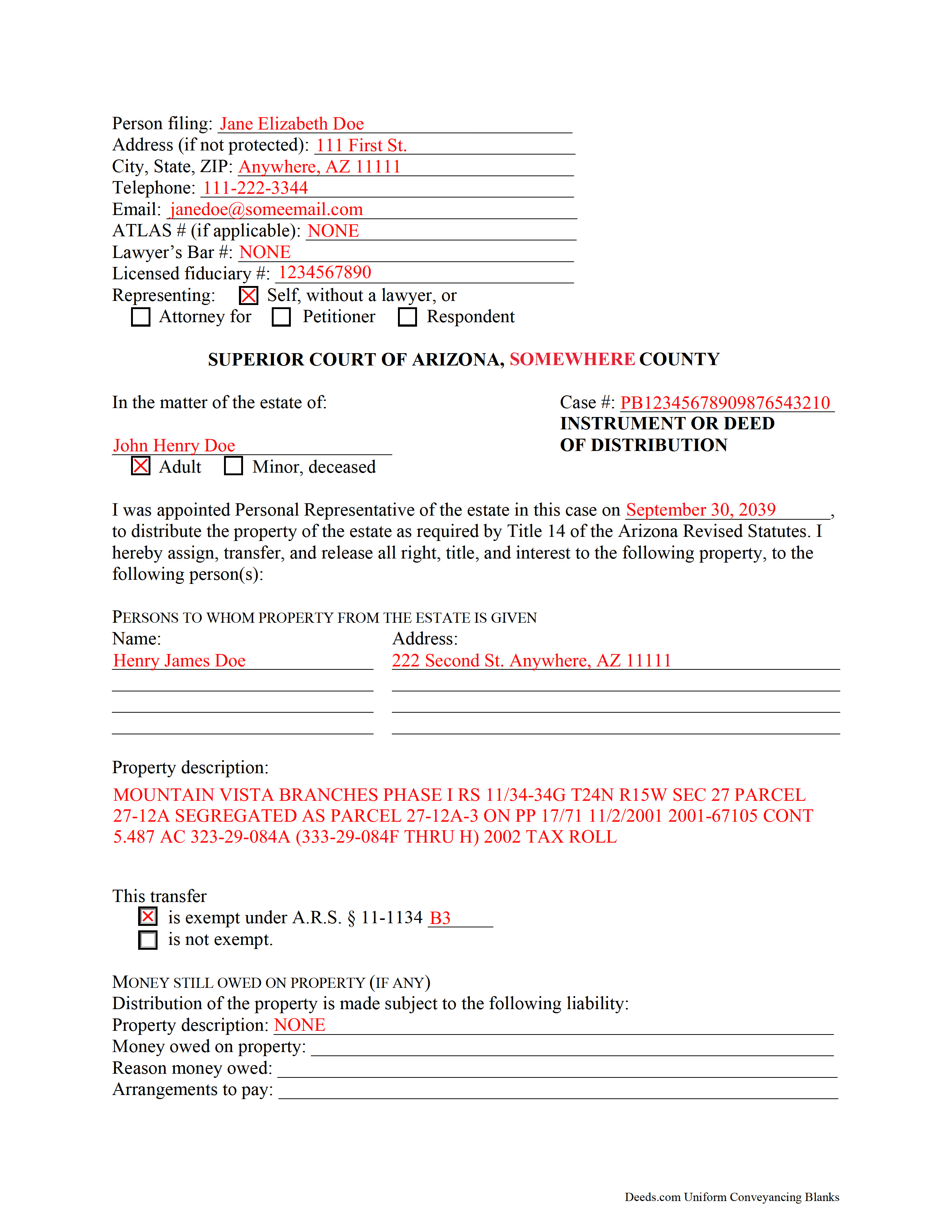
Pima County Completed Example of the Personal Representative Deed of Distribution Document
Example of a properly completed Arizona Personal Representative Deed of Distribution document for reference.
All 3 documents above included • One-time purchase • No recurring fees
Immediate Download • Secure Checkout
Additional Arizona and Pima County documents included at no extra charge:
Where to Record Your Documents
Recorder: Main Office
Tucson, Arizona 85701
Hours: Monday through Friday 8:00 am to 5:00 pm
Phone: 520) 740-4350
Recorder: Eastside Office
Tucson, Arizona 85710
Hours: Monday through Friday 8:00 to noon & 1:00 to 5:00
Phone: 520) 740-4350
Recording Tips for Pima County:
- Bring your driver's license or state-issued photo ID
- Ensure all signatures are in blue or black ink
- Make copies of your documents before recording - keep originals safe
- Recorded documents become public record - avoid including SSNs
- Recording fees may differ from what's posted online - verify current rates
Cities and Jurisdictions in Pima County
Properties in any of these areas use Pima County forms:
- Ajo
- Arivaca
- Catalina
- Cortaro
- Green Valley
- Lukeville
- Marana
- Mount Lemmon
- Rillito
- Sahuarita
- Sasabe
- Sells
- Topawa
- Tucson
- Vail
Hours, fees, requirements, and more for Pima County
How do I get my forms?
Forms are available for immediate download after payment. The Pima County forms will be in your account ready to download to your computer. An account is created for you during checkout if you don't have one. Forms are NOT emailed.
Are these forms guaranteed to be recordable in Pima County?
Yes. Our form blanks are guaranteed to meet or exceed the applicable formatting requirements used for recording in Pima County, including margin requirements, font requirements, and other layout standards. This guarantee applies to formatting, not to the legal sufficiency of information entered by the user or the suitability of a form for a particular transaction.
Can I reuse these forms?
Yes. You can reuse the forms for your personal use. For example, if you have multiple properties in Pima County you only need to order once.
What do I need to use these forms?
The forms are PDFs that you fill out on your computer. The free Adobe Acrobat Reader is recommended, and most PDF apps also work. You do NOT enter your property information online - you download the blank forms and complete them privately on your own computer.
Are there any recurring fees?
No. This is a one-time purchase. Nothing to cancel, no memberships, no recurring fees.
How much does it cost to record in Pima County?
Recording fees in Pima County vary. Contact the recorder's office at 520) 740-4350 for current fees.
Questions answered? Let's get started!
Download an Arizona Personal Representative Deed of Distribution form for documenting a probate distribution of Arizona real property from a decedent’s estate.
The Arizona Personal Representative Deed of Distribution is designed for probate situations where real property is being distributed from a decedent’s estate to the person or persons entitled to receive it. In Arizona probate practice, the court-appointed estate fiduciary is called the personal representative. The person receiving distributed estate property is commonly described as a distributee, heir, devisee, beneficiary, or other successor, depending on the facts of the estate.
This form follows Arizona’s distribution terminology. A.R.S. § 14-3907 refers to an “instrument or deed of distribution” executed by the personal representative when distribution in kind is made. The deed serves as written evidence that the estate’s interest in the described property has been assigned, transferred, or released to the distributee.
What This Arizona Deed of Distribution Does
This deed form documents a distribution of estate property by the personal representative. It identifies the probate case, the decedent’s estate, the personal representative, the person or persons receiving the property, and the real property being distributed.
The form is structured for a probate distribution rather than an ordinary sale deed. It is not framed as a buyer-seller transaction, and it is not the same product as an Arizona Personal Representative Special Warranty Deed. The deed of distribution is aimed at the estate-administration step where property is being distributed out of the probate estate.
When This Form Is Commonly Used
This form is commonly associated with an Arizona probate case in which a personal representative has been appointed and real property remains in the estate. The property may be distributed to a devisee named in a will, to heirs in an intestate estate, to multiple distributees, or to another person or entity entitled to receive the property through the estate administration.
The form can be used to show that the personal representative is assigning, transferring, and releasing the estate’s interest in the described property to the listed distributee or distributees. The form includes space for the court case number, the estate name, the appointment date, the recipients’ names and addresses, the property description, and any liability still owed on the property.
Why the Form Uses “Personal Representative”
Arizona uses the term “personal representative” for the fiduciary appointed to administer a decedent’s estate. In everyday language, people may use terms like executor or administrator. In the Arizona probate deed context, the deed identifies the signer by the role created by the probate appointment: personal representative of the estate.
That fiduciary capacity matters because the deed is not signed by the decedent and is not signed by the personal representative as an individual owner. It is signed by the personal representative in the representative role shown in the probate case.
How This Form Differs From a Personal Representative Special Warranty Deed
An Arizona Personal Representative Deed of Distribution and an Arizona Personal Representative Special Warranty Deed serve different transaction types.
The Deed of Distribution is for distribution of property from the estate to the person or persons entitled to receive it through probate. It uses a probate-style format and focuses on the estate case, the distributees, the property being distributed, and any money still owed on the property.
The Personal Representative Special Warranty Deed is a separate sale/conveyance product. It is designed for a deed-style transfer by the personal representative, often in an estate sale to a purchaser, and includes special warranty deed language. A sale transaction and a probate distribution are different fact patterns, so separating the forms helps users choose a document that matches the purpose of the transfer.
Information Requested in the Form
The Arizona Personal Representative Deed of Distribution form contains blanks for the information commonly associated with a probate distribution of real property. These include:
- the name and contact information for the person filing the document;
- the Arizona superior court county and probate case number;
- the name of the decedent’s estate;
- whether the decedent was an adult or minor;
- the date the personal representative was appointed;
- the names and addresses of the persons receiving property from the estate;
- the property description;
- whether the transfer is identified as exempt under A.R.S. § 11-1134 or not exempt;
- any money still owed on the property;
- the reason money is owed and payment arrangements, if stated;
- the date of signing;
- the personal representative’s signature and printed name;
- the notary acknowledgment; and
- an Exhibit A page for the legal description or additional property information.
Property Description and Exhibit A
The form includes space for the property description and provides an Exhibit A page. The property description section is where the real property being distributed is identified. For many Arizona real estate documents, the legal description is different from the street address, and the Exhibit A page gives room for the longer legal description when the description does not fit neatly in the main body of the form.
The form is designed to keep the property description tied to the probate distribution, the named distributees, and the personal representative’s signature.
Money Still Owed on the Property
The deed includes a section for money still owed on the property, if any. This section allows the document to describe liabilities connected with the distributed property, the reason money is owed, and the arrangements stated for payment.
This section is descriptive. It provides space to identify an existing liability connected with the property; it does not determine the legal effect of a mortgage, lien, debt, claim, or estate obligation.
Affidavit of Property Value and Exemption Notation
The form includes a transfer-exemption section referencing A.R.S. § 11-1134. Arizona deeds that evidence a transfer of title are commonly associated with an affidavit of legal value, often referred to in practice as an Affidavit of Property Value, unless the instrument bears an exemption notation.
Because probate distributions can vary, the form provides a place to indicate whether the transfer is identified as exempt or not exempt. The form does not select an exemption for the user or determine whether a particular transfer qualifies for a specific statutory exemption.
Arizona Recording Format
The form is formatted for Arizona recording practice, including a document caption, readable type, recording margins, and a notary acknowledgment. Arizona recording rules include requirements for a caption, legibility, original signatures unless otherwise provided by law, page size, print size, margins, and a first-page recording area.
County recorder offices may have practical filing procedures in addition to the statewide formatting rules. This product is drafted for the Arizona deed-of-distribution format while leaving the transaction-specific and county-specific details to be completed in the form.
What Is Included in the Download Package
The Arizona Personal Representative Deed of Distribution package includes:
- a fillable PDF deed of distribution form;
- a completed example using sample information; and
- a blank-by-blank field guide explaining the purpose of each blank on the form.
The completed example shows how the form may appear when filled out for a basic probate distribution. The field guide describes the purpose of each blank in plain language so the user can understand what information the form is requesting.
Designed for a Standard Probate Distribution
This product is intended for a standard Arizona probate distribution of real property by a personal representative. It is built around the court case, the decedent’s estate, the personal representative’s appointment, the distributees receiving the property, and the real property being distributed.
The form does not determine whether probate is required, whether the signer has current authority, whether a distribution is proper, whether all estate debts or claims have been handled, whether a particular person is entitled to receive the property, whether a property-value affidavit or exemption applies, or whether title is acceptable for a specific transaction. Those are transaction-specific issues outside the function of a blank deed form.
Good Fit for Searches Like These
This product may match users searching for:
- Arizona personal representative deed of distribution;
- Arizona deed of distribution form;
- Arizona probate deed of distribution;
- Arizona instrument or deed of distribution;
- personal representative deed of distribution Arizona;
- Arizona probate real estate distribution form;
- executor deed of distribution Arizona;
- administrator deed of distribution Arizona; or
- Arizona estate property distribution deed.
Important Product Note
This is a deed form and educational document package, not a legal opinion, title opinion, or substitute for transaction-specific review. Probate authority, estate-administration facts, title status, creditor issues, beneficiary rights, tax statements, and county recording practices can affect a particular transaction.
The form is written to describe and document a personal representative’s distribution of estate property. It does not decide whether a distribution is legally appropriate for a specific estate.
Download the Arizona Personal Representative Deed of Distribution form package to receive the fillable deed, completed example, and blank-by-blank field guide.
Important: Your property must be located in Pima County to use these forms. Documents should be recorded at the county recording office listed above.
This Personal Representative Deed of Distribution meets all recording requirements specific to Pima County.
Our Promise
The documents you receive here are guaranteed to meet or exceed the applicable Pima County recording format requirements. If there is a rejection caused by our formatting, we will correct the issue or refund your payment. This guarantee applies to document formatting only and does not extend to information entered by the user, the selection of the form, or the legal effect of the completed document.
Save Time and Money
Get your Pima County Personal Representative Deed of Distribution form done right the first time with Deeds.com Uniform Conveyancing Blanks. At Deeds.com, we understand that your time and money are valuable resources, and we don't want you to face a penalty fee or rejection imposed by a county recorder for submitting nonstandard documents. We constantly review and update our forms to meet rapidly changing state and county recording requirements for roughly 3,500 counties and local jurisdictions.
4.8 out of 5 - ( 4,828 Reviews )
David S. 5 out of 5 stars
All Star Support and less than a one day turnaround. Outstanding service. Thank you !
We appreciate your business and value your feedback. Thank you. Have a wonderful day!
Billy A. 5 out of 5 stars
Documents were as described, Will not be able to tell if it works or not.. Will be Dead, but easy enough to fill out.
Thank you for taking a moment to share your thoughts.
Barbara C. 5 out of 5 stars
Excellent site; easy to use
Thank you!
Irwin C. 5 out of 5 stars
For starters, enrolling was as easy as could be. Then, it only took minutes before my entry was formatted and filed. Finally, when I asked a question, I got an answer within a few minutes. Couldn't be happier with service
We appreciate your business and value your feedback. Thank you. Have a wonderful day!
Jill R. 5 out of 5 stars
So helpful and extremely responsive. Such a convenient way to record deeds.
We appreciate your business and value your feedback. Thank you. Have a wonderful day!
Kelly M. 5 out of 5 stars
Deeds.com made it so easy and convenient to get my homestead document recorded. Thank you!
We appreciate your business and value your feedback. Thank you. Have a wonderful day!
Lori F. 5 out of 5 stars
That was easy!
Thank you for your feedback. We really appreciate it. Have a great day!
Sylvia B. 5 out of 5 stars
What a wonderful resource! Forms are so easy to use, made the process a breeze. Deeds even helped with the recording. Thank you.
We appreciate your business and value your feedback. Thank you. Have a wonderful day!
Scott G. 5 out of 5 stars
Frankly, if our tax dollars were being used to run government "services" correctly, we wouldn't need Deeds.com Since the sun will burn out before government is run correctly, Deeds.com provides an important, efficient, time-saving service that, all things considered, offers big savings over time-and-soul-draining struggles with government agencies.
Your feedback is greatly appreciated. Thank you for taking the time to share your experience!
Christine S. 5 out of 5 stars
Very good site! I found everything I needed right here on Deeds.com. Excellent quality forms, easy access, perfect delivery, reasonable price
We appreciate your business and value your feedback. Thank you. Have a wonderful day!
Rachelle S. 5 out of 5 stars
Wow that was easy
Thank you!
Susan N. 5 out of 5 stars
Easy to use.
Thank you!
william w. 5 out of 5 stars
Simple, straight forward, and easy to use.
We appreciate your business and value your feedback. Thank you. Have a wonderful day!
Arthur T. 5 out of 5 stars
Thanks
Thank you!
Hugh B R. 5 out of 5 stars
Very user friendly and fast. Pleasure using this site.
Thank you for your feedback. We really appreciate it. Have a great day!