Florida Notice to Contractor
County Specific Legal Forms Validated as recently as October 16, 2026 by our Forms Development Team
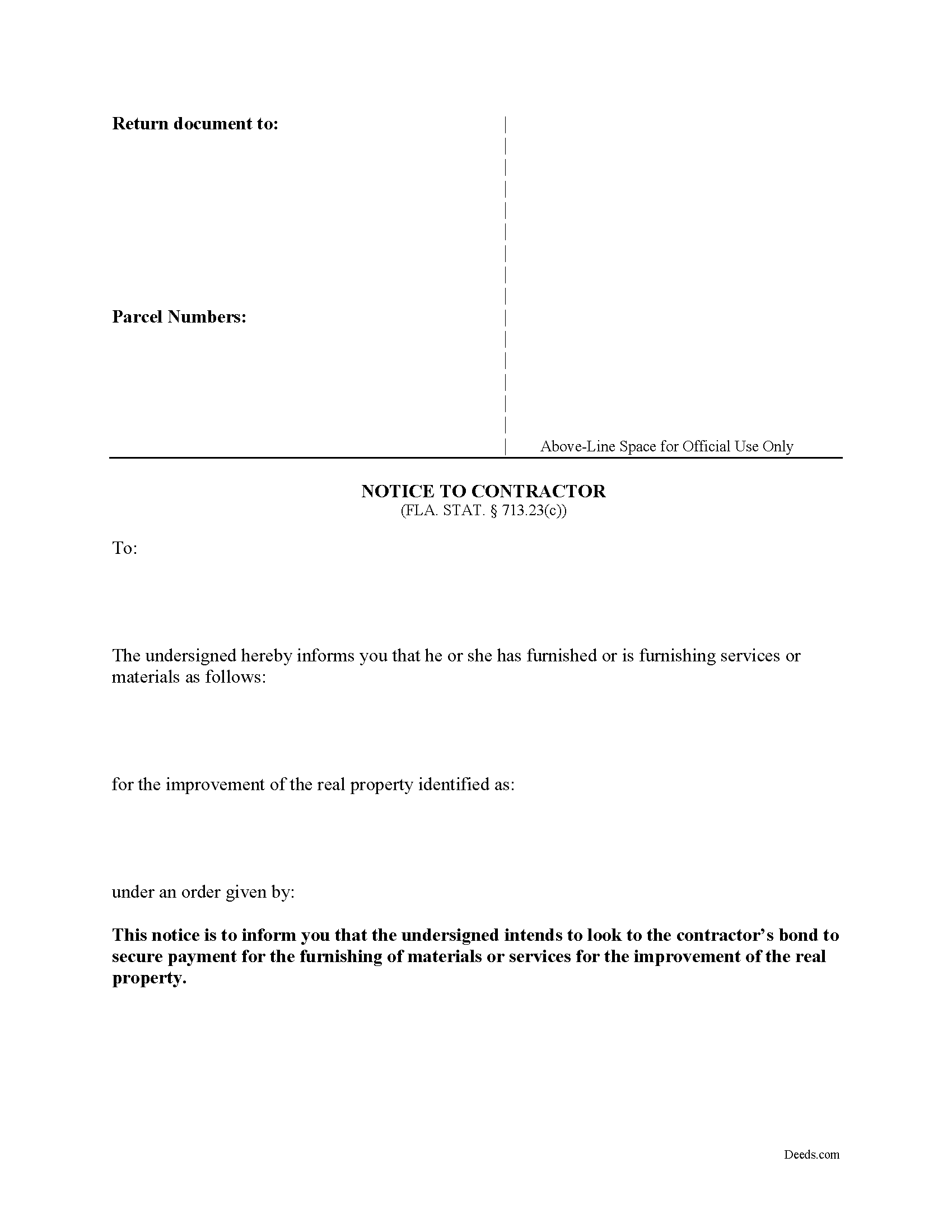
About the Florida Notice to Contractor
How to Use This Form
- Select your county from the list
- Download the county-specific form
- Fill in the required information
- Have the document notarized if required
- Record with your county recorder's office
What Others Like You Are Saying
"Package downloaded without any problems. Help sheet was fair. Maybe they could cross reference the h…"
"Easy process!"
"Easy to use, inexpensive, very helpful"
"quick, easy and simple. Also thank you for having the e-submission area particularly with the Covid-…"
"This form really helped me out a lot could be a little more explanatory in some areas but all and al…"
4.8/5 from 4,828 reviews. Read all
Florida's construction lien law splits payment-protection notices into two parallel tracks, and the Florida Notice to Contractor belongs to one of them. When a general contractor has furnished a statutory payment bond under FLA. STAT. 713.23 — recorded with the notice of commencement before work begins — a subcontractor or supplier not in direct contract with the general contractor cannot rely on the standard Notice to Owner. The bond replaces the property as the security for payment, and the document that perfects a claim against that bond is the Notice to Contractor. Sending the wrong notice, or sending the right notice late, eliminates the bond as a payment source.
What the Florida Notice to Contractor Does and When It Is Used
This notice tells the general contractor — and, in practice, the surety — that the lienor intends to look to the payment bond for protection on the work being supplied. It applies to private Florida construction projects where a 713.23 statutory payment bond has been recorded along with the notice of commencement. Material suppliers, sub-subcontractors, equipment lessors, and other lienors who are not contractually connected to the general contractor must serve this notice to preserve a claim. Laborers and parties in privity with the general contractor are excepted. Federal projects fall under the Miller Act and use a different mechanism entirely.
Statutory Requirements Under FLA. STAT. 713.23
The form identifies the parties and the project. At a minimum it names the owner who ordered the work, the general contractor coordinating the project, and the lienor furnishing labor or materials. It describes the real property where the improvement is being made and identifies the type of work or materials being supplied. The notice substantially follows the form set out in the statute (FLA. STAT. 713.23(1)(c)). Florida courts construe lien-law compliance strictly, and homemade variations risk being held insufficient.
The 45-Day Clock and Its Alternative
Timing is the trap that ends most bond claims. A lienor not in privity with the contractor — except a laborer — must serve the notice before beginning, or within 45 days after beginning, to furnish labor, materials, or supplies (FLA. STAT. 713.23(1)(c)). The clock runs from the first day of furnishing — not from the contract date and not from the purchase order.
An alternative window applies when the notice of commencement with the bond attached is not recorded before construction begins. In that situation, the lienor may serve the notice up to 45 days after being served with a copy of the bond (FLA. STAT. 713.23(1)(c)). A lienor who has not been provided a copy of the bond is entitled to demand one, and the statute imposes consequences on a party who refuses to furnish it.
Notice of Nonpayment — The Second Required Notice
The Notice to Contractor preserves the right to claim, but it is not the only notice the statute requires. Before bringing an action against the bond, the lienor must also serve a written notice of nonpayment on the contractor and the surety not later than 90 days after final furnishing of labor, services, or materials by the lienor (FLA. STAT. 713.23(1)(d)). The 90-day notice of nonpayment is a separate document with its own deadline; missing it eliminates the bond claim even when the initial Notice to Contractor was timely and correctly served.
How the Notice Must Be Served
Unlike many lien-related documents in Florida, the Notice to Contractor is served — not recorded with the county clerk. Service follows the methods authorized by FLA. STAT. 713.18: actual delivery to the person being served, or by common carrier delivery service or U.S. mail (registered, certified, or first-class with a certificate of mailing). Proof of service must be retained, because a bond claim that proceeds to litigation will turn on it.
Florida-Specific Traps
- Confusing the Notice to Contractor with the Notice to Owner. The Notice to Owner under FLA. STAT. 713.06 perfects a lien against real property on non-bonded jobs. The Notice to Contractor under 713.23 perfects a claim against a payment bond. They are not interchangeable, and using the wrong one on a bonded job is fatal to the claim.
- Statutory bond versus common law bond. Section 713.23 governs statutory payment bonds that meet the section's requirements. A bond that does not conform to 713.23 may be treated as a common law bond, and the statutory notice rules may not apply in the same way.
- The 45-day clock runs from first furnishing. Not from contract execution, not from a purchase order, not from delivery to the jobsite — the clock starts when the lienor first furnishes materials or services to the project.
- One-year limit on action against the bond. An action on the payment bond must be brought within one year (FLA. STAT. 713.23(1)(e)). This deadline is measured from the statutory trigger and cannot be casually extended.
- Strict construction against the lienor. Florida courts read the lien and bond statutes strictly against the party claiming the right. Defects that might be excused in other states are routinely fatal here.
- Identifying the correct bond and surety. The lienor must look to the specific bond recorded with the notice of commencement. Naming the wrong surety, or relying on a non-conforming bond document, undermines the claim before it begins.
What Is Included in the Download Package
The Florida Notice to Contractor download includes the fillable form prepared by the Deeds.com forms development team, completed-example pages illustrating typical entries, and a guide outlining the statutory framework, deadlines, and service requirements under FLA. STAT. 713.23. Files are delivered as instant downloads after checkout.
Important: County-Specific Forms
Our notice to contractor forms are specifically formatted for each of the 67 counties in Florida.
After selecting your county, you'll receive forms that meet all local recording requirements, ensuring your documents will be accepted without delays or rejection fees.