Florida Notice of Nonpayment
County Specific Legal Forms Validated as recently as August 24, 2026 by our Forms Development Team
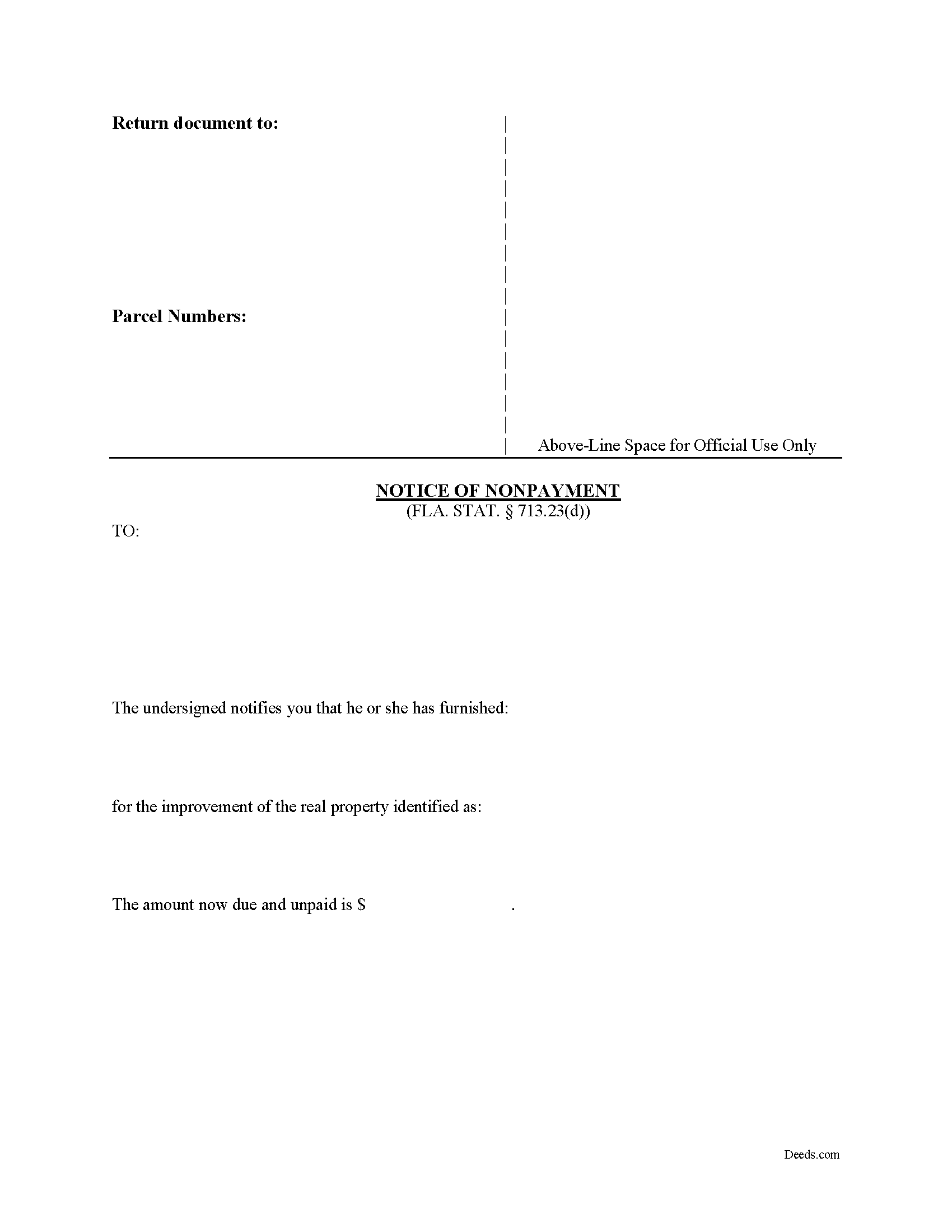
About the Florida Notice of Nonpayment
How to Use This Form
- Select your county from the list
- Download the county-specific form
- Fill in the required information
- Have the document notarized if required
- Record with your county recorder's office
What Others Like You Are Saying
"I found the site to be useful,informative and very accessable. Thank You"
"Th forms were correct, exactly what I needed."
"Exactly what I needed, at a reasonable cost."
"It's all good!!!!"
"The process to record took five minutes of my time, and within 45 minutes, my document was recorded!…"
4.8/5 from 4,823 reviews. Read all
The Florida Notice of Nonpayment is the document an unpaid subcontractor, sub-subcontractor, laborer, or material supplier must serve to preserve a claim against the contractor's payment bond on a private bonded construction project in Florida. It exists because of Florida's particular approach to private bonded work under Chapter 713 of the Florida Statutes: when a contractor records a payment bond under § 713.23, the lien rights that would otherwise attach to the property are transferred to the bond, and the lienor's path to payment runs through a strict statutory notice sequence rather than through a recorded mechanic's lien. Miss a deadline in that sequence and the bond claim is gone, regardless of how solid the underlying debt is.
Florida's version of this notice differs from bond claim notices in many other states. Florida demands a sworn statement, imposes a fixed 90-day deadline measured from the lienor's final furnishing, requires service on both the contractor and the surety, and treats willful exaggeration of the amount owed as forfeiture of the bond claim. Those features come from § 713.23(1)(d) and the related provisions of Chapter 713; they are not optional drafting preferences.
When the Florida Notice of Nonpayment Is Used
This notice applies to private construction projects in Florida where the contractor has recorded a payment bond that conditionally exempts the property from mechanic's liens under § 713.23. After the lienor has finished furnishing labor, services, or materials and remains unpaid, the notice tells the contractor and surety that money is still owed, identifies the work, and triggers the surety's obligation to evaluate and pay the claim. Public projects bonded under § 255.05 use a different notice scheme. This form is for the private payment bond context governed by § 713.23.
What Section 713.23(1)(d) Requires in the Notice
The statute is specific about content. A Florida Notice of Nonpayment must state, under oath:
- The name of the lienor and the address to which the contractor or surety should respond
- The name of the person for whom the labor, services, or materials were furnished
- A description of the labor, services, or materials furnished and the contract price or value
- The amount paid, if any, on account of the labor, services, or materials
- The amount due and unpaid as of the date of the notice
The "under oath" requirement is not a formality. The form must be acknowledged before a notary or other officer authorized to administer oaths, and Florida courts have rejected bond claims where the verification was missing or technically defective.
The 90-Day Deadline and What "Final Furnishing" Means
Section 713.23(1)(d) requires the lienor to serve the notice within 90 days after the final furnishing of labor, services, or materials by the lienor. Florida courts and the statute itself have narrowed what counts as final furnishing in ways that catch lienors off guard. Punchlist work, warranty repairs, returning to fix defective work, and minor correctional items generally do not restart the clock. The 90 days runs from the last day of substantive contract work, and sending a worker back to the site to extend a deadline is a recognized trap that contractors and sureties routinely challenge. The deadline is firm, and courts do not extend it for equitable reasons.
Service Requirements Under Florida Law
Section 713.23(1)(d) requires service on both the contractor and the surety. Service on one without the other is a defective notice. Section 713.18 controls the manner of service and accepts personal delivery, certified or registered mail with return receipt requested, and the other methods listed in that section. Certified mail with return receipt is standard practice because it produces the proof of delivery a lienor will need if the claim ends up in litigation. The contractor's address and the surety's address are typically found on the recorded Notice of Commencement and on the recorded payment bond itself, and a lienor relying on stale or informal addresses without verifying them against the recorded documents is taking an unnecessary risk.
Florida-Specific Traps Beyond the Basic Requirements
- The prerequisite Notice to Contractor. A Notice of Nonpayment alone does not preserve bond rights. Subcontractors and suppliers who do not have a direct contract with the contractor must also have served a Notice to Contractor under § 713.23(1)(c), generally within 45 days of first furnishing. The Notice of Nonpayment does not cure a missed Notice to Contractor.
- Willfully exaggerated amounts. Under § 713.23, a fraudulent notice of nonpayment forfeits the lienor's rights under the bond, and the consequence falls on the entire claim rather than only on the inflated portion. Padding the figure to include disputed change orders the lienor knows are not yet owed is a high-risk move.
- Confusing the private bond statute with the public project statute. Section 713.23 governs private bonds. Section 255.05 governs bonds on public projects. The notices, deadlines, and procedures are not interchangeable, and using the wrong form is a frequent source of denied claims.
- Treating service of the notice as collection. Service preserves the right to sue on the bond, but it does not by itself produce payment. The lienor must still bring an action on the bond within the limitations period set by § 713.23(1)(e), which runs from final furnishing.
- Earliest-service rule. A Notice of Nonpayment given before 45 days after the lienor began to furnish labor, services, or materials is premature under § 713.23(1)(d). The 90-day window is the back end; there is also a front-end restriction.
What's Included in the Download Package
The download package contains the Florida Notice of Nonpayment form drafted to the requirements of § 713.23(1)(d), a completed example showing how each field should be populated, and a guide that walks through service options under § 713.18, the 90-day deadline, and the prerequisite Notice to Contractor for parties without a direct contract with the contractor. The forms are prepared by the Deeds.com forms development team and are formatted for service on the contractor and surety. Files are delivered as an instant download upon purchase.
Important: County-Specific Forms
Our notice of nonpayment forms are specifically formatted for each of the 67 counties in Florida.
After selecting your county, you'll receive forms that meet all local recording requirements, ensuring your documents will be accepted without delays or rejection fees.