Kansas Quitclaim Deed (Corrective)
County Specific Legal Forms Validated as recently as October 5, 2026 by our Forms Development Team
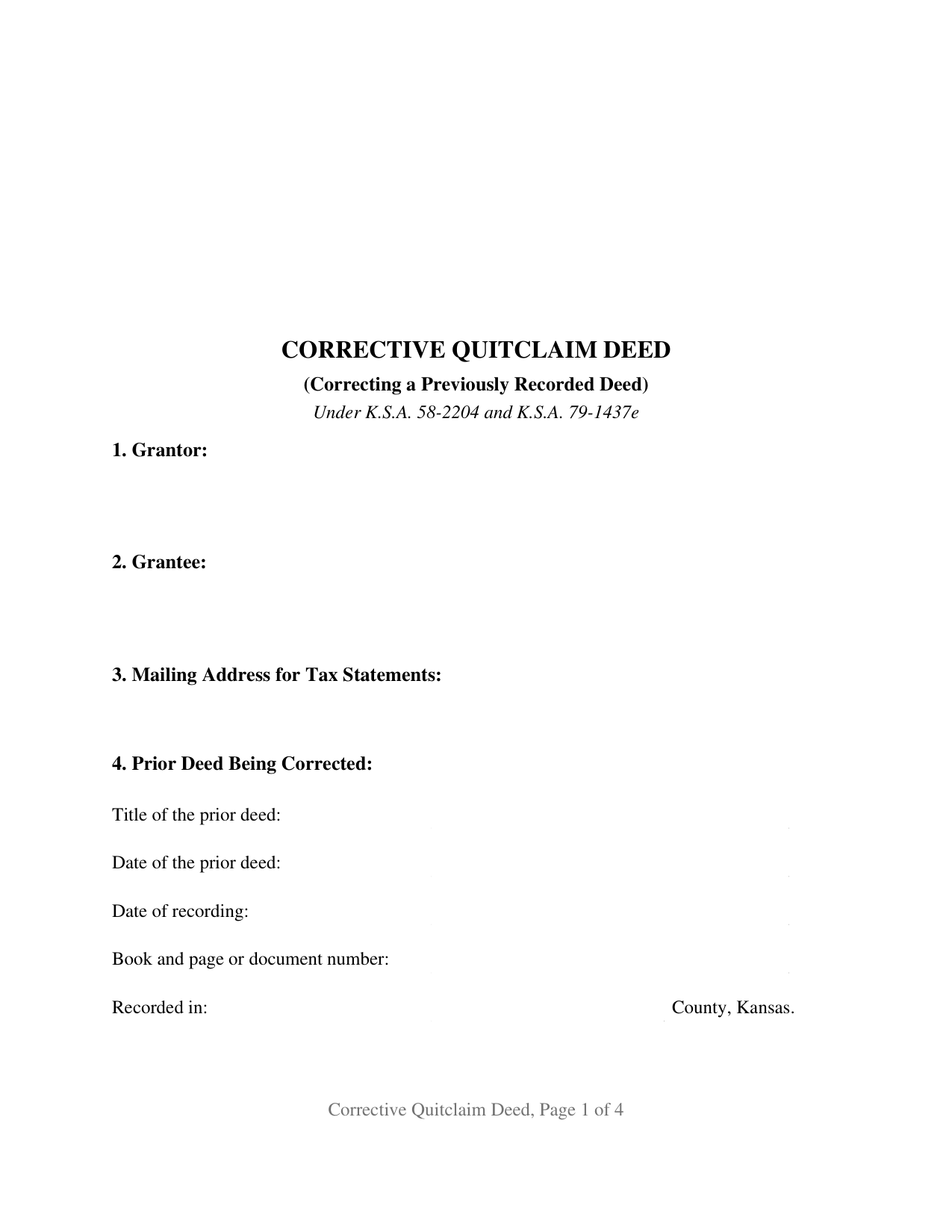
About the Kansas Quitclaim Deed (Corrective)
How to Use This Form
- Select your county from the list
- Download the county-specific form
- Fill in the required information
- Have the document notarized if required
- Record with your county recorder's office
What Others Like You Are Saying
"Thank you for your service,,you have a very good site,,easy to use"
"Wow! Nice and easy!"
"My complete name is Johnny Alicea Rodriguez And the DEED is on my half brother and mine name. Jimmy …"
"Deed.com had some hard to find mineral interest deeds for Oklahoma.I'm an attorney in Texas with no …"
"I Love Deeds.com. They have all of the documents you need to take care of your needs. IT is also saf…"
4.8/5 from 4,832 reviews. Read all
Every other Kansas deed looks forward. This one looks back, at an instrument already stamped, indexed, and sitting in a register of deeds' books with something wrong on its face. The grantor of that earlier deed signs again; the form names it by date, recording date, and document number, sets the wording it carries beside the wording it was meant to carry, and quitclaims. Buyers arrive searching for a Kansas correction deed, a corrective deed, or a scrivener's error deed.
Kansas leaves this one to ordinary conveyancing law
There is no Kansas correction-instrument statute. Nothing in the conveyancing chapter defines one, prescribes its contents, or dates it earlier than its own delivery. A corrective quitclaim therefore runs on the plain conveyancing sentence: K.S.A. 58-2204 asks only that the instrument read in substance that the grantor quitclaims the described premises for the sum stated, signed and acknowledged. K.S.A. 58-2202 still passes the grantor's entire estate unless the instrument shows a smaller one, and no covenant K.S.A. 58-2203 hangs on the words conveys and warrants travels along. Fixing a typographical error improves the record; it improves no title. Where the two sides disagree, the repair leaves the counter altogether, because reformation is an equitable remedy for mutual mistake or fraud, described in Liggatt v. Employers Mut. Cas. Co., 273 Kan. 915.
Exemption 3, and how narrowly the state reads it
Kansas questionnaire law has one entry written for this instrument. K.S.A. 79-1437e(a)(3) lifts out a transfer of title made for the purpose of confirming, correcting, modifying or supplementing a deed previously recorded, and without additional consideration. Kansas Department of Revenue Directive 19-041 reads it tightly, concluding that the recurrent theme is an incidental change rather than a change in substance, and that for a deed previously recorded the change does not change the grantor or the grantee, although a name's spelling may be corrected. A document adding an owner, dropping one, or enlarging the land described is a fresh conveyance whatever it is titled. Section 9 holds the statement either way, since the same directive tells registers of deeds not to write exemption information onto a deed.
One grantor, and two blocks that face each other
The form states one individual grantor, who granted the deed named in Section 4, together with one grantee. Eleven numbered sections gather the parties, the tax statement address K.S.A. 58-2221 puts in the county clerk's hands, the consideration, the corrected legal description, matters of record, and the questionnaire statement. Section 4 is the earlier instrument's fingerprint: title, dates, document number, county. Section 7 is the correction, drawn as two facing blocks, earlier wording in one and corrected wording in the other, so the difference reads at a glance. One signature block above a printed name line and one Kansas short form certificate under K.A.R. 7-43-17 close the document. Errors presenting this configuration include a wrong lot or block number in a platted description, a party name misspelled or short a middle initial, and a grantee line missing the co-ownership words the parties intended. A single signature line is drawn, with no spousal consent block and no trustee, entity, or agency capacity, so an earlier deed signed by two people, or in a representative capacity, presents a signing arrangement this layout does not carry.
The register compares before recording
Kansas recording law expects errors to surface at the counter. K.S.A. 58-2221 directs the register of deeds, in counties keeping a numerical index, to compare an instrument against the last record of transfer before copying it into the record, and where apparent errors turn up, the instrument waits until the grantee has been notified, where such notice is reasonably possible. A corrective deed is measured against the very deed it addresses. Recording also makes the repair public, since K.S.A. 58-2222 attaches notice of an instrument's contents to the moment of filing. County schedules under K.S.A. 28-115 publish twenty-one dollars for a first page, seventeen thereafter, and Kansas imposes no deed transfer tax. One limit the guide develops: no Kansas statute or located decision gives a corrective deed an effective date earlier than its own delivery.
Included in the download: the fillable Kansas corrective quitclaim deed, a completed example set in Harvey County where a Newton grantor corrects the spelling of her own name on a 2024 instrument, and a guide walking the eleven sections, the correction and reformation rules behind them, and the filing. Kansas law is described in general terms only, and nothing here is legal advice.
Important: County-Specific Forms
Our quitclaim deed (corrective) forms are specifically formatted for each of the 105 counties in Kansas.
After selecting your county, you'll receive forms that meet all local recording requirements, ensuring your documents will be accepted without delays or rejection fees.