Kansas Quitclaim Deed (Married Grantor with Non-Owner Spouse Joinder)
County Specific Legal Forms Validated as recently as September 17, 2026 by our Forms Development Team
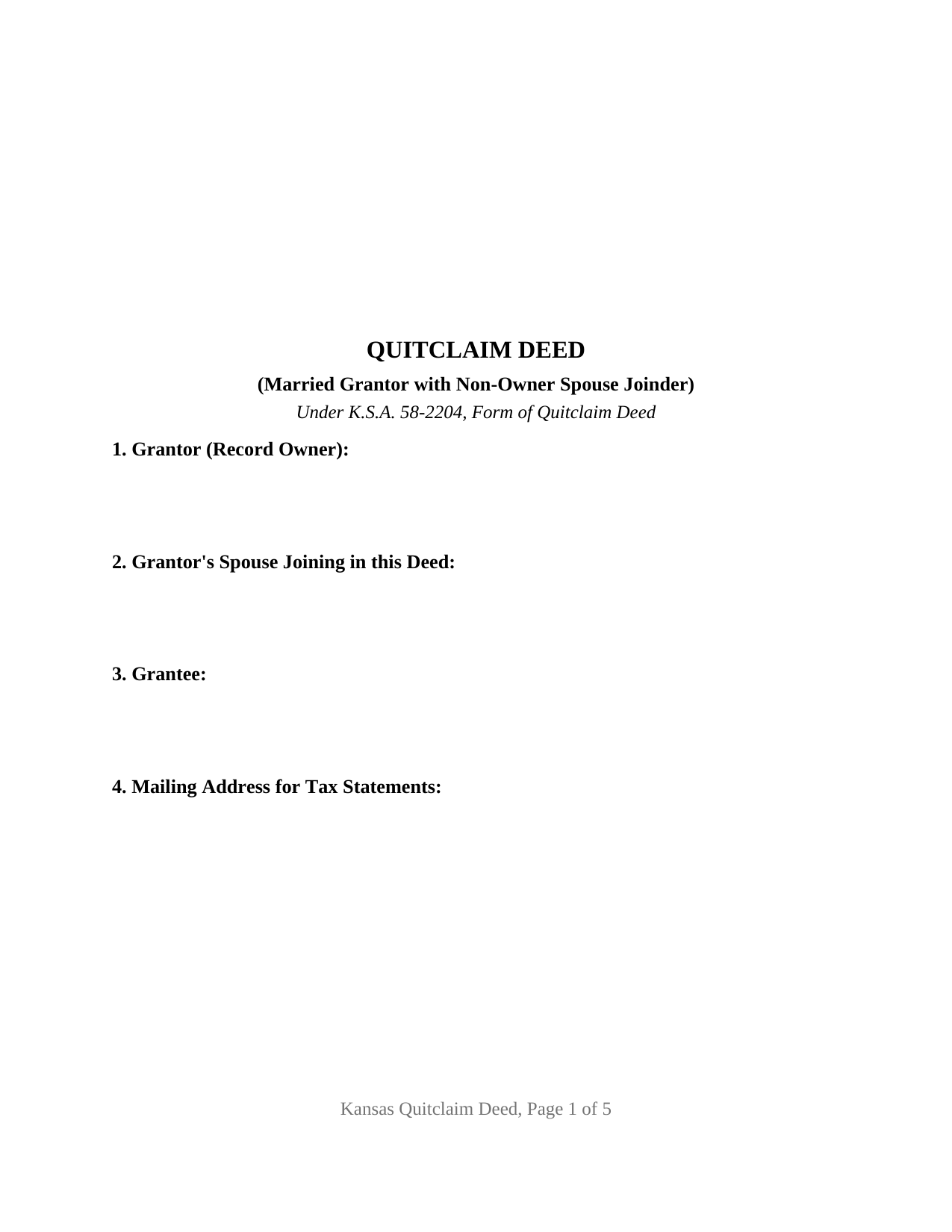
About the Kansas Quitclaim Deed (Married Grantor with Non-Owner Spouse Joinder)
How to Use This Form
- Select your county from the list
- Download the county-specific form
- Fill in the required information
- Have the document notarized if required
- Record with your county recorder's office
What Others Like You Are Saying
"As an experienced attorney new to estate planning, I attest that this website and its documents were…"
"Great..."
"Kind of expensive for a 3 page item...but I received it pronto and it will fill the bill."
"My experience could not have been better. Easy to communicate with, even though I'm largely ignorant…"
"Easy, fast, and a they even check your work before submitting it. Very convenient service."
4.8/5 from 4,828 reviews. Read all
One name sits in the granting clause of this Kansas quitclaim deed, and two names sit at the signature lines. The record owner is the only Grantor. That owner's husband or wife, holding no record title, signs the same page under a section spelling out what that signature does and does not do: the spouse consents, releases a homestead interest, and conveys nothing. A Kansas quit claim deed or quick claim deed with spousal consent means this arrangement.
A consent that is not a conveyance
Two Kansas rules reach a married owner's lifetime deed, for different reasons. Section 9 of Article 15 of the Kansas Constitution, echoed in K.S.A. 60-2301, protects a homestead of 160 acres of farming land or one acre inside a town or city occupied as a residence by the owner's family, and forbids alienation of it without the joint consent of husband and wife. Occupancy, not the source of title, makes land homestead in Kansas. Separately, K.S.A. 59-505 hands a surviving spouse one-half of any real estate the deceased spouse held at any point during the marriage and disposed of without the survivor's written consent. Section 12 answers both grounds and stops there: the joining spouse gives the constitutional consent, consents in writing for purposes of K.S.A. 59-505, releases every homestead and marital interest to the Grantee, and takes on no covenant of title. The annotations to K.S.A. 60-2301 report U.S. Bank NA v. McConnell, 48 Kan. App. 2d 892, where a spouse who signed a mortgage without signing the underlying note voluntarily consented to alienation of homestead rights.
One grantor, one joining spouse, thirteen sections
The architecture follows from that split. Section 1 collects a single record owner and Section 2 the spouse who joins; the sections between gather the grantee, the address Kansas routes to the county tax rolls under K.S.A. 58-2221, the consideration, the legal description, the source of title, and the sales validation statement. Section 11 then performs the conveyance and Section 12 the consent. Two labeled signature blocks follow, one captioned for the record owner and one for the joining spouse who is not a record owner, each carrying a printed name line, the typed-name practice of K.S.A. 28-115(c). A Kansas short-form certificate from K.A.R. 7-43-17 follows each signature, so the two acknowledgments can be taken weeks apart in different counties. Ownership patterns presenting this shape include a vesting deed older than the marriage passed to a child of an earlier marriage, a tract received alone from a parent released to a sibling, and occupied land whose record title has never carried the spouse's name. The form describes one record owner joined by one non-owner spouse, both acting personally; it states no trustee, entity, or agency capacity, and a transaction in which every signer already holds record title follows a different layout.
Quitclaim, in the 1887 words
K.S.A. 58-2204 has read the same way since 1887: a conveyance worded in substance as A.B. quitclaims to C.D., describing the premises, for a stated sum, signed and acknowledged by the grantor, is a good and sufficient conveyance in quitclaim. Substance rather than exact phrasing is the test, and Section 11 satisfies it in one sentence keyed to the blanks above it. What travels is the Grantor's interest as it stands at delivery. Absent by design is every covenant K.S.A. 58-2203 attaches to conveys and warrants: seizin, freedom from encumbrances, quiet possession, and the duty to defend.
Across the counter at the register of deeds
Two intake items decide whether the deed goes on record. First the questionnaire: K.S.A. 79-1437c blocks recording of a title transfer unless a completed Kansas sales validation questionnaire travels with it, or a K.S.A. 79-1437e exemption is written onto the instrument by the parties, the register having no authority to add it. Section 10 holds that space. Second the fee, published on county schedules under K.S.A. 28-115 at twenty-one dollars for page one and seventeen for each page after, with no deed transfer tax in Kansas. K.S.A. 28-115(e) meets a cramped first page with an added sheet at an added fee, so page one here holds three inches open.
The purchase brings the fillable deed, a completed example set in Shawnee County where a Topeka owner conveys to his adult son while his wife joins to consent, and a guide covering all thirteen sections, both consent statutes, the notarization of each signature, and recording. The materials describe Kansas law in general terms and are not legal advice.
Important: County-Specific Forms
Our quitclaim deed (married grantor with non-owner spouse joinder) forms are specifically formatted for each of the 105 counties in Kansas.
After selecting your county, you'll receive forms that meet all local recording requirements, ensuring your documents will be accepted without delays or rejection fees.