Kansas Quitclaim Deed (Interspousal)
County Specific Legal Forms Validated as recently as October 16, 2026 by our Forms Development Team
About the Kansas Quitclaim Deed (Interspousal)
How to Use This Form
- Select your county from the list
- Download the county-specific form
- Fill in the required information
- Have the document notarized if required
- Record with your county recorder's office
What Others Like You Are Saying
"Prompt review and submission of documents could be an appropriate tagline for this business. The att…"
"Easy to downloand. Instructions were helpful and easy to follow. Made the process a lot easier for m…"
"Great help Quite useful"
"used before awesome forms"
"The price is right, and very simple to follow"
4.8/5 from 4,830 reviews. Read all
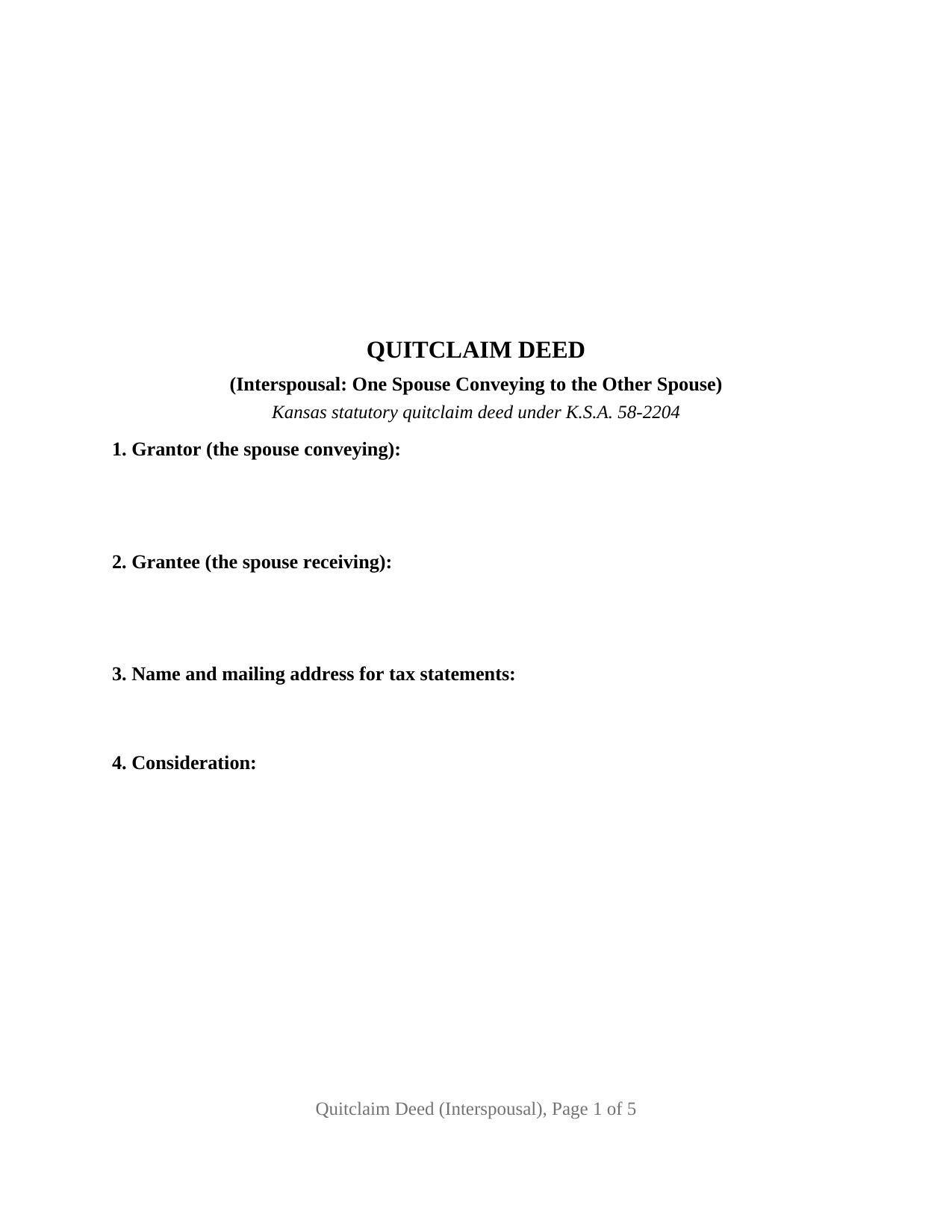
On this Kansas quitclaim deed the same two people stand on both sides of the granting clause. One spouse is the Grantor and conveys; the other spouse is the Grantee and receives; and the Grantee signs the instrument too, under a section explaining why the person taking the property signs for it. That is the interspousal arrangement, searched as an interspousal transfer deed or a quit claim deed between husband and wife, and it is what this form recites under K.S.A. 58-2204.
Consent that arrives from the receiving side
Two Kansas consent rules meet a married person's lifetime deed, and an interspousal transfer answers both with the signature of the person taking the land. Article 15, Section 9 of the Kansas Constitution exempts a homestead occupied as a residence by the family of the owner and provides that it shall not be alienated without the joint consent of husband and wife when that relation exists; K.S.A. 60-2301 carries the same exemption in statutory form. K.S.A. 59-505 separately reserves to a surviving spouse one-half of real estate the decedent held at any point in the marriage and disposed of without the survivor's written consent. Section 12 states that the Grantee, being the Grantor's spouse, joins in the deed to give the constitutional consent and to consent in writing for purposes of K.S.A. 59-505, adding no covenant of title. No Kansas appellate decision was located deciding whether the joint consent rule reaches a homestead deed whose grantee is the other spouse rather than a stranger, so this form takes that acknowledged signature in every case.
What marriage moves, and what it does not
Kansas is a common law property state, so a wedding redraws no title. K.S.A. 23-2602 provides that a married person, while the marriage relation subsists, may bargain, sell and convey his or her real and personal property, the capacity the Grantor exercises here. K.S.A. 23-2601 leaves property owned at marriage, and property arriving by descent, devise, bequest, or gift from any person, the separate property of that person notwithstanding the marriage. Tenancy by the entirety was abolished in 1891, and under K.S.A. 58-501 a grant to husband and wife makes a tenancy in common absent clear joint tenancy language, so no marital estate springs from the deed and title lands in the Grantee alone. Under K.S.A. 23-2801, all property owned by married persons becomes marital property once a divorce, separate maintenance, or annulment action commences, so a transfer between spouses does not fix how the property is treated if the marriage later ends.
A gift, stated in the deed
Interspousal transfers usually move for love and affection rather than money, and Kansas intake has a category for exactly that. K.S.A. 79-1437c keeps a title transfer off the record unless the Department of Revenue sales validation questionnaire rides along, while K.S.A. 79-1437e(a) lists the transfers it never reaches, among them gift, donation or contribution stated in the deed, numbered exemption 4. The register of deeds has no authority to write an exemption onto an instrument, so Section 10 holds the blank for it and Section 4 is where the gift itself is recited. Fees run under K.S.A. 28-115 at the county-published twenty-one dollars for page one and seventeen for each page after, and Kansas levies no deed transfer tax.
How the pages are arranged
Thirteen numbered sections collect the two spouses, the tax statement address contemplated by K.S.A. 58-2221, the consideration, the county and legal description, the source of the Grantor's title, an informational listing of matters of record, and the sales validation statement, before Section 11 quitclaims and Section 12 consents. Each spouse signs above a printed name line, reflecting the typed name practice of K.S.A. 28-115(c), and a Kansas short form certificate from K.A.R. 7-43-17 follows each signature, so the two acknowledgments can be taken on different days before different officers. Record patterns presenting this configuration include a spouse who owned the house before the marriage moving it to the other, and a couple retitling a tract in one name. The form recites two individuals married to each other and acting personally, with no trustee, entity, or attorney-in-fact recitals.
The purchase brings the fillable Kansas interspousal quitclaim deed, a completed example set in Riley County where a Manhattan husband deeds the family home to his wife as a stated gift, and a guide covering the sections, both consent statutes, notarization, and recording. The materials describe Kansas law in general terms and are not legal advice.
Important: County-Specific Forms
Our quitclaim deed (interspousal) forms are specifically formatted for each of the 105 counties in Kansas.
After selecting your county, you'll receive forms that meet all local recording requirements, ensuring your documents will be accepted without delays or rejection fees.