Kansas Quitclaim Deed (Trustee Grantee)
County Specific Legal Forms Validated as recently as October 1, 2026 by our Forms Development Team
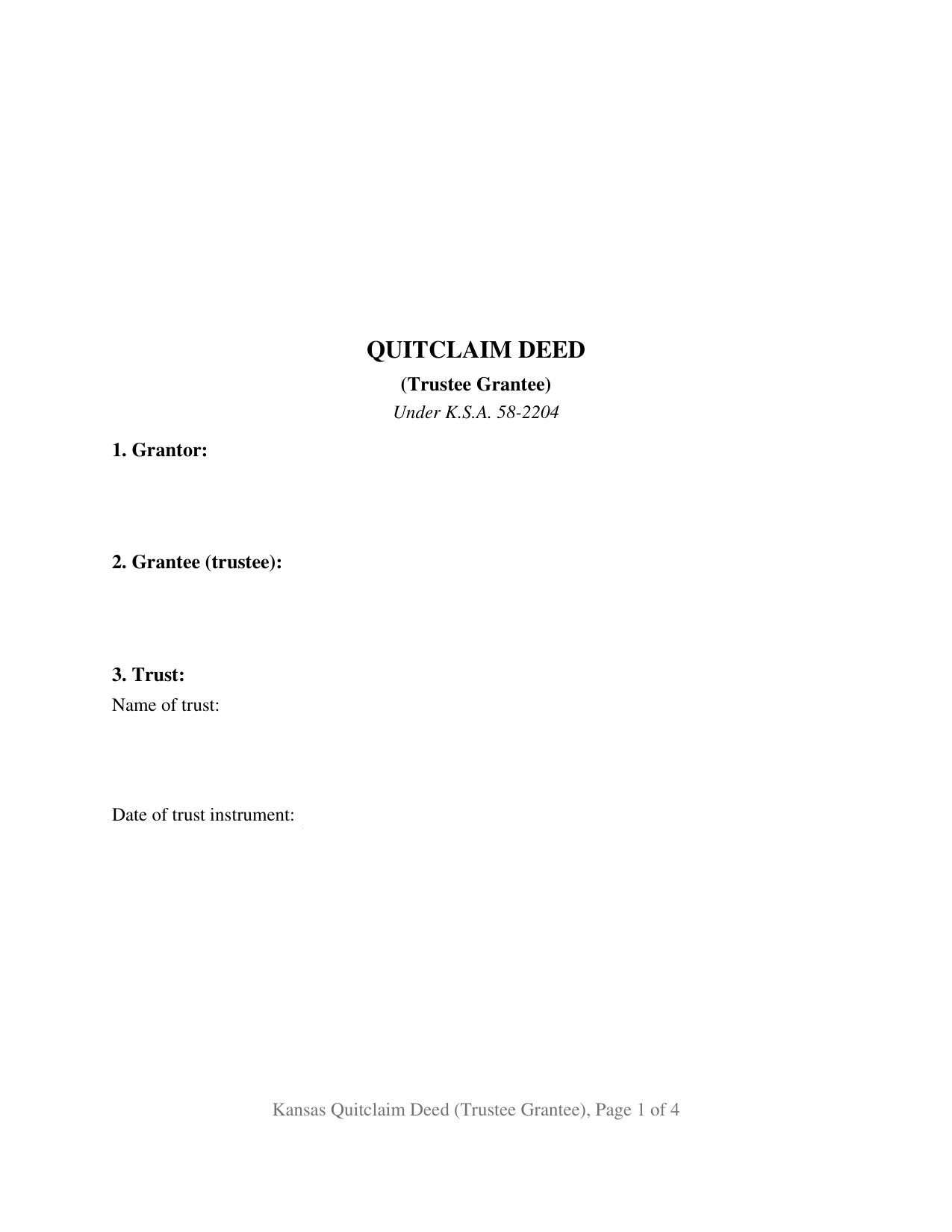
About the Kansas Quitclaim Deed (Trustee Grantee)
How to Use This Form
- Select your county from the list
- Download the county-specific form
- Fill in the required information
- Have the document notarized if required
- Record with your county recorder's office
What Others Like You Are Saying
"Good documents. Very helpful."
"Exactly what the form i was looking for as a PR to sell my brothers property after he passed away. S…"
"Easy fill in the blanks form. Just FYI make sure you have a copy of whatever deed you are changing a…"
"Our home was in only my husband’s name and as we are getting older, it was time to add my name to th…"
"The form was very easy to use and the sample tool you had was very helpful. the only problem i had w…"
4.8/5 from 4,828 reviews. Read all
The grantee on this Kansas quitclaim deed is a trustee. One individual grantor signs, and whatever interest that grantor holds at delivery lands with the person named in Section 2 as trustee, holding it for the trust named and dated in Section 3, not individually. Buyers reach it searching for a deed into trust, a quitclaim deed to a trust, or a quit claim deed to a trustee; underneath sits the plain statutory quitclaim of K.S.A. 58-2204, with its receiving side built for a trust.
Kansas lets trust title sit in either name
K.S.A. 58a-401 counts a transfer of property to another person as trustee, or to the trust in the trust's name, among the ways a trust is created during the settlor's lifetime, and K.S.A. 58a-810(e) says the same from the titling side: property may be acquired in the name of the trust or of the trustee, and trust-name property may be conveyed in either name provided the trust name is clearly set forth. This form takes the trustee route and prints both identifiers. Where cotrustees are named together, K.S.A. 58-501 adds a rule peculiar to fiduciaries: a grant to trustees as such creates a joint tenancy unless the instrument expressly provides otherwise, the one exception to the Kansas tenancy in common default.
The exemption written for trust transfers
K.S.A. 79-1437c stops a register of deeds from recording a transfer of title unless the Department of Revenue questionnaire comes with it, and K.S.A. 79-1437e(a) numbers the transfers it never reaches. Item 7 is a transfer of title to or from a trust, and without consideration, the entry a funding deed ordinarily rides. The exemption goes onto the instrument by the parties' hand, since K.S.A. 79-1437e(b) calls for it to be clearly stated on the document being filed and registers are instructed not to supply it; Section 10 holds that space and Section 5 recites the absence of consideration. Fees run under K.S.A. 28-115 at the county published twenty-one dollars for a first page and seventeen after, with no deed transfer tax anywhere in Kansas.
No covenants, and no proof of the trust
No covenant K.S.A. 58-2203 attaches to the words conveys and warrants rides along, so the trustee receives the grantor's interest with its encumbrances intact. The deed also leaves the trust's own paperwork alone: a Kansas trust holding real estate rests on a written instrument executed in the manner of a deed under K.S.A. 58-2210, a trustee shows authority through an acknowledged certification of trust under K.S.A. 58a-1013, prepared separately and not included here, and K.S.A. 58-2403 makes a recorded trust actual notice to anyone claiming under a later conveyance or lien. K.S.A. 58a-1107 reads on the transaction from the insurance side, protecting title insurance coverage, the trustee's insured status, homestead exemption and redemption rights, and freedom from a due on sale clause where a settlor beneficiary moves property into an inter vivos trust by warranty deed. That section names a warranty deed, and no Kansas decision was located reading it onto a quitclaim, a limit the guide states plainly.
One grantor, one certificate, twelve sections
Twelve numbered sections collect the grantor, the trustee grantee, the trust name and trust instrument date, the tax statement address K.S.A. 58-2221 routes to the county clerk, the consideration, the county and legal description, the source of title, an informational listing of matters of record, the sales validation statement, the conveyance, and the signature. One signature block carries a printed name line, reflecting the typed name practice of K.S.A. 28-115(c), and one Kansas short form certificate from K.A.R. 7-43-17 follows it. Record patterns presenting this configuration include a sole owner funding a revocable trust settled years earlier, an heir releasing an inherited fractional interest to the trustee of a family trust, and a co-owner passing an undivided share to a corporate trustee holding the balance. The grantor side states no trustee, entity, or attorney in fact capacity, and one signature line with no consent section leaves occupied homestead land, which the Kansas Constitution and K.S.A. 60-2301 make a joint consent transaction, outside what this deed recites.
The download delivers the fillable form, a completed example set in Wyandotte County where an unmarried owner deeds her house to herself as trustee of her revocable trust with exemption 7 stated on the instrument, and a guide covering the sections, the trust code provisions behind the trustee capacity, notarization, and recording. These materials describe Kansas law in general terms and are not legal advice.
Important: County-Specific Forms
Our quitclaim deed (trustee grantee) forms are specifically formatted for each of the 105 counties in Kansas.
After selecting your county, you'll receive forms that meet all local recording requirements, ensuring your documents will be accepted without delays or rejection fees.