Kansas Quitclaim Deed (Trustee Grantor)
County Specific Legal Forms Validated as recently as October 6, 2026 by our Forms Development Team
About the Kansas Quitclaim Deed (Trustee Grantor)
How to Use This Form
- Select your county from the list
- Download the county-specific form
- Fill in the required information
- Have the document notarized if required
- Record with your county recorder's office
What Others Like You Are Saying
"The experience was very good, great guidance, quick responses, I would recommend. using Deeds.com."
"Answered all of my questions and was very easy to use. I will use Deeds.com to do all of my real est…"
"Made a hard task easy! Very smooth and we were printed and ready to go"
"Easy to use, thank you."
"Had used website while working as Land Rep for major oil company (retired 2.5 years ago). Recently h…"
4.8/5 from 4,828 reviews. Read all
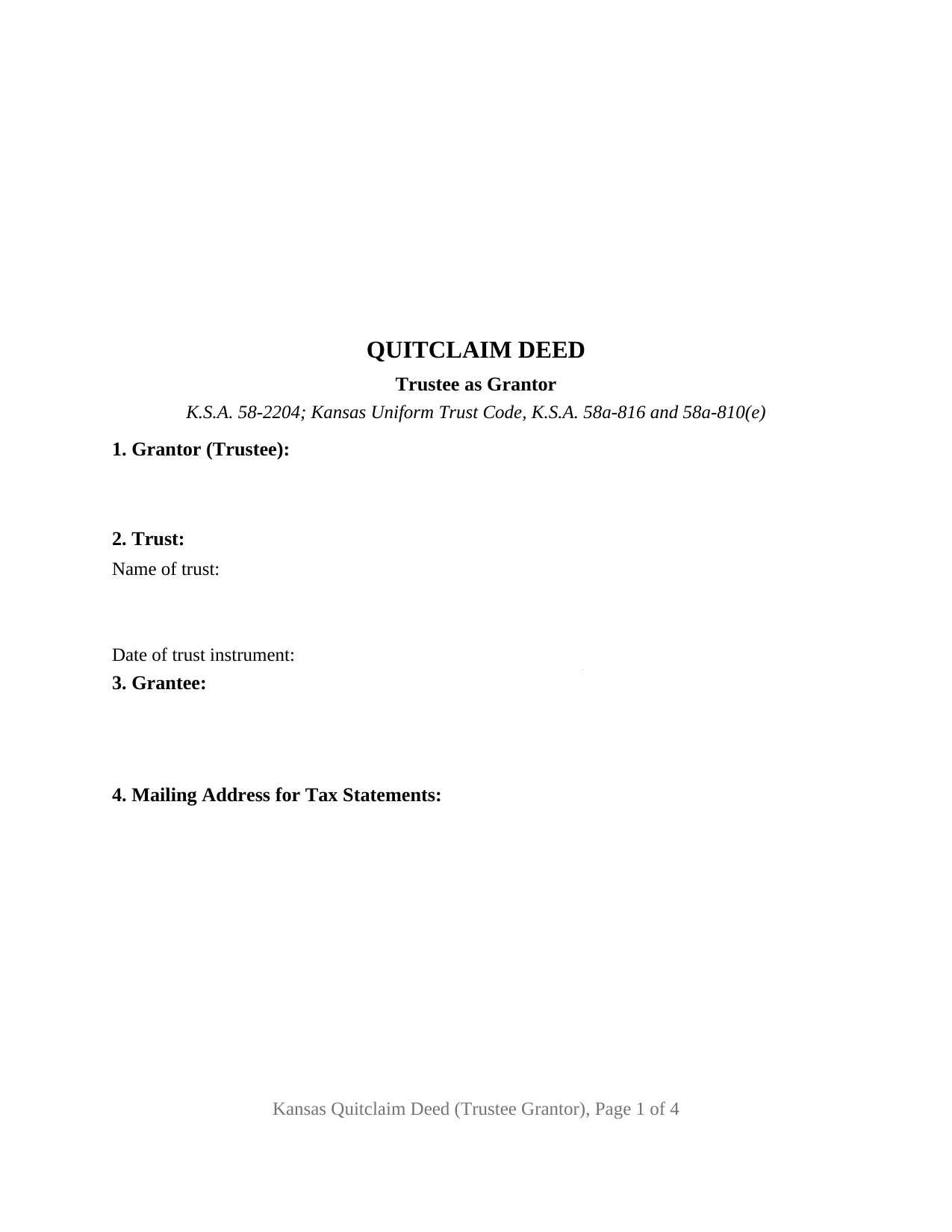
The grantor on this Kansas quitclaim deed signs as trustee. One person fills the grantor block in that capacity, the trust holding the real estate is named and dated just below it, and the interest leaving the trust reaches the grantee without a single covenant attached. Kansas supplies the sentence that does the work in K.S.A. 58-2204; what this variant adds is the fiduciary standing of the signer, together with the trust name that a conveyance out of trust title has to carry.
Authority that lives in the trust instrument, not on the deed
A trustee's power to convey comes from the trust instrument and from the Kansas Uniform Trust Code. K.S.A. 58a-816(2) lets a trustee acquire or sell property, for cash or on credit, at public or private sale, and item 25 covers signing and delivering the instruments that carry such a power into effect. Trust title may stand in either name, and K.S.A. 58a-810(e) conditions a conveyance of property titled in the trust name on the trust name being clearly set forth in that conveyance, which is the reason Section 2 prints the name of the trust and the date of its instrument. Proof of that authority is a separate document: the acknowledged certification of trust described in K.S.A. 58a-1013, prepared separately and not included in this package. Kansas also looks after the far side of the closing table: K.S.A. 58a-1012 relieves a person other than a beneficiary, dealing in good faith and for value, of any duty to inquire into the extent of the trustee's powers.
A sale and a distribution part ways at the counter
The questionnaire regime that greets every Kansas deed treats a trustee's transfer in two different ways, because the trust entry carries a condition. Item 7 of K.S.A. 79-1437e(a) reaches a transfer of title to or from a trust, and without consideration, so a distribution of trust land to a beneficiary travels under it while a sale of the same land for a price does not. Section 10 is drawn for both answers: it takes either the exemption statement that K.S.A. 79-1437e(b) calls for on the face of the filed document, or a line stating that the completed questionnaire rides along. Kansas Department of Revenue Directive 19-041 instructs registers of deeds not to add exemption information at filing, so that entry belongs to the parties. No transfer tax applies anywhere in the state.
One trustee, one certificate, twelve sections
The form recites a single acting trustee. Twelve numbered sections run from the trustee and the trust through the grantee, the address Kansas sends to the county clerk for tax statements under K.S.A. 58-2221, what the trust receives, the property description, the vesting instrument, matters of record, and the questionnaire entry, closing with the conveyance and one signature block above a printed name line. One acknowledgment certificate follows, completed by the notarial officer. The signer may be the trustee the settlor named or a successor holding the office through K.S.A. 58a-704, as in the completed example. A trust with two acting cotrustees presents a different signing picture, since K.S.A. 58a-1013 treats the number of trustees required to sign as a matter of the terms of the particular trust, and this layout draws one signature line. The grantor side states no attorney-in-fact, executor, conservator, or business entity capacity, and the deed carries no spousal consent section for land occupied as a residence.
Interest out, encumbrances intact
A quitclaim moves the interest as it stands at delivery and nothing more. None of the covenants K.S.A. 58-2203 fastens to the words conveys and warrants appear here, so the grantee reads the condition of the title from the county record. Recording supplies what follows: under K.S.A. 58-2222 a filed instrument gives notice of its contents from the time of filing, while K.S.A. 58-2223 leaves an unrecorded one good only between the parties and persons having actual notice. The grantee entry also carries any co-ownership designation, and under K.S.A. 58-501 clear language is what marks a joint tenancy, the arrangement the example illustrates.
The download brings the fillable trustee quitclaim deed, a completed example set in Reno County where a successor trustee sells a Hutchinson house to a married couple taking as joint tenants with right of survivorship, and a guide that walks the twelve sections, the trust code provisions standing behind the signature, the notarial rules, and the trip to the register of deeds. This package describes Kansas law in general terms and is not legal advice.
Important: County-Specific Forms
Our quitclaim deed (trustee grantor) forms are specifically formatted for each of the 105 counties in Kansas.
After selecting your county, you'll receive forms that meet all local recording requirements, ensuring your documents will be accepted without delays or rejection fees.