Kansas Quitclaim Deed
County Specific Legal Forms Validated as recently as October 6, 2026 by our Forms Development Team
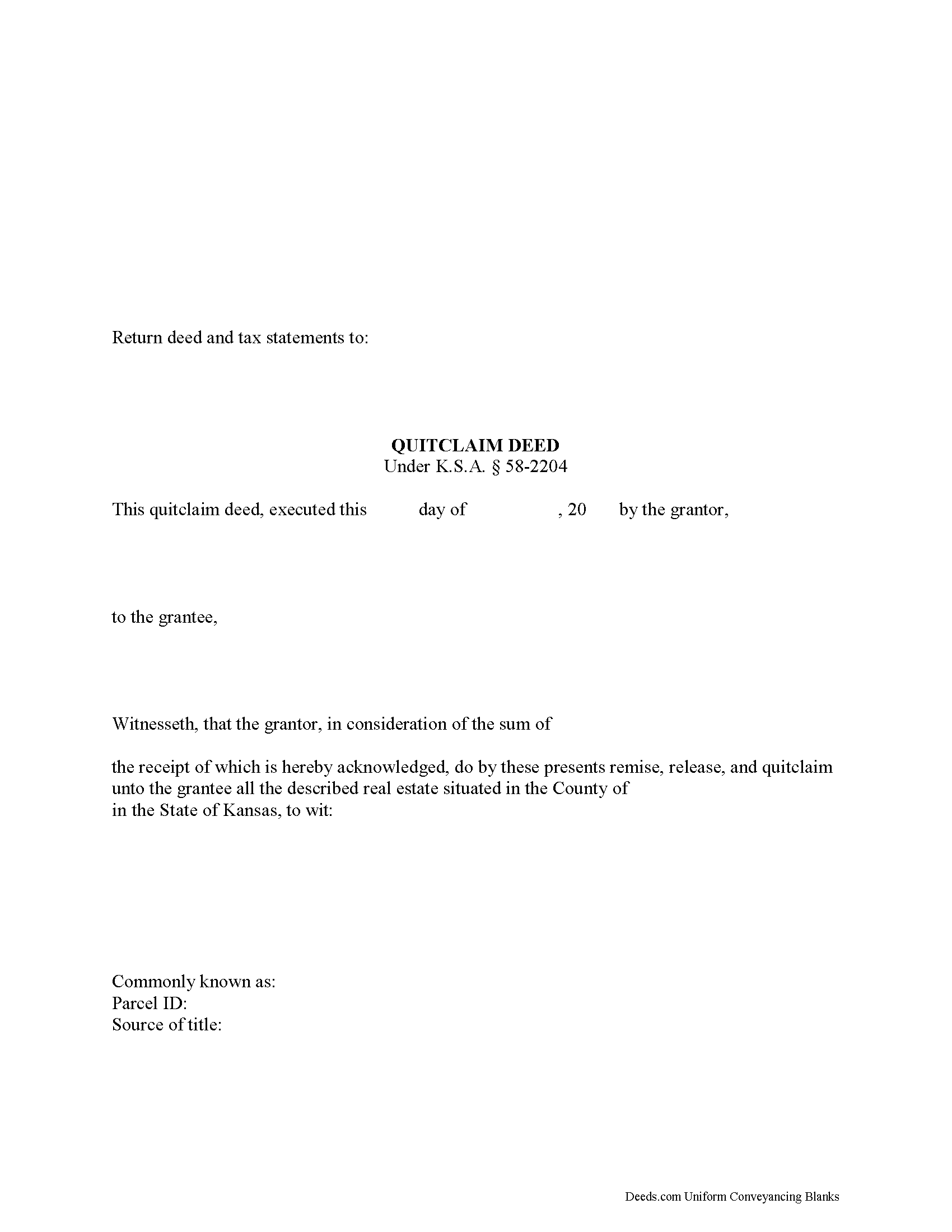
About the Kansas Quitclaim Deed
How to Use This Form
- Select your county from the list
- Download the county-specific form
- Fill in the required information
- Have the document notarized if required
- Record with your county recorder's office
What Others Like You Are Saying
"very informative and thank everyone involved,my deed needed to be changed and will adjusted."
"Deeds.com was a money saver for me. It made a daunting task of preparing a Quit Claim Deed a very si…"
"Easy to use, thank you."
"The support received was far above expectations."
"Very fast and easy to use!"
4.8/5 from 4,823 reviews. Read all
Two blanks on this Kansas quitclaim deed decide more than the rest of the page put together, and neither carries a word of preprinting. The grantor line takes one or two people signing in their own names. The grantee line takes one or two people, plus whatever co-ownership words the parties write after them, and Kansas supplies a result for silence: a deed naming two grantees and saying nothing further leaves them tenants in common. This is the general Kansas quitclaim deed, the form shoppers reach for typing quit claim deed, or quick claim deed, into a search box.
What the grantee line decides
K.S.A. 58-501 is the governing sentence. A grant or devise to two or more persons, including a grant to a married pair, creates a tenancy in common unless the language used in the instrument makes clear that a joint tenancy was intended. Kansas threw out the old presumption favoring joint tenancy in 1891 and abolished estates by the entirety with it, so no family relationship supplies survivorship. The statute also settles a fight the older deeds produced: where the granting clause clearly grants a joint tenancy, an inconsistent habendum clause does not undo it. The annotated decisions mark the boundary: in Spresser v. Langmade, 199 Kan. 96, an introductory clause reading as joint tenants with the right of survivorship and not as tenants in common controlled, while or survivor language alone fell short in Swingle. Open party lines exist because in Kansas those written words, rather than the deed's title, perform the vesting.
A conveyance that promises nothing
The transfer runs on a sentence from 1887: K.S.A. 58-2204 asks that the instrument read in substance that A.B. quitclaims to C.D., describing the premises, for the sum inserted, duly signed and acknowledged. What moves is the grantor's right, title, and interest at delivery. Absent is every covenant K.S.A. 58-2203 fastens to the words conveys and warrants, from seizin through the duty to defend. K.S.A. 58-2202 still carries the grantor's entire estate across unless the deed expressly shows a smaller one. Recording supplies what the missing covenants do not, since K.S.A. 58-2222 makes a filed instrument notice of its contents from the moment of filing.
One or two signers, on either side
Ten numbered sections gather the parties, the tax statement address K.S.A. 58-2221 routes to the county clerk, the consideration, the property, the vesting instrument, matters of record, and the sales validation statement, before Section 9 quitclaims and Section 10 takes the signatures. Two signature blocks are drawn, headed GRANTOR and SECOND GRANTOR, each above a printed name line in the manner K.S.A. 28-115(c) contemplates, each followed by its own certificate in the K.A.R. 7-43-17(a)(1) individual short form. On a one-grantor deed the second block and its certificate stay blank; on a two-grantor deed they let the acknowledgments be taken on different days before different officers. Where a married owner's land is occupied homestead, Article 15, Section 9 of the Kansas Constitution and K.S.A. 60-2301 condition an alienation on the joint consent of husband and wife, and the second block carries the consenting spouse's acknowledged signature. No capacity beyond the individual appears anywhere on the form: an entity name with an officer's authorization, a fiduciary office, and an agent under a power of attorney each belong to a differently built instrument, as does an arrangement for three or more owners on one side.
At the register of deeds
Two intake items decide whether a Kansas deed goes on record. K.S.A. 79-1437c keeps a transfer of title off the books unless the Department of Revenue sales validation questionnaire rides along, or a K.S.A. 79-1437e exemption is written onto the instrument by the parties, the register of deeds having no authority to add it. Section 8 holds that entry either way. County schedules under K.S.A. 28-115 publish twenty-one dollars for the first page and seventeen for each additional page, and Kansas imposes no deed transfer tax. The page is drawn for that counter: letter size, three inches open at the top of page one for the recording stamp, one inch margins, twelve point type.
The download delivers the fillable Kansas quitclaim deed, a completed example in which two Douglas County grantors release a platted Lawrence lot to two grantees taking with survivorship, and a guide covering the ten sections, the co-ownership rules behind the grantee line, the consent statutes, notarization, and recording. These materials describe Kansas law in general terms and are not legal advice.
Important: County-Specific Forms
Our quitclaim deed forms are specifically formatted for each of the 105 counties in Kansas.
After selecting your county, you'll receive forms that meet all local recording requirements, ensuring your documents will be accepted without delays or rejection fees.