Kansas Quitclaim Deed (Reserving Life Estate)
County Specific Legal Forms Validated as recently as September 10, 2026 by our Forms Development Team
About the Kansas Quitclaim Deed (Reserving Life Estate)
How to Use This Form
- Select your county from the list
- Download the county-specific form
- Fill in the required information
- Have the document notarized if required
- Record with your county recorder's office
What Others Like You Are Saying
"First time user. Was pleased with the easy of use and the step-by-step directions provided by the we…"
"I just submitted a beneficiary deed and it was accepted immediate and then recorded the next day! I …"
"Made recording my document so much easier and faster. First attempt failed due to illegible blue ink…"
"The directions were clear, I typed the deed out and it was successfully recorded and mailed back to …"
"Very easy to navigate... will be back to use!"
4.8/5 from 4,820 reviews. Read all
Most quitclaim deeds empty the signer's hands. This Kansas one holds something back. The grantor signs once, the described real estate moves to the grantee, and a single estate stays behind: a life estate measured by the grantor's own lifetime, reserved in the operative words, so the signer keeps possession until death while the grantee already owns the interest that becomes possessory then. Buyers arrive searching for a Kansas life estate deed, a deed reserving a life estate, or a quit claim deed with life estate.
Two estates cut from one instrument
The reservation runs on a sentence Kansas has carried since 1868. Under K.S.A. 58-2202 a conveyance moves every bit of the grantor's estate unless an intent to pass a less estate expressly appears, or is necessarily implied, in the terms of the grant. Express is the operative word, because Kansas reads a deed generously toward the person receiving it: the annotations collect Keller v. Ely, 192 Kan. 698, that a deed confers the greatest estate its terms permit. Both halves are property in Kansas hands: a future interest in land may be created by deed, Purcell v. Baskett, 121 Kan. 678, and the owner of a life estate may sell or encumber it, Alexander v. Goellert, 153 Kan. 202.
Delivered now, possessory later
Delivery is when the remainder changes owners, which keeps this instrument on the deed side of a line Kansas polices closely: in Lowry v. Lowry, 160 Kan. 11, papers styled as warranty deeds were held testamentary in character and void. Section 10 says so in capital letters, reciting that the deed is neither a will nor a transfer-on-death deed, that it takes effect on delivery, and that the remainder is not revocable by the grantor alone. A later deed signed by the grantor alone carries only the retained life estate.
Eleven sections, one signature, one certificate
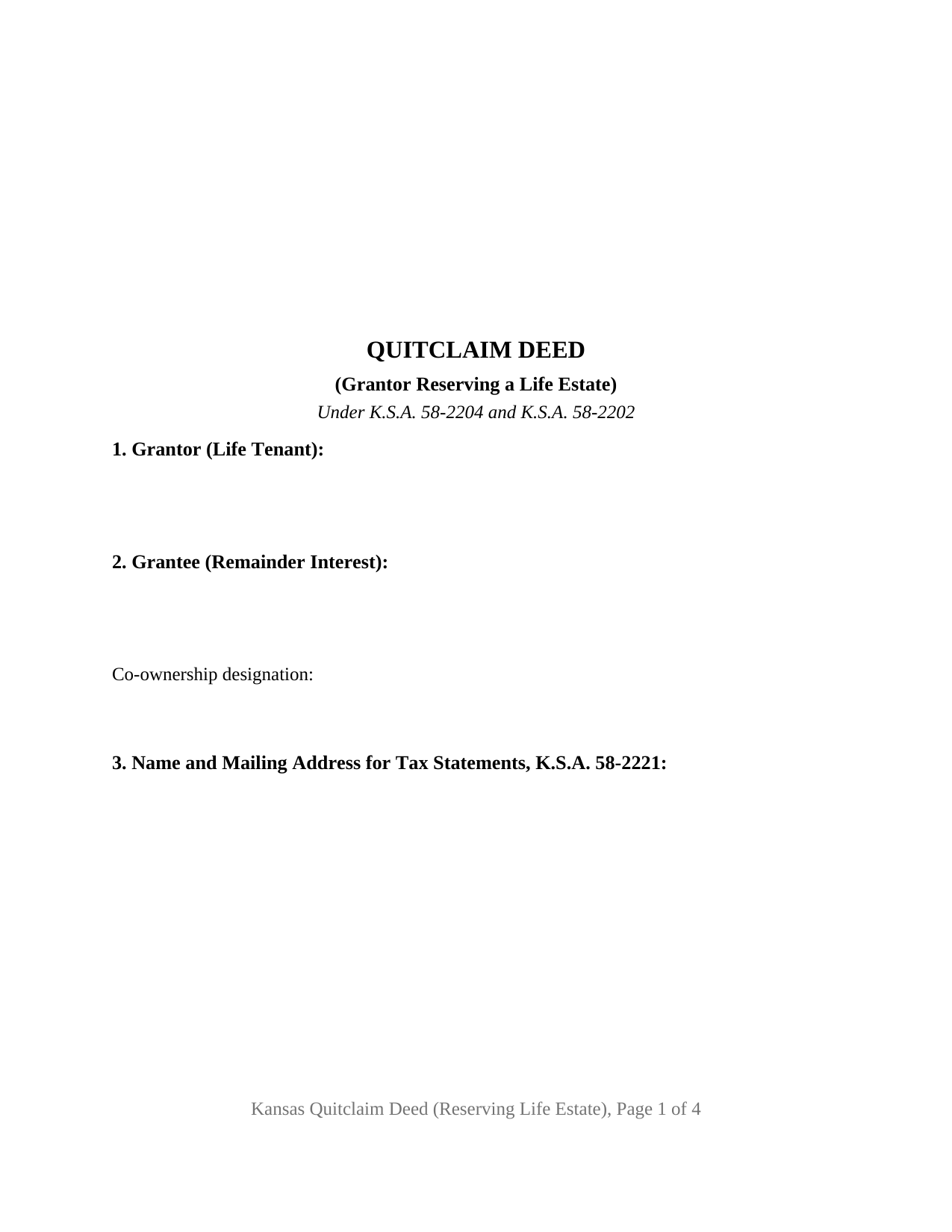
The form recites a single individual grantor holding record title. Section 1 names that grantor as life tenant; Section 2 names the grantee and carries a co-ownership designation blank, since K.S.A. 58-501 makes clear language the mark of a joint tenancy and sends everything else to tenancy in common. Section 3 carries a wrinkle peculiar to this deed: K.S.A. 58-2221 routes to the county clerk the tax statement address of the grantee or that grantee's designee, and the life tenant who stays in possession is commonly the designee named. Section 11 then takes one signature above a printed name line, followed by one Kansas short form certificate from K.A.R. 7-43-17. Patterns presenting this configuration include a sole owner passing the future interest in a residence and continuing to live in it, an owner of farm ground keeping the crop rents for life, and an owner who deeds away a rental and keeps the rent. The reserved estate is measured by the life of the grantor named in Section 1 and by no other, and it runs to that grantor rather than to a stranger to the deed. No spousal consent block is drawn, and Kansas makes an alienation of occupied homestead ground a joint consent transaction under Article 15, Section 9 of its constitution.
Duties the reserved estate carries
Kansas hands the remainderman a remedy that does not wait for the funeral. K.S.A. 58-2523 lets an owner in remainder or reversion sue for waste or trespass for injury to the inheritance despite the intervening life estate, and Moore v. Phillips, 6 Kan. App. 2d 94, applied it to a neglected farmhouse, separating real waste from ordinary depreciation with age and use.
A partial interest at the recording counter
Kansas intake has no category for this deed. None of the sixteen items K.S.A. 79-1437e(a) lifts out of the sales validation questionnaire requirement is written for a reserved life estate or a partial interest as such, so the answer follows the money: a remainder given away rides item 4, gift, donation or contribution stated in the deed, which Sections 4 and 9 put in writing, while a remainder sold for a price sends the completed Department of Revenue questionnaire along under K.S.A. 79-1437c.
The download delivers the fillable form, a completed example set in Finney County where a Garden City widow gives her two adult children the remainder in her house as tenants in common and keeps the house for life, and a guide walking all eleven sections, the reservation and delivery rules, the notarial requirements, and recording. These materials describe Kansas law in general terms and are not legal advice.
Important: County-Specific Forms
Our quitclaim deed (reserving life estate) forms are specifically formatted for each of the 105 counties in Kansas.
After selecting your county, you'll receive forms that meet all local recording requirements, ensuring your documents will be accepted without delays or rejection fees.