Kansas Quitclaim Deed (Married Couple as Grantors)
County Specific Legal Forms Validated as recently as October 9, 2026 by our Forms Development Team
About the Kansas Quitclaim Deed (Married Couple as Grantors)
How to Use This Form
- Select your county from the list
- Download the county-specific form
- Fill in the required information
- Have the document notarized if required
- Record with your county recorder's office
What Others Like You Are Saying
"All went well."
"This is an extremely helpful and very fast way to file with property recorders. It saved me time awa…"
"It was actually very easy to use and not very expensive. I'm glad I tried it out"
"Very responsive. I was notified very quickly if the deed I was looking for was available."
"Professional and courteous and responsive service by KVH for my problem. He or she should receive a …"
4.8/5 from 4,828 reviews. Read all
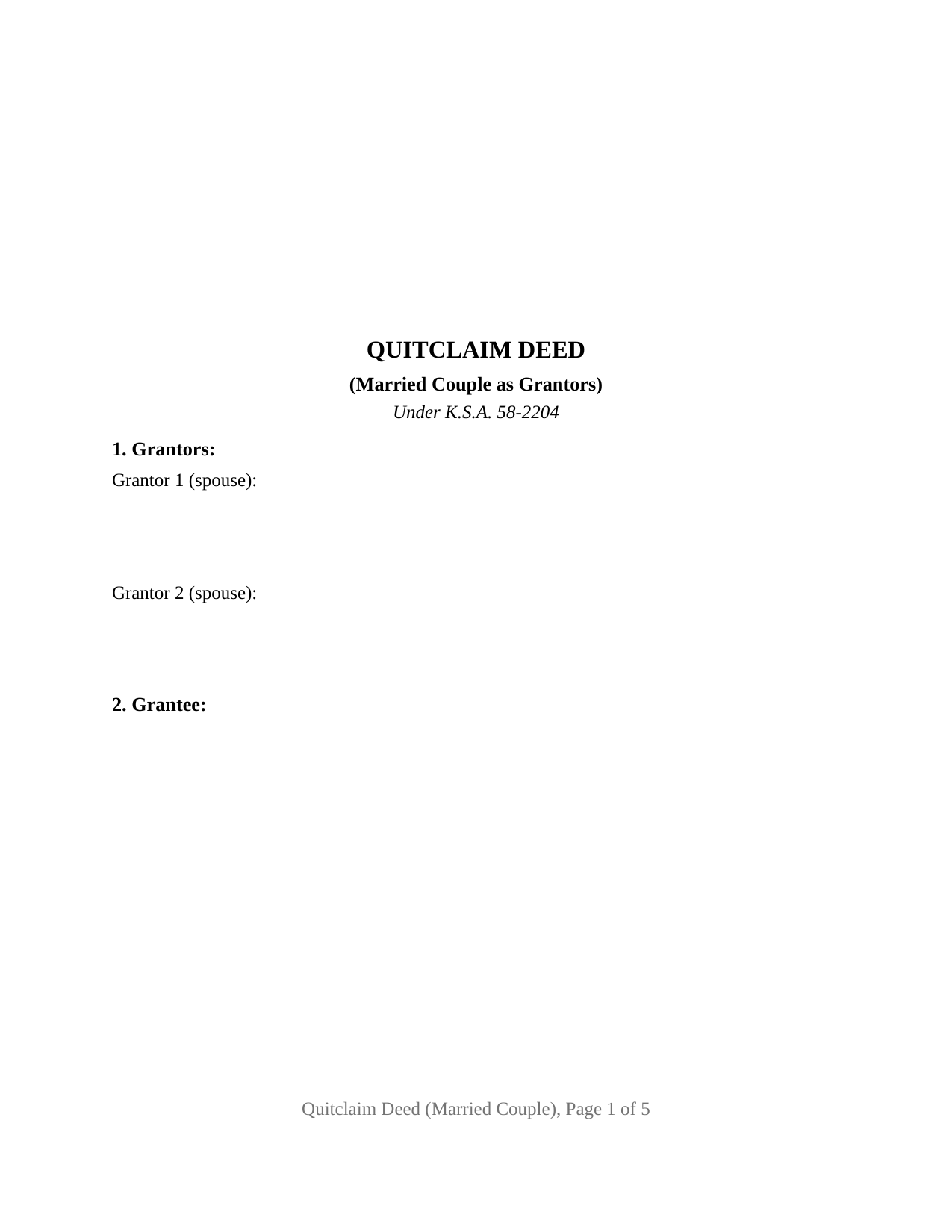
A married couple signs this Kansas quitclaim deed together. The form recites two grantors who are married to each other, gives each spouse a signature line, and follows each signature with its own acknowledgment certificate, so one recorded instrument carries both the conveyance and each spouse's consent to it. Under the brief statutory form of K.S.A. 58-2204, whatever right, title, and interest each spouse holds passes to the grantee at delivery, with no covenants attached; couples typing quick claim deed or quit claim deed into a search box are looking for this Kansas husband and wife form.
Two consents folded into one signing
Kansas attaches a pair of consent rules to a married owner's conveyance, and the signature section of this deed answers both at once. K.S.A. 59-505 preserves one-half of real estate for a surviving spouse when the deceased spouse disposed of it during the marriage without the survivor's written consent; a spouse who joins in the deed as a grantor writes that consent into the recorded chain of title, where every later examiner can find it. And when the land is the couple's occupied homestead, article 15, section 9 of the Kansas Constitution and K.S.A. 60-2301 permit no alienation without the joint consent of husband and wife, so both spouses' acknowledged signatures are the path Kansas law lays out for conveying the home place. Section 10 of the deed recites both consents in words, next to the operative conveyance itself.
One name on the record, or two
The married-couple layout does not assume that both spouses appear on the current vesting deed. Where the couple took title together, each spouse conveys an undivided interest and the grantee collects the whole; Kansas abolished tenancy by the entirety long ago, and under K.S.A. 58-501 a deed to husband and wife makes tenants in common unless joint tenancy language is clear, so the two interests this deed gathers are genuinely separate ones. Where the record stands in one spouse's name alone, the titled spouse conveys the record ownership while the other spouse, named as the second grantor, quitclaims whatever interest Kansas law gives a spouse and consents to the transfer in the same breath. Patterns presenting the configuration include a couple deeding the family home to an adult child with the gift stated in the deed, spouses conveying land to the trustee of a trust they have settled, and a married pair releasing every interest they hold so a purchaser's title examiner stops asking questions. The form recites two individual spouses acting personally; it carries no trustee, entity, or attorney-in-fact recitals, and grantors who are not married to each other present a different consent picture than the one this deed recites.
No warranties ride along
A quitclaim by both spouses still promises nothing. K.S.A. 58-2202 passes each grantor's whole estate unless the deed shows a lesser one, but nothing in K.S.A. 58-2204 warrants seizin, clear title, or quiet possession, and the grantee measures what arrived by the county record rather than by the deed. Recording then does its usual Kansas work: a filed deed imparts notice from the moment of filing under K.S.A. 58-2222, and an unrecorded one binds only the parties and those with actual notice under K.S.A. 58-2223.
Handing it across the counter
Every Kansas deed meets the sales validation questionnaire regime at intake. K.S.A. 79-1437c bars recording unless the Department of Revenue questionnaire travels with the deed or a K.S.A. 79-1437e exemption appears on the face of the instrument, written there by the parties because the register of deeds is not permitted to add it; Section 9 of this form holds that statement with a blank for the exemption number. County fee schedules under K.S.A. 28-115 currently publish twenty-one dollars for a deed's first page and seventeen dollars for each page after it, with no transfer tax anywhere in the state, and the page itself is drawn to Kansas intake habits: letter size, a 3 inch recording reserve on page one, 1 inch margins, and 12 point type.
The purchase delivers this married-couple quitclaim deed as a fillable PDF, a completed example showing a Sedgwick County couple's gift of the family home to their daughter with the exemption stated on the deed, and a guide that walks the eleven sections, the two consent statutes, the notarization of both signatures, and the recording steps. The materials describe Kansas law in general terms and are not legal advice.
Important: County-Specific Forms
Our quitclaim deed (married couple as grantors) forms are specifically formatted for each of the 105 counties in Kansas.
After selecting your county, you'll receive forms that meet all local recording requirements, ensuring your documents will be accepted without delays or rejection fees.