Maine Transfer on Death Deed (Individual Tenant in Common, Undivided Interest)
County Specific Legal Forms Validated as recently as October 27, 2026 by our Forms Development Team
About the Maine Transfer on Death Deed (Individual Tenant in Common, Undivided Interest)
How to Use This Form
- Select your county from the list
- Download the county-specific form
- Fill in the required information
- Have the document notarized if required
- Record with your county recorder's office
What Others Like You Are Saying
"Thank you!"
"I downloaded the forms, which was very easy, and filled them out with the help of the very helpful i…"
"Wonderful!! So easy to locate the file you need and printing is a snap!! Thank you so much for this …"
"Was easy to find forms I needed and download was quick."
"Very informative and helpful Thank you so much"
4.8/5 from 4,836 reviews. Read all
A co-owner who holds an undivided fractional interest in Maine real estate can name who receives that share at death without touching the other owners' shares. This form prepares a Maine transfer on death deed for exactly that owner: one person holding an undivided interest as a tenant in common, signing alone, designating the beneficiaries of that interest under the Maine Uniform Real Property Transfer on Death Act, Title 18-C, Article 6, Part 4 of the Maine Revised Statutes. It is also searched as a Maine TOD deed or beneficiary deed.
One share, one signature, no waiting for a second death
Section 6-402(3) defines a joint owner as an individual who owns property concurrently with others with a right of survivorship and states that the term does not include a tenant in common. The timing rule of Section 6-413(3), under which a joint owner's deed waits for the death of the last surviving joint owner, therefore never reaches a tenant in common. A tenant in common's deed takes effect at that tenant's death and transfers that tenant's undivided interest to the named beneficiaries, who step into the fractional share as tenants in common with the surviving co-owners. During the transferor's life, Section 6-412 provides, the deed affects no right of any other owner.
What the deed recites
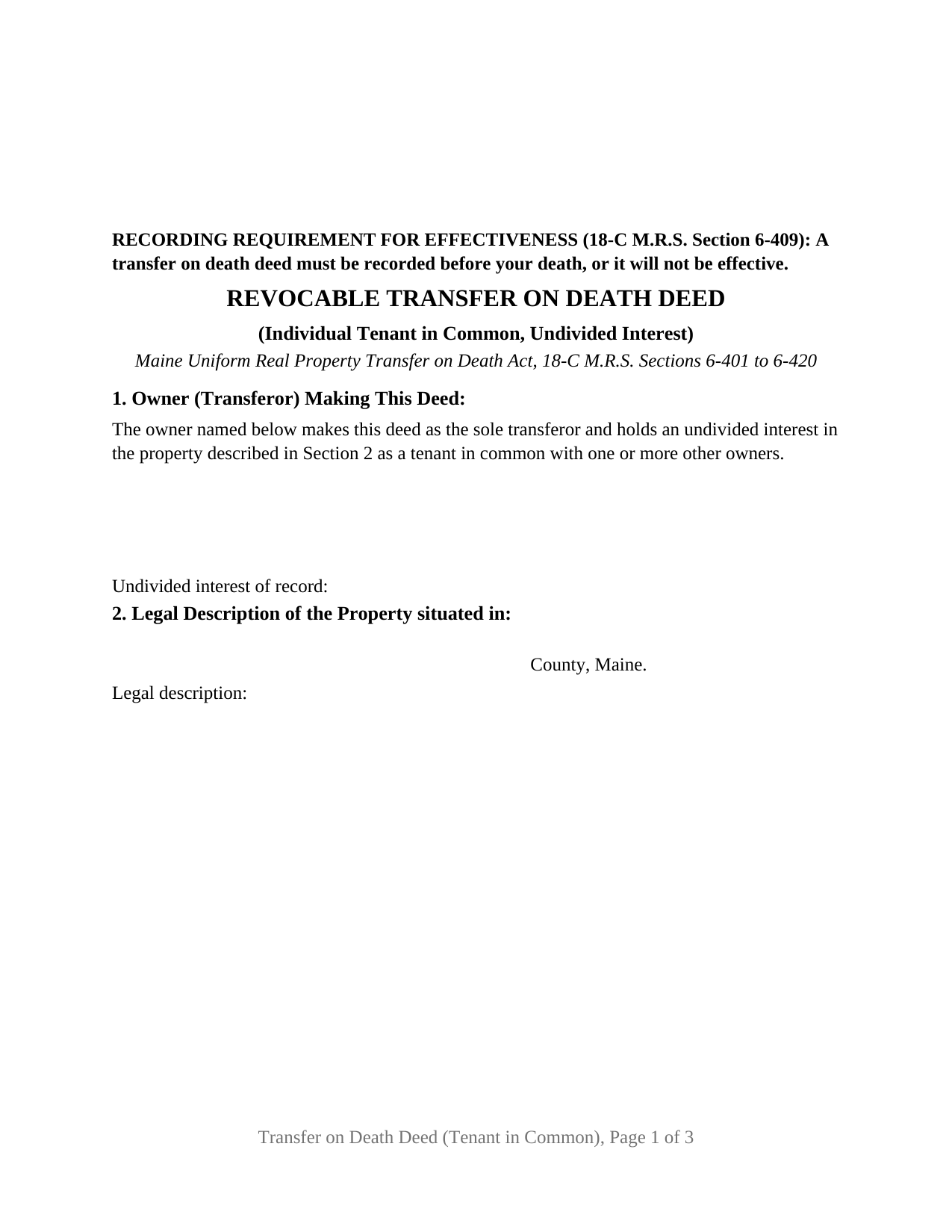
Section 1 recites, as fixed deed text, that the owner named below makes the deed as the sole transferor and holds an undivided interest in the described property as a tenant in common with one or more other owners; the owner's name and mailing address are the entries, and an optional line records the fractional interest as the vesting instrument states it. The operative section carries the two sentences of the statute's own Section 6-417 template word for word, followed by a scope sentence fixing the transfer to the owner's undivided interest at death and no interest of any co-owner. The form carries one signature block and one acknowledgment certificate. It is not set up as a joint tenant's deed, a deed of two owners on one instrument, a deed by a trustee, an entity, or an attorney-in-fact, or a sole owner's deed of the whole property.
The pattern appears wherever Maine's default co-ownership rule operated. Title 33, Section 159 provides that a conveyance or devise to two or more persons creates an estate in common unless the instrument expresses survivorship, so siblings who took a parent's house by a deed of distribution and co-purchasers whose deed names no survivorship hold as tenants in common. The completed example recites one of three siblings holding an undivided one-third interest in a Bangor lot.
Beneficiaries of a fractional share
The primary and alternate beneficiary blocks are open space for one or more beneficiaries, each named with a mailing address, which Title 33, Section 456 contemplates for a grantee in every Maine deed. Where two or more beneficiaries share the owner's interest, Section 6-413 supplies the defaults unless the deed provides otherwise: each takes only on surviving the owner, concurrent beneficiaries take equal and undivided shares with no right of survivorship among them, and a lapsed share passes to the others in proportion. The beneficiary takes subject to every mortgage and lien affecting the property at the owner's death, and without covenant or warranty of title.
Recorded in the owner's lifetime
Under Section 6-409 the deed has effect only if it reaches the record, in the registry of deeds of the county where the land lies, while the owner is still living; the form prints that condition at the top of its first page in the template's own words. Once recorded, the deed is revoked only by a later acknowledged and recorded instrument under Section 6-411, not by a will. The owner signs before a notary public or a Maine attorney under Title 33, Section 203, and the certificate is the Revised Uniform Law on Notarial Acts short form with a title-of-office line. A transfer by transfer on death deed is exempt from the Maine real estate transfer tax and the declaration of value under Title 36, so the deed goes to the registry alone with the flat recording fee.
Three items make up the package: the fillable transfer on death deed, a completed example prepared on a Penobscot County fact pattern, and a guide that walks through each numbered section, signing, and recording. The description above and the guide explain the form and the Maine statutes behind it in general terms; neither is legal advice.
Important: County-Specific Forms
Our transfer on death deed (individual tenant in common, undivided interest) forms are specifically formatted for each of the 16 counties in Maine.
After selecting your county, you'll receive forms that meet all local recording requirements, ensuring your documents will be accepted without delays or rejection fees.