Maine Transfer on Death Deed
County Specific Legal Forms Validated as recently as October 26, 2026 by our Forms Development Team
About the Maine Transfer on Death Deed
How to Use This Form
- Select your county from the list
- Download the county-specific form
- Fill in the required information
- Have the document notarized if required
- Record with your county recorder's office
What Others Like You Are Saying
"The form I needed were easy to find. And very affordable. Great service."
"It was a breeze to utilize."
"Excellent service bc you create your own account and have immediate access to documents!"
"The forms are just what I needed! Easy to navigate."
"Gave me exactly what i needed"
4.8/5 from 4,836 reviews. Read all
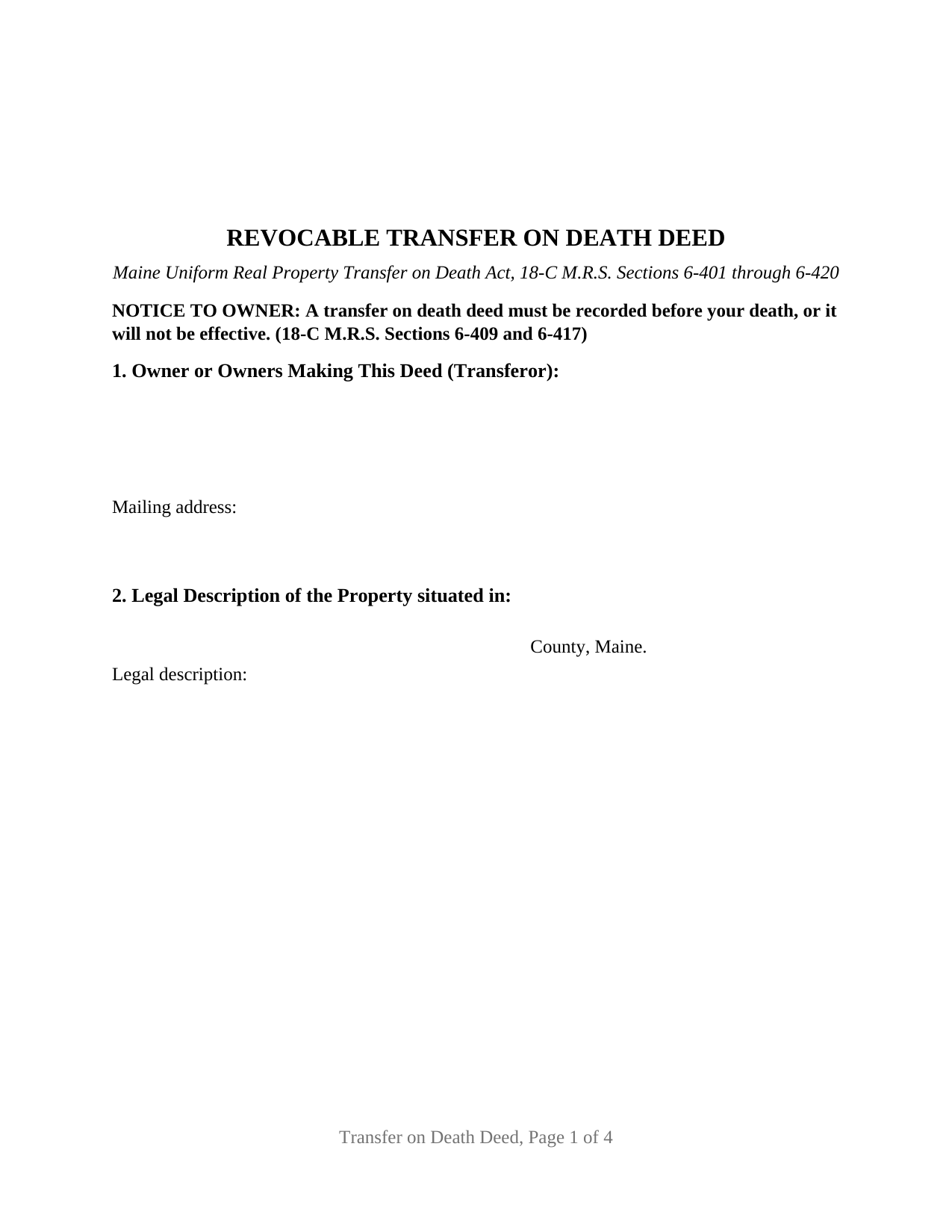
A Maine transfer on death deed lets the owner of Maine real estate name who receives the property at death, outside probate, while keeping every right of ownership during life. This form prepares that deed under the Maine Uniform Real Property Transfer on Death Act, Title 18-C, Article 6, Part 4 of the Maine Revised Statutes, for one or two owners signing in their own right. The same instrument is also called a Maine TOD deed or beneficiary deed.
A deed that waits
Section 6-412 states what the deed does during the owner's life, and the answer is nothing. The owner keeps the right to sell, mortgage, or lease, the beneficiary receives no interest, and creditors of either are unaffected. Section 6-406 makes it revocable, and Section 6-410 makes it effective without notice to the beneficiary or consideration. The deed operates once, at the owner's death, when Section 6-413 transfers the owner's interest to the named beneficiaries, subject to every mortgage and lien then of record and without covenant or warranty of title.
Recorded before death, or not at all
Recording is what separates a Maine transfer on death deed from a will. Section 6-409 requires the deed to be recorded before the transferor's death in the registry of deeds for the county where the property is located; a deed unrecorded at the death transfers nothing. Once recorded, it cannot be undone by tearing it up; Section 6-411 permits revocation only by a later acknowledged and recorded instrument, and a will does not revoke it. The form prints the recording notice from the statute's own Section 6-417 template at the top of the first page.
One or two owners, in their own words
This is the General configuration of the Maine transfer on death deed. The owner block is open space for one or two natural persons, with no preprinted marital status, vesting, or capacity language; the owners enter their names and whatever status recital they choose, as the completed example shows for a married couple holding as joint tenants. The form carries two signature blocks and two acknowledgment certificates, one for each signer, so a sole owner leaves the second block blank and two owners may acknowledge on different dates or before different notarial officers. Where two owners hold with a right of survivorship, Section 6-413 supplies the timing without extra words on the deed: the property belongs to the surviving owner at the first death, and the deed takes effect at the death of the last surviving owner, and a deed of joint owners is revoked only by all living joint owners. Tenants in common each transfer their own share at their own death. Trustees, entities, attorneys-in-fact, and three or more owners are configurations this form does not recite.
Beneficiaries under the Maine statute
Section 6-402 lets the beneficiary be an individual, a trust named through its trustee, or an entity, and the primary and alternate beneficiary blocks are multi-line so that more than one may be named. Where two or more are named, Section 6-413 supplies the defaults except as the deed provides otherwise: each interest is contingent on surviving the owner, concurrent beneficiaries take in equal and undivided shares with no right of survivorship, and a lapsed share passes to the other concurrent beneficiaries in proportion to their interests. The guide covers each rule and the naming convention for each class of beneficiary.
Maine recording details that matter here
A transfer on death deed is exempt from the Maine real estate transfer tax under Title 36, Section 4641-C, and from the declaration of value under Section 4641-D, so no transfer tax declaration accompanies it. Registries charge a flat $40 recording fee for a nongovernment deed under Title 33, Sections 751 and 752. The form is laid out within the Maine Registers of Deeds Association all-county format standard, with 12 point body type and a non-recorded instructions cover page that is removed before signing. After the death, a beneficiary may record a notice of death affidavit under Section 6-414 to confirm title; that affidavit is prepared separately after the death and is not part of this package.
The package includes the fillable transfer on death deed, a completed example filled in for a realistic Cumberland County fact pattern, and a guide to every numbered section, signing, and recording. This description and the guide describe the form and the governing Maine statutes in general terms; they are not legal advice.
Important: County-Specific Forms
Our transfer on death deed forms are specifically formatted for each of the 16 counties in Maine.
After selecting your county, you'll receive forms that meet all local recording requirements, ensuring your documents will be accepted without delays or rejection fees.