Maine Transfer on Death Deed (Two Unmarried Owners, Joint Tenants with Right of Survivorship)
County Specific Legal Forms Validated as recently as October 27, 2026 by our Forms Development Team
About the Maine Transfer on Death Deed (Two Unmarried Owners, Joint Tenants with Right of Survivorship)
How to Use This Form
- Select your county from the list
- Download the county-specific form
- Fill in the required information
- Have the document notarized if required
- Record with your county recorder's office
What Others Like You Are Saying
"Excellent experience. Quickly responded and was able to get us exactly what we needed!"
"I was very pleased with the entire package we received. It will certainly make my job easier."
"It was fast and easy to find."
"Easy to use website and reasonably priced forms. I recommend it."
"Was very helpful!"
4.8/5 from 4,836 reviews. Read all
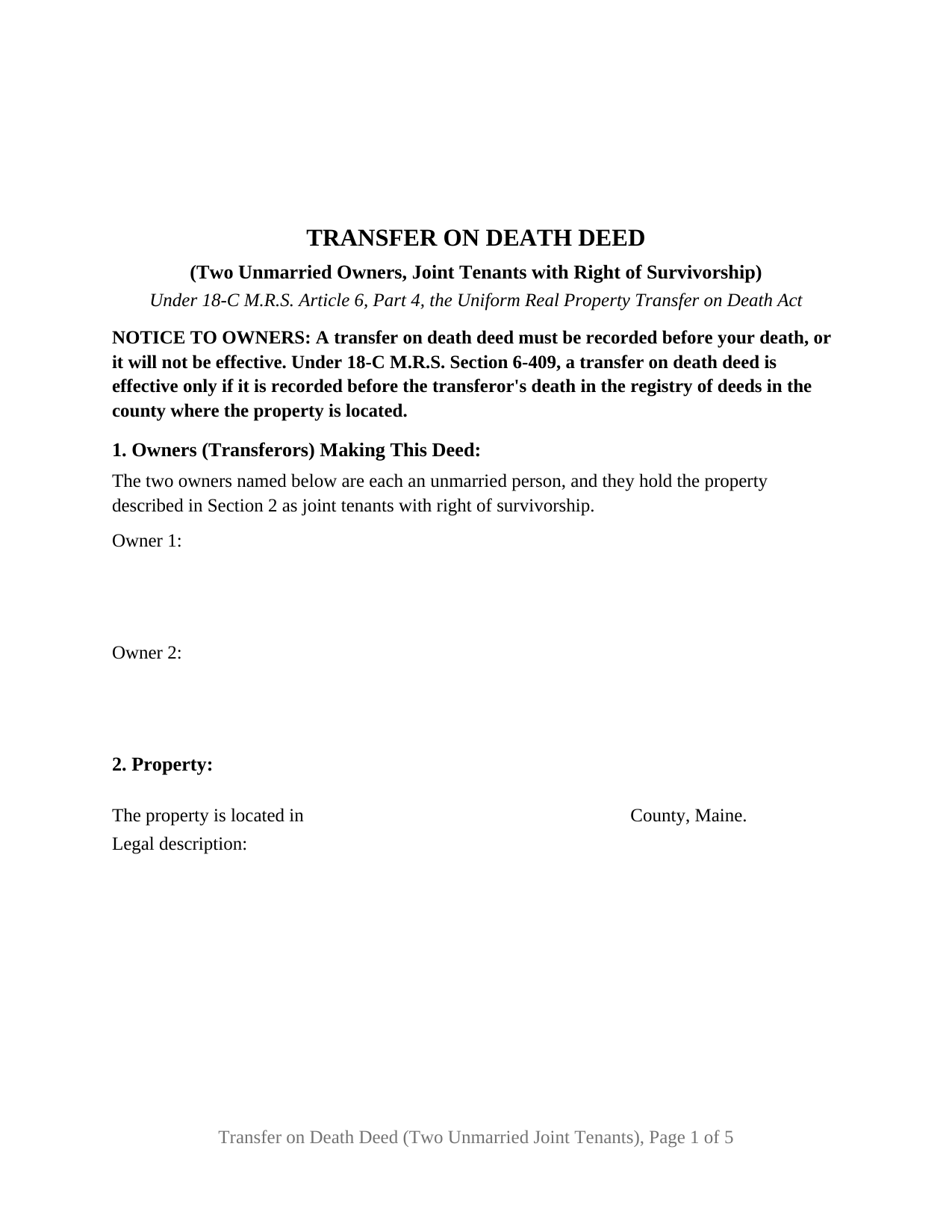
Two unmarried co-owners of Maine real estate who hold title as joint tenants with right of survivorship can name, in one recorded deed, who receives the property after both of them have died. This form prepares that transfer on death deed under 18-C M.R.S. Article 6, Part 4, the Uniform Real Property Transfer on Death Act, for exactly two owners, each an unmarried person. Maine practice also calls the instrument a TOD deed or a beneficiary deed.
Survivorship first, then the deed
Between joint tenants, the first death is settled by the title itself: the survivor takes the whole. Section 6-413 writes that sequence into the statute. When a transferor who is a joint owner is survived by another joint owner, the property belongs to the surviving joint owner with right of survivorship, and the transfer on death deed is effective when the transferor is the last surviving joint owner. The deed sleeps through the first death and operates at the second, when the named beneficiaries receive whatever interest the last surviving owner then holds, outside probate, subject to the mortgages and liens of record at that death, and without covenant or warranty of title.
Two owners, one instrument, the second death
The form recites exactly two record owners, each an unmarried person, holding the described property as joint tenants with right of survivorship, as fixed deed text above the two owner blanks. Section 8 of the deed carries the operative sentence in the same terms: at the death of the last surviving owner, the owners transfer their interest to the primary beneficiaries who survive that owner, and otherwise to the alternates. Siblings who inherited a family home together, a parent and an adult child on one deed, and unmarried partners who bought with survivorship wording present the pattern this deed recites. A sole owner, a married couple, tenants in common, trustees, entities, attorneys-in-fact, and three or more owners are configurations the form is not set up as.
Maine joint tenancy is a matter of the vesting deed's words. Under 33 M.R.S. Section 159, a deed to two or more grantees as joint tenants, with rights of survivorship, or in similar language creates a joint tenancy with its common law incidents, and no marriage is required.
Both sign, and neither revokes alone
Both owners sign as transferors, and the form carries a separate acknowledgment certificate for each, so the two may appear before different notarial officers on different dates, in Maine or elsewhere, with the certificate sentence drawn from the Maine short form in 4 M.R.S. Section 1917. Revocation follows the joint owner rule of Section 6-411: a transfer on death deed of joint owners is revoked only if all of the living joint owners revoke it, by a later acknowledged and recorded instrument, and a will does not revoke it. Once one owner has died, the survivor is the only living joint owner.
Survival measured from the last death
A beneficiary's interest is contingent on surviving the transferor under Section 6-413, and on this form that transferor is the last surviving owner. Under 18-C M.R.S. Section 2-702, an individual not shown by clear and convincing evidence to have survived an event by 120 hours is deemed to have predeceased it. Two or more primary beneficiaries take in equal and undivided shares with no survivorship among them, a lapsed share passes to the others in proportion to their interests, and the optional alternate block takes over if no primary beneficiary survives.
Recording in a Maine registry
Recording is an effectiveness condition under Section 6-409, and the deed prints the recording sentence of the statute's own Section 6-417 template on its first page. The instrument is recorded in the registry of deeds for the county where the land lies, for a flat $40 fee under 33 M.R.S. Sections 751 and 752, with no transfer tax and no declaration of value, because 36 M.R.S. Sections 4641-C and 4641-D exempt a transfer on death deed from both. The layout follows the Maine Registers of Deeds Association all-county standard, with a 2 inch recording reserve on the first page and a clear 1 1/2 inch bottom margin on the last.
The package includes the fillable transfer on death deed, a completed example filled in for a York County fact pattern, and a guide covering each section of the form, execution, and recording. This description and the guide describe the form and the Maine statutes behind it in general terms and are not legal advice.
Important: County-Specific Forms
Our transfer on death deed (two unmarried owners, joint tenants with right of survivorship) forms are specifically formatted for each of the 16 counties in Maine.
After selecting your county, you'll receive forms that meet all local recording requirements, ensuring your documents will be accepted without delays or rejection fees.