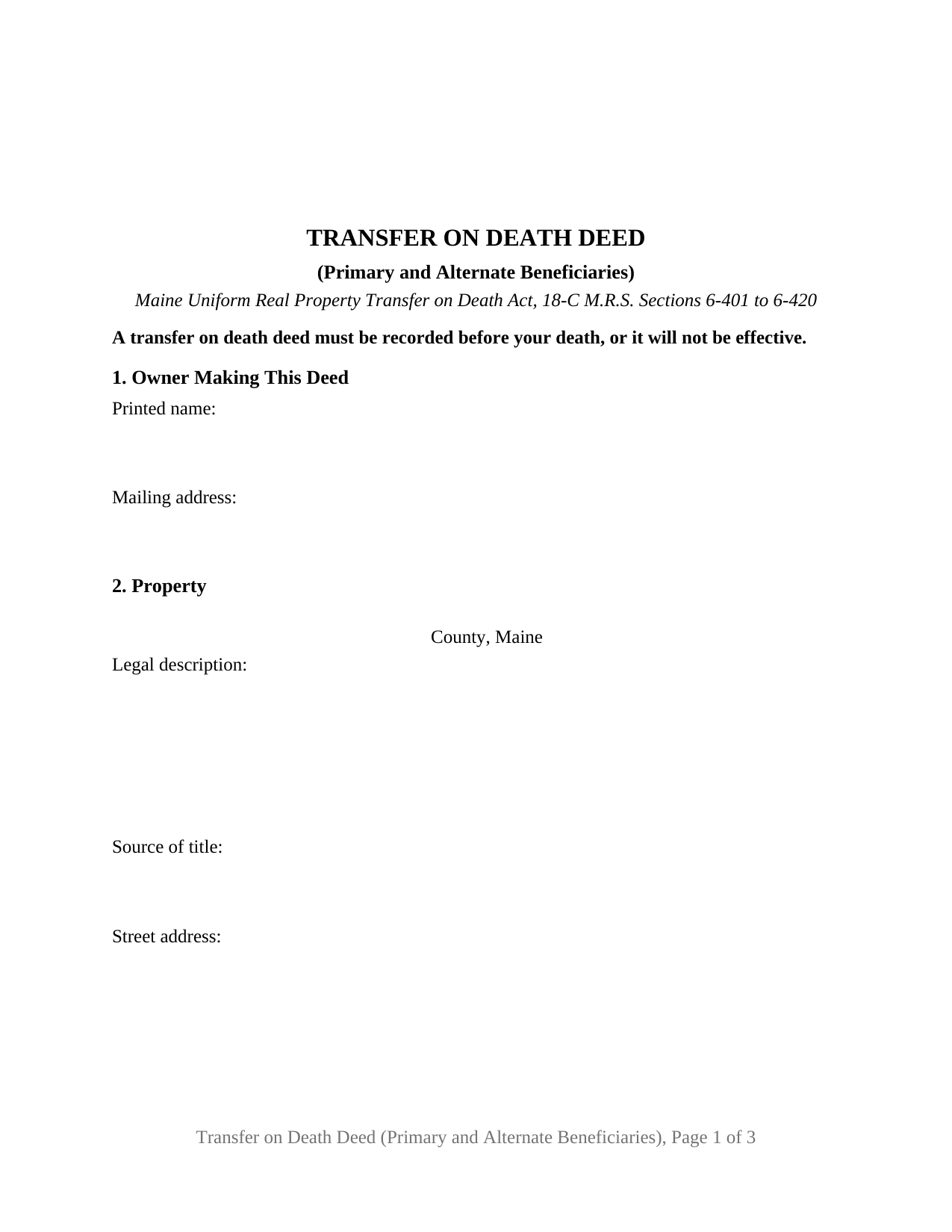
Maine Transfer on Death Deed (Primary and Alternate Beneficiaries)
County Specific Legal Forms Validated as recently as October 27, 2026 by our Forms Development Team
About the Maine Transfer on Death Deed (Primary and Alternate Beneficiaries)
How to Use This Form
- Select your county from the list
- Download the county-specific form
- Fill in the required information
- Have the document notarized if required
- Record with your county recorder's office
What Others Like You Are Saying
"I just purchased the documents. I appreciate that they are accurate to the county and state I live i…"
"quick and easy, thankyou"
"I was happy with my purchase. I honestly received more than I expected . I recommend you expand to o…"
"I received every form I requested, immediately upon payment. All forms were up to date and easy to e…"
"The beneficiary deed was acceptable to the county clerk and my notarized official deed was mailed to…"
4.8/5 from 4,836 reviews. Read all
This Maine transfer on death deed names two people in a fixed order: a primary beneficiary who takes the property at the owner's death if that beneficiary survives, and an alternate beneficiary who takes only if the primary does not. One owner signs it. The governing statute is Part 4 of Article 6 of the Maine Probate Code, 18-C M.R.S. Sections 6-401 to 6-420, Maine's enactment of the Uniform Real Property Transfer on Death Act; the instrument is also searched as a Maine TOD deed or beneficiary deed.
First the primary, then the alternate
The designation sections of this deed are the sentences of the statutory template in Section 6-417, printed as fixed deed text rather than left to a blank. Section 3 reads, I designate the following beneficiary if the beneficiary survives me, and names one person. Section 4 reads, If my primary beneficiary does not survive me, I designate the following alternate beneficiary if that beneficiary survives me, and names one more. The deed itself states the order between the two names, and the template's transfer sentence in Section 5 is the statement of transfer at death that Section 6-409 requires.
What survival means here
Under Section 6-413, a designated beneficiary's interest is contingent on surviving the owner, and an interest that fails to survive lapses. On this deed the alternate designation is what catches that lapse: where the primary beneficiary has died first, the alternate takes the owner's interest, and where the primary survives, the alternate takes nothing. Section 6-413 opens those rules with a cross-reference to Section 2-603, the antilapse section of the Maine Probate Code, which treats words of survivorship such as if he survives me as an indication against substituting a deceased beneficiary's descendants and lets an express alternative designation supersede a substitute gift. This deed prints those survivorship words, and the guide describes the cross-reference without resolving how a will-construction rule operates on a deed.
One owner, one signature
This is the primary and alternate beneficiary configuration of the Maine transfer on death deed. The form identifies exactly one owner by printed name and mailing address, with no marital status, vesting, or capacity recital preprinted, and carries one signature block and one acknowledgment certificate in the Revised Uniform Law on Notarial Acts short form of Title 4, Section 1917. Each beneficiary tier holds a single name, an individual, a trustee named for a trust, or an entity, with a mailing address. A sole owner of a house lot, a tenant in common passing an undivided share, and a joint tenant whose deed waits for the last surviving joint owner under Section 6-413(3) present the one-owner pattern this deed recites. Two or more concurrent beneficiaries sharing the property, two owners on one instrument, a trustee owner, and an owner signing through an attorney-in-fact follow different patterns that this form is not set up as.
Revocable until recorded, then revocable only on the record
Section 6-406 makes the deed revocable whatever it says. Once recorded, Section 6-411 permits revocation only by a later acknowledged and recorded instrument, a new transfer on death deed, an instrument of revocation, or a lifetime deed that expressly revokes it, and never by a will. The capacity to make or revoke the deed is the capacity to make a will under Section 6-408, and the deed is effective without notice to or acceptance by either beneficiary under Section 6-410.
Recording in the Maine registry
Recording before death in the registry of deeds for the county where the property lies is a condition of effectiveness under Section 6-409(3), and the deed prints the template's own notice to that effect at its head. The recording fee is a flat $40 per instrument for a nongovernment submitter under Title 33, Sections 751 and 752, and a transfer on death deed carries no transfer tax and no declaration of value under Title 36, Sections 4641-C(21) and 4641-D(7). A notice of death affidavit under Section 6-414, which a beneficiary may record after the death to confirm title, is prepared separately and is not included in this package.
The package contains the fillable transfer on death deed, a completed example filled in for a York County owner naming her son as primary and her granddaughter as alternate, and a guide covering each section, execution, and recording. The description on this page and the guide explain the form and the Maine statutes behind it in general terms and are not legal advice.
Important: County-Specific Forms
Our transfer on death deed (primary and alternate beneficiaries) forms are specifically formatted for each of the 16 counties in Maine.
After selecting your county, you'll receive forms that meet all local recording requirements, ensuring your documents will be accepted without delays or rejection fees.