Maine Transfer on Death Deed (Trust Beneficiary)
County Specific Legal Forms Validated as recently as October 27, 2026 by our Forms Development Team
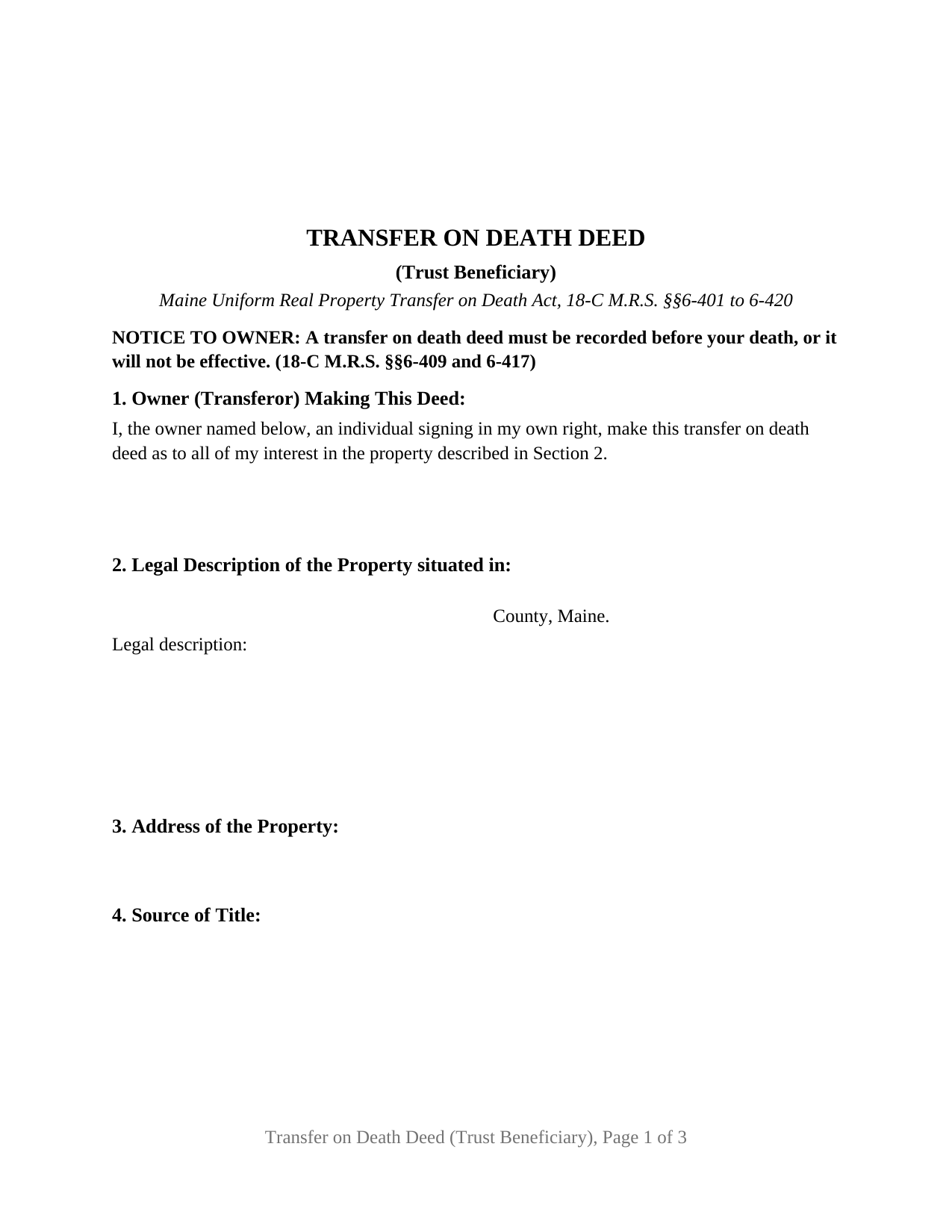
About the Maine Transfer on Death Deed (Trust Beneficiary)
How to Use This Form
- Select your county from the list
- Download the county-specific form
- Fill in the required information
- Have the document notarized if required
- Record with your county recorder's office
What Others Like You Are Saying
"Was very helpful it helped me find out everything I needed for the deed."
"This was a good experience. I easily found the document I needed and easily downloaded it and its co…"
"Total package. Very prompt with complete instructions & example to complete forms. If you don't …"
"Excellent! Follow the prompts for easy access. Forms readily available. Thanks!"
"Super easy and quick. Love the service-"
4.8/5 from 4,836 reviews. Read all
A Maine transfer on death deed can name a trust, through its trustee, as the person who takes the property when the owner dies, so a revocable living trust can stay at the center of an estate plan without retitling the home during life. This form prepares that deed under 18-C M.R.S. Part 4, the Maine Uniform Real Property Transfer on Death Act, for one owner designating the trustee of a named trust as the sole beneficiary; the same instrument is searched as a Maine TOD deed or beneficiary deed to a trust.
Why the trustee, not the trust, is the beneficiary
Maine does not treat a trust as an entity that holds title in its own name; Title 33, Section 851-A says so and deems a conveyance naming a trust to run to its trustees as trustees. Section 6-402 of Title 18-C fits the transfer on death chapter to that rule by defining a designated beneficiary as a person and person to include a trustee. Section 5 of the form is written around those two sections: its fixed sentence designates the trustee of the identified trust, as trustee, and reaches any successor trustee serving at the owner's death, the reading Title 18-B, Section 103(19) gives the word trustee. Three entries identify the trust by name, by the date of its trust instrument, and by the trustee now serving, so the trust capacity appears on the face of the deed as the Maine Title Standards describe.
Nothing moves until the death
The deed is not a deed into the trust. During the owner's life the property stays in the owner's name, Section 6-412 leaves creditors and the beneficiary where they were, and the deed stays revocable. At the death, Section 6-413 carries whatever interest the owner then holds to the trustee, subject to the mortgages, liens, and other interests then affecting it and without covenant or warranty of title; from that moment the trust instrument says who the property is for. Section 6-409 makes recording before the death an effectiveness condition, which the form states under its title in the statute's own template words, and Section 6-411 permits revocation only by a later acknowledged and recorded instrument, never by will.
One owner, one trust, one certificate
In this Trust Beneficiary configuration of the Maine transfer on death deed, the deed recites exactly one owner, an individual signing in the owner's own right, making the deed as to all of the owner's interest. The owner block carries no marital status and no vesting words; Title 33, Section 480 lets an owner convey without a nonowner spouse's signature, and a surviving spouse's rights run through the probate code rather than the deed. The designation is fixed to the trustee of one trust, with no alternate beneficiary line and no second beneficiary, and the operative sentence is the Section 6-417 template's own. One signature block and one acknowledgment certificate in the Title 4, Section 1917 short form complete the instrument. An owner who holds the parcel alone, a tenant in common making a deed of that owner's own share, and a surviving joint tenant present the pattern the deed recites; two owners on one deed, an individual or entity beneficiary, and an owner already holding title as trustee follow patterns this form is not set up as.
Recording a Maine deed to a trustee
The deed records in the registry of deeds for the county where the land lies, at the flat 40 dollar fee Title 33, Sections 751 and 752 fix for a nongovernment submitter, and it carries no transfer tax declaration because Title 36, Sections 4641-C and 4641-D exempt a transfer on death deed from both the tax and the declaration. The trustee's mailing address answers Title 33, Section 456, the grantee address rule for a Maine deed. The layout sits inside the Maine Registers of Deeds Association all-county standard, with a two inch first-page recording reserve and 12 point type. After the death the trustee may record the Section 6-414 notice of death affidavit, an instrument prepared separately after the death and not included in this package.
The package contains the fillable transfer on death deed, a completed example filled in for a York County owner naming the trustee of her revocable trust, and a guide to each numbered section, the signing, and the recording. This description and the guide explain the form and the Maine statutes behind it in general terms and are not legal advice.
Important: County-Specific Forms
Our transfer on death deed (trust beneficiary) forms are specifically formatted for each of the 16 counties in Maine.
After selecting your county, you'll receive forms that meet all local recording requirements, ensuring your documents will be accepted without delays or rejection fees.