Maine Transfer on Death Deed (Unmarried Sole Owner)
County Specific Legal Forms Validated as recently as October 27, 2026 by our Forms Development Team
About the Maine Transfer on Death Deed (Unmarried Sole Owner)
How to Use This Form
- Select your county from the list
- Download the county-specific form
- Fill in the required information
- Have the document notarized if required
- Record with your county recorder's office
What Others Like You Are Saying
"So far the web site and the tools are a pleasure to use. The price is reasonable. If only getting ri…"
"Wonderful experience. Was preapred to wait days, recording was finished in less than an hour."
"Site was easy to navigate. I found the lien discharge form I was looking for immediately and the dow…"
"Thank you for combining all necessary documents in one simple location."
"My 1st trip to your site. I give it a full 5-star rating! Thank you. I'll be back."
4.8/5 from 4,836 reviews. Read all
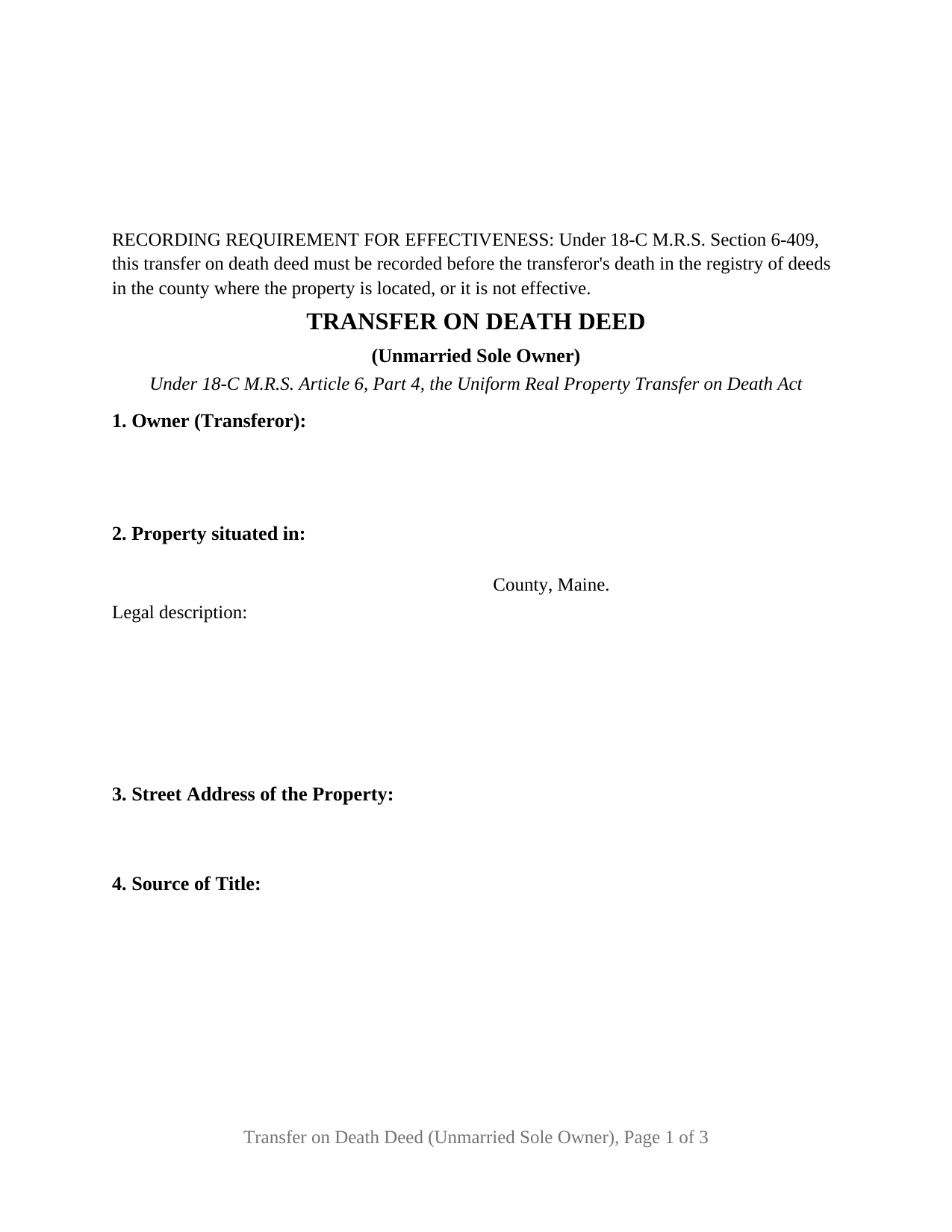
One owner, one signature line, one acknowledgment certificate. This Maine transfer on death deed is built for a single person who holds Maine real estate alone and is not married, and it says so in the deed itself: a fixed recital in the transfer section identifies the signer as an unmarried person and the sole owner of the described property. The owner names who takes the property at death and records the deed under Title 18-C, Article 6, Part 4 of the Maine Revised Statutes; the same instrument is searched as a Maine TOD deed or beneficiary deed.
The recital the deed prints for a sole owner
Section 7 of the deed opens with fixed text: the owner named in Section 1 is an unmarried person and the sole owner of the property described in Section 2. Nothing about marital status or co-ownership is left to a blank or a checkbox; the owner's name and address, the property, and the beneficiaries are the only entries. The recital states the status the signer asserts and is not a title search; the vesting deed cited in Section 4 remains the record of title. Because the recital fixes a single unmarried owner, the deed carries no joinder line and no second signature block: 33 M.R.S. Section 480 lets an owner convey without a nonowner spouse's signature outside the situations it lists, dower and curtesy are abolished by 18-C M.R.S. Section 2-111, and a transfer on death deed moves nothing during life in any event.
What the transfer sentence does, and when
The same section states that at the death of the owner, the owner transfers the owner's interest in the property to the beneficiaries designated in the deed, which is the statement Section 6-409 requires, and reserves the right to revoke under Section 6-411. The deed then states what Section 6-413 provides at death: the beneficiary takes subject to every mortgage, lien, and other interest affecting the property at that moment, and the deed transfers without covenant or warranty of title. During the owner's life, Section 6-412 keeps the deed inert: the owner may still sell, mortgage, or lease, and a beneficiary acquires no interest. A lifetime conveyance of the property leaves nothing for this deed to carry.
Beneficiaries named by a sole owner
Section 5 names one or more primary beneficiaries by full name and mailing address, and Section 6 names optional alternates who take only if no primary beneficiary survives the owner. Section 6-402 defines a beneficiary as a person and defines person broadly, so a trust is named through its trustee and an entity by its legal name. Where two or more primary beneficiaries are named, Section 6-413 supplies the shares: equal and undivided, no right of survivorship, a lapsed share passing to the others in proportion to their interests. The form prints no share menu and no drafting box; the statute supplies those results.
Signing before a notary or a Maine attorney
Maine's acknowledgment statute, 33 M.R.S. Section 203, admits an acknowledgment before a notary public or before an attorney at law eligible to practice in Maine, so the certificate names both and provides a title of office line for the office actually held. Its operative sentence is the 4 M.R.S. Section 1917 short form, and the certificate carries the jurisdiction, printed name, and commission expiration elements Section 1916 requires. The printed name beneath the owner's signature meets the 33 M.R.S. Section 651-A indexing rule.
Recording in the county registry
The deed is recorded in the registry of deeds for the county where the land lies, before the owner's death, which is the effectiveness condition printed above the title. A transfer on death deed carries no Maine transfer tax under 36 M.R.S. Section 4641-C and needs no declaration of value under Section 4641-D, so the deed is presented with the statutory $40 nongovernment recording fee and no tax form. The pages follow the Maine Registers of Deeds Association standards every county registry applies, with a two inch recording reserve on page one. After the death, a beneficiary may record the Section 6-414 notice of death affidavit, a separate instrument prepared after the death and not included here,.
The package includes the fillable transfer on death deed, a completed example filled in for a York County owner, and a guide to every numbered section, the acknowledgment, and recording. This description and the guide describe the form and the governing Maine statutes in general terms; they are not legal advice.
Important: County-Specific Forms
Our transfer on death deed (unmarried sole owner) forms are specifically formatted for each of the 16 counties in Maine.
After selecting your county, you'll receive forms that meet all local recording requirements, ensuring your documents will be accepted without delays or rejection fees.