Maine Transfer on Death Deed (Married Owners with Right of Survivorship, Primary and Alternate Beneficiaries)
County Specific Legal Forms Validated as recently as October 27, 2026 by our Forms Development Team
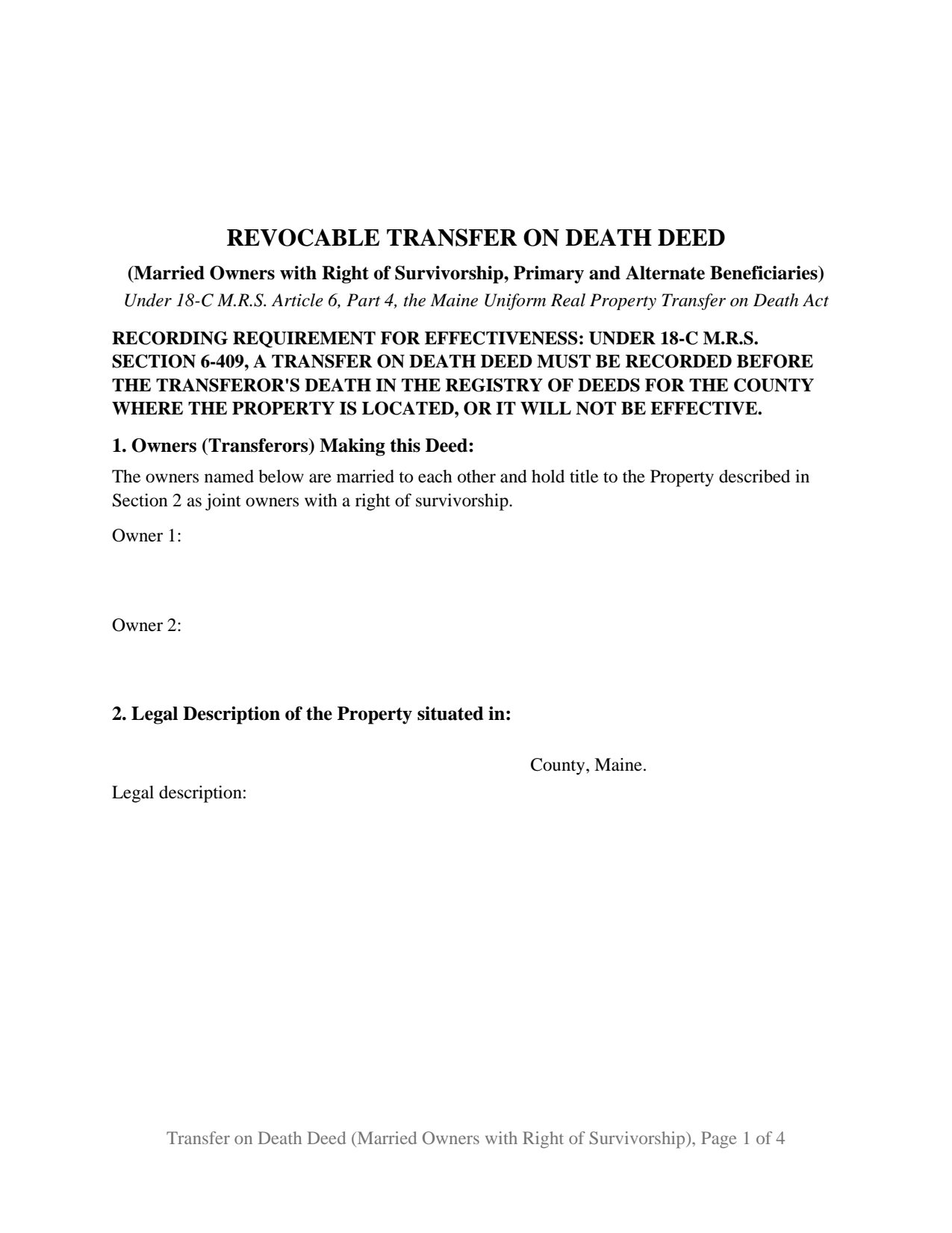
About the Maine Transfer on Death Deed (Married Owners with Right of Survivorship, Primary and Alternate Beneficiaries)
How to Use This Form
- Select your county from the list
- Download the county-specific form
- Fill in the required information
- Have the document notarized if required
- Record with your county recorder's office
What Others Like You Are Saying
"Very user friendly. I was totally amazed. Thank you so much."
"TOOK ME SEVERAL DAYS TO FIND A SITE THAT DIDNT CHARGE $100 JUST TO USE ONE FORM. THANKS"
"I received prompt attention to the package I submitted. It was submitted promptly the recorders offi…"
"Forms were perfect, recorded quickly with no issue."
"Very quick and easy!! Thanks!"
4.8/5 from 4,836 reviews. Read all
Maine spouses who own their home as joint tenants can settle, in one recorded deed, who takes the property after both have died. The form prepares a Maine transfer on death deed, authorized by 18-C M.R.S. Sections 6-401 to 6-420, for exactly two owners who are married to each other and hold title with a right of survivorship, naming a primary beneficiary and an optional alternate. Both spouses sign, and nothing changes during either spouse's life.
A deed that waits for the second death
The timing is written into the statute. Section 6-413, subsection 3, provides that when a transferor who is a joint owner dies survived by another joint owner, the property belongs to the surviving joint owner with right of survivorship, and that the transfer on death deed is effective when the transferor is the last surviving joint owner. The operative paragraph of this deed states both halves: at the first death the property belongs to the surviving spouse, and the transfer to the beneficiaries takes effect at the death of the last surviving owner. Until then, Section 6-412 keeps every right of ownership with the spouses, including the right to sell or mortgage, and gives the beneficiary no interest.
Two signatures, and two to revoke
Both owners sign the deed, and the form carries a separate acknowledgment certificate for each of them, so the spouses may acknowledge on the same afternoon before one notary or on different days before different officers, in Maine or elsewhere. Revocation follows the same two-owner logic: under Section 6-411, a transfer on death deed made by joint owners is revoked only by all of the living joint owners, so while both spouses live, both join in any recorded revocation instrument or replacement deed, each prepared separately and not included in this package, and after the first death the survivor may revoke alone. A will revokes nothing.
Primary first, alternate only if no primary survives
The beneficiary structure follows the optional template in Section 6-417. The primary beneficiary block designates one or more persons who take if they survive the last surviving owner. The alternate beneficiary block, which is optional, designates who takes if no primary beneficiary survives, provided the alternate survives. Where two or more primary beneficiaries are named, the deed adopts the Section 6-413 defaults in its own text: equal and undivided shares with no survivorship among them, and a lapsed share passing to the remaining primary beneficiaries in proportion to their interests, so the alternate is reached only when the primary designation fails entirely.
Joint tenants or tenants by the entirety, the same estate in Maine
This configuration recites that the two owners are married to each other and hold title as joint owners with a right of survivorship. Maine does not maintain a separate tenancy by the entirety: Title 33, Section 159 lists as tenants by the entirety among the wordings that create a joint tenancy, alongside as joint tenants and with rights of survivorship, so a couple whose vesting deed used either phrase holds the survivorship estate that Section 6-402 calls joint ownership. A couple whose deed carries no survivorship words holds as tenants in common under Section 159, and each tenant in common transfers only that spouse's own share at that spouse's own death; that pattern, a sole owner, co-owners who are not married to each other, trustees, entities, and three or more owners are configurations this deed does not recite.
Placing it of record
Recording before death is what gives the deed effect under Section 6-409, and for a deed made by two owners, recording after the second acknowledgment, while both are living, places it of record before either death. The deed goes to the registry of deeds for the county where the land lies, and where a parcel crosses a county line, to each registry. Because a transfer on death deed is outside the Maine real estate transfer tax and the declaration of value, the deed itself recites both exemptions by subsection so the register sees the instrument's tax status on its face.
The package contains three pieces: the fillable deed, a completed example worked through for a York County couple, and a guide that walks each numbered section, the two acknowledgments, and the registry filing. Both the guide and this description explain the form and the Maine statutes behind it in general terms only and are not legal advice.
Important: County-Specific Forms
Our transfer on death deed (married owners with right of survivorship, primary and alternate beneficiaries) forms are specifically formatted for each of the 16 counties in Maine.
After selecting your county, you'll receive forms that meet all local recording requirements, ensuring your documents will be accepted without delays or rejection fees.