Maine Transfer on Death Deed (Unmarried Sole Owner, Primary and Alternate Beneficiaries)
County Specific Legal Forms Validated as recently as October 27, 2026 by our Forms Development Team
About the Maine Transfer on Death Deed (Unmarried Sole Owner, Primary and Alternate Beneficiaries)
How to Use This Form
- Select your county from the list
- Download the county-specific form
- Fill in the required information
- Have the document notarized if required
- Record with your county recorder's office
What Others Like You Are Saying
"So easy and fast. Since covid-19 is here, this option is perfect."
"So far so good!"
"5 stars"
"A great time and money saver that also has a money back guarantee. I received all the pertinent form…"
"Wow! Deeds.com provided proficient eRecording with great response time and great service... and it w…"
4.8/5 from 4,836 reviews. Read all
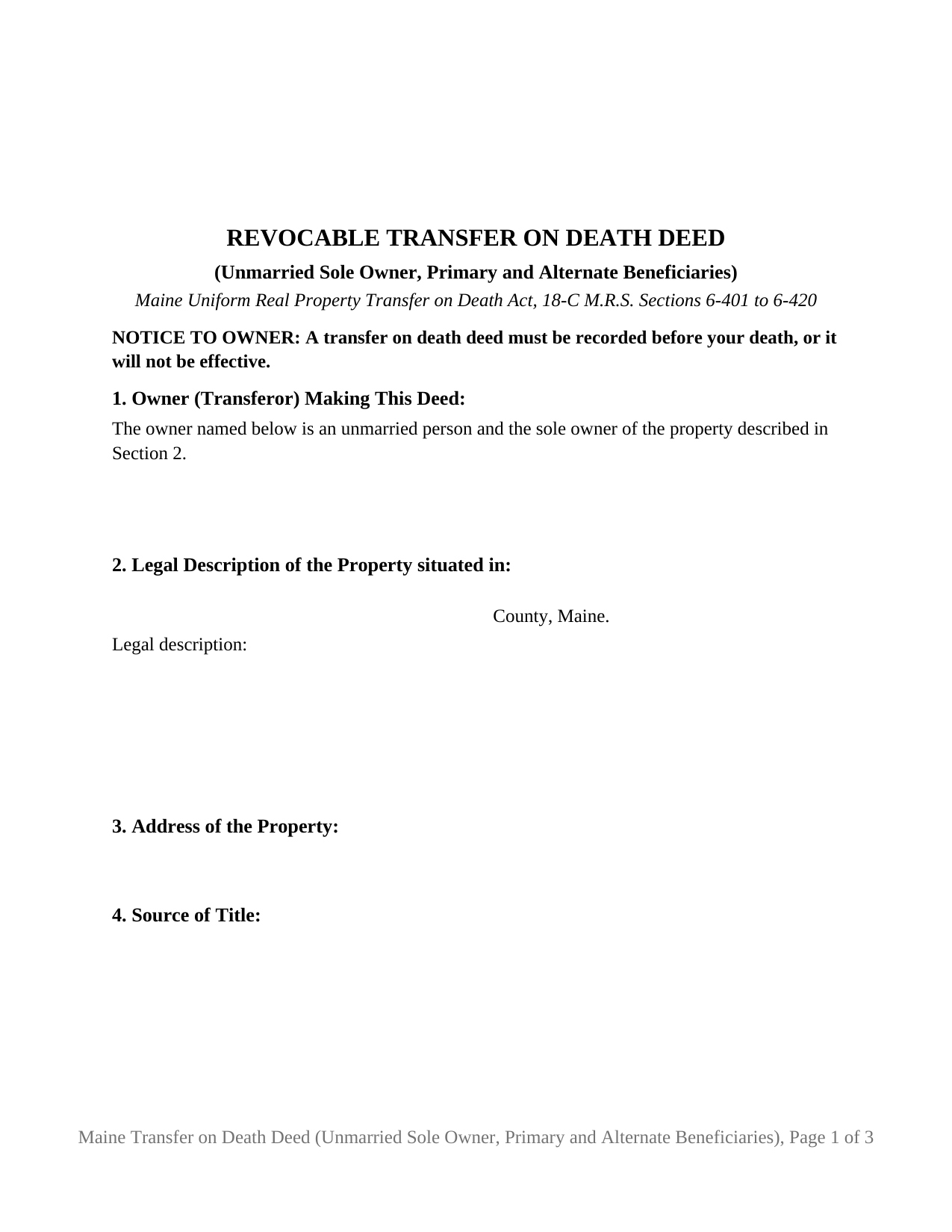
A Maine transfer on death deed signed by one unmarried owner who holds the whole title alone is the simplest shape the Maine Uniform Real Property Transfer on Death Act allows: one owner, one signature, one acknowledgment, and a named fallback in case the first choice of beneficiary does not survive. This form prepares that deed under Title 18-C, Article 6, Part 4 of the Maine Revised Statutes, with the owner's unmarried, sole-owner status printed as fixed deed text and separate sections for primary and alternate beneficiaries. The same instrument is also searched for as a Maine TOD deed or beneficiary deed.
What the sole-owner recital fixes
Section 1 of the deed states, as printed language rather than a blank or a checkbox, that the owner named below is an unmarried person and the sole owner of the property described in Section 2. The recital is the owner's own statement of status: no co-owner whose interest Section 6-413(3) would carry to a survivor first, and no spouse whose elective share under Title 18-C, Section 2-202 is measured against the owner's nonprobate transfers. Because the status is fixed, the form prints one owner block, one signature block, and one acknowledgment certificate, and nothing on the instrument asks whether a second owner or a spouse exists.
A named fallback: the alternate beneficiary
Section 6-413(1)(B) makes every designated beneficiary's interest contingent on surviving the transferor, and an interest that fails to survive lapses. The alternate beneficiary section is the deed's own answer to that lapse. The form prints the Section 6-417 template's alternate sentence word for word: if the primary beneficiary does not survive the owner, the alternate named in Section 6 takes, if that alternate survives. Where two or more primary beneficiaries are named and one dies first, Section 6-413(1)(D) passes the lapsed share to the surviving primary beneficiaries, and the alternate takes only when no primary beneficiary is left. Each box holds more than one name, and the guide walks through the survival, equal-share, and lapse defaults of Section 6-413; where no alternate is named, the entry None designated shows the section was considered.
In the legislature's own words
Maine's template in Section 6-417 is optional, and the statute says it is not intended to be printed and recorded in its current format, so no mandatory Maine form exists. This deed carries the template's operative sentences verbatim inside a numbered layout built for the county registries: the primary and alternate designating sentences, the transfer-at-death sentence, the reservation of the right to revoke, and the template's one-line recording warning in bold beneath the title. The template's common questions stay in the guide.
One signature, recorded where the land lies
The owner signs once and acknowledges once, before a Maine notary public, a Maine attorney, or an out-of-state officer whose act Title 4, Section 1911 recognizes, and the deed goes to the registry of deeds for the county where the property is located. Section 6-409 makes recording before the owner's death a condition of effectiveness, and revocation afterward takes a later acknowledged and recorded instrument under Section 6-411. The registry collects its flat fee and no transfer tax, because Title 36 exempts a transfer on death deed from both the tax and the declaration of value, and the layout follows the Maine Registers of Deeds Association all-county standard.
The configuration this deed recites
The form recites exactly one record owner who is unmarried and holds the entire interest in that owner's own name, signing personally. A widowed owner who holds the family home alone, a single owner who took title by deed in one name, and a divorced owner whose recorded decree left the property in one name present the pattern this deed recites. The form is not set up as a deed by two owners, by a married owner, by a trustee or personal representative, by an attorney-in-fact, or by an entity; each is a different configuration with different fixed text. The beneficiary side stays flexible: one or several primary beneficiaries, with or without an alternate, each named by full name and mailing address.
The package includes the fillable transfer on death deed, a completed example filled in for a realistic York County fact pattern, and a guide to every numbered section, the signing, and the recording. This description and the guide describe the form and the governing Maine statutes in general terms; they are not legal advice.
Important: County-Specific Forms
Our transfer on death deed (unmarried sole owner, primary and alternate beneficiaries) forms are specifically formatted for each of the 16 counties in Maine.
After selecting your county, you'll receive forms that meet all local recording requirements, ensuring your documents will be accepted without delays or rejection fees.